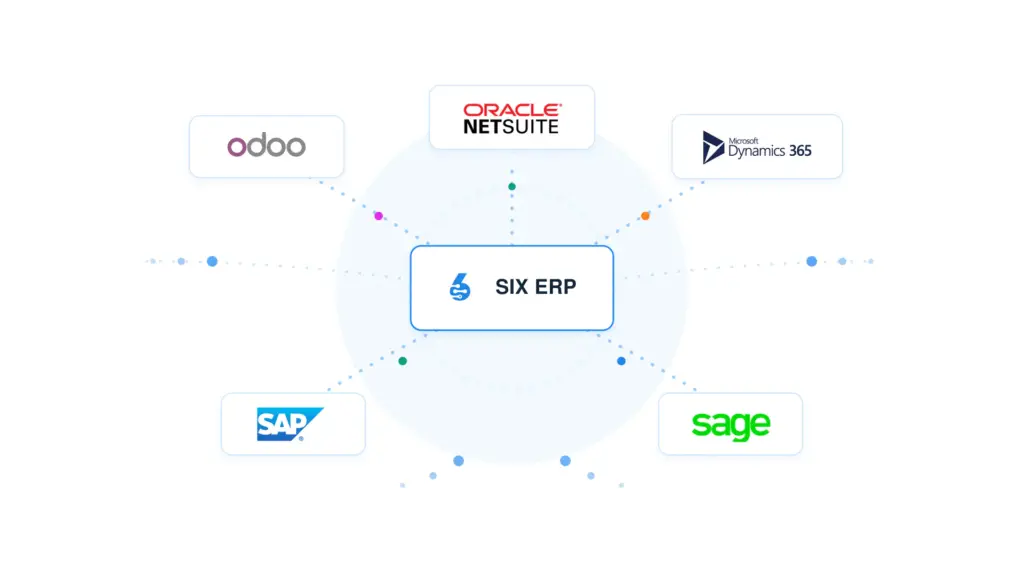


A manufacturer closes the month in four days instead of ten. A distributor sees inventory risk before a stockout becomes a customer problem. A finance team runs margin analysis without waiting for spreadsheets to be reconciled. These are the kinds of operational changes business leaders expect from a modern ERP, and they are the practical outcomes SIX ERP is designed to support.

For organizations pursuing business transformation, SIX ERP brings core management processes into a unified environment where data, automation, and intelligence work together. Instead of treating ERP as a back-office system of record, SIX ERP positions enterprise resource planning as a decision platform for the entire business.
Why Business Transformation Needs More Than Traditional ERP
Many companies still operate with disconnected tools for finance, purchasing, sales, inventory, production, and reporting. Each system may solve a local problem, but the business pays for the fragmentation through duplicate work, delayed reporting, inconsistent data, and limited visibility.
Traditional ERP projects often focused on standardization and control. Those goals still matter. But business transformation now requires more: faster decisions, predictive insight, process automation, and the ability to adapt as markets change.
SIX ERP addresses this shift by combining operational management with embedded intelligence. The objective is not simply to digitize existing workflows, but to improve how the business plans, executes, measures, and evolves.
What Makes SIX ERP Different
SIX ERP is built around the idea that enterprise software should do more than store transactions. It should help users understand what is happening, identify what requires attention, and act with confidence.
In practical terms, that means connecting business functions through a shared ERP foundation while giving teams access to timely information and guided workflows. Finance can track performance with current data. Operations can manage capacity and inventory with fewer blind spots. Sales and service teams can see customer activity in context.
This combination of integration and intelligence is what turns SIX ERP from a software implementation into a business management platform.
Core Business Areas Supported by SIX ERP
Finance and Accounting
Finance teams are often the first to feel the cost of fragmented systems. They collect data from multiple sources, validate numbers manually, and spend valuable time preparing reports instead of analyzing performance.
With SIX ERP, finance processes can be centralized across accounting, budgeting, cash flow, payables, receivables, fixed assets, and financial reporting. A unified ERP environment helps reduce reconciliation work and improves the accuracy of management information.
For example, a controller can review real-time expense trends by department, compare actuals against budget, and detect variance patterns before the monthly close is complete.
Procurement and Supplier Management

Procurement is no longer just about issuing purchase orders. It is a strategic function tied to cost control, supplier reliability, inventory performance, and operational continuity.
SIX ERP supports procurement workflows from requisition to approval, supplier selection, purchase order management, receiving, and invoice matching. By connecting procurement data with inventory, finance, and operations, the system gives teams better visibility into commitments and supply risks.
A purchasing manager, for instance, can identify delayed supplier deliveries that may affect production schedules and take corrective action before the issue escalates.
Inventory and Warehouse Operations

Inventory is one of the clearest areas where business intelligence creates measurable value. Too much inventory ties up cash. Too little inventory risks missed sales and production delays.
SIX ERP helps companies manage stock levels, locations, replenishment rules, warehouse movements, and item availability through a connected operational model. When inventory data is aligned with demand, purchasing, and sales activity, leaders can make better decisions about working capital and service levels.
Instead of discovering shortages during order fulfillment, teams can use ERP visibility to anticipate demand and adjust replenishment earlier.
Sales and Customer Management


Revenue teams need access to accurate pricing, product availability, order status, credit information, and customer history. When that information is scattered, customer experience suffers.
SIX ERP connects sales activity with inventory, finance, and fulfillment. Sales teams can quote with greater accuracy, manage customer orders more effectively, and monitor the operational impact of demand.
This is especially valuable for organizations with complex product catalogs, multiple locations, or customer-specific pricing arrangements.
Production and Operations

For manufacturers and operationally complex businesses, production planning depends on reliable data. Materials, labor, machine capacity, demand forecasts, and supplier lead times all affect performance.
SIX ERP supports planning, scheduling, materials management, work orders, and operational tracking. By integrating production data with purchasing, inventory, finance, and sales, the platform helps teams understand the full business impact of operational decisions.
A production planner can see whether material shortages, capacity constraints, or order changes will affect delivery commitments and then adjust schedules accordingly.
Intelligence Included: From Reporting to Action
Many ERP systems provide reports. SIX ERP goes further by emphasizing intelligence that supports action. The difference is important.
A static report may show that costs increased last quarter. An intelligent ERP environment helps users understand where the increase occurred, which processes were affected, whether the trend is continuing, and what action should be taken.
This matters because transformation depends on decision speed. Leaders cannot wait until the end of the month to discover issues that could have been addressed in real time.
With SIX ERP, business intelligence can be embedded into dashboards, alerts, performance indicators, and workflow triggers. Users gain access to operational and financial insights without leaving the system where work is performed.
How SIX ERP Supports Better Decision-Making
One Version of Business Data
Business transformation often fails when teams do not trust the data. Sales has one number, finance has another, and operations has a third. Meetings become debates about data quality instead of decisions.
SIX ERP helps solve this by centralizing critical business information in a shared ERP structure. When transactions, approvals, stock movements, orders, and financial postings are connected, the organization can work from a more consistent version of reality.
Real-Time Visibility
Real-time visibility enables faster correction. If sales orders are increasing but inventory is tightening, the business can respond before fulfillment performance declines. If expenses are exceeding budget, managers can investigate while there is still time to act.
SIX ERP gives decision-makers access to current business information across departments, helping reduce the lag between activity and insight.
Process Automation
Automation is a practical driver of transformation. It reduces repetitive manual work, improves consistency, and helps enforce business rules.
Within SIX ERP, automation can support approval routing, purchase order generation, invoice matching, replenishment, notifications, and reporting workflows. The result is less administrative burden and more time for higher-value work.
Business Transformation Outcomes Companies Can Target
Implementing SIX ERP can support a range of transformation goals, depending on the company’s starting point and strategic priorities.
Common targets include faster financial close, improved inventory accuracy, shorter order-to-cash cycles, better procurement control, stronger cash flow visibility, reduced manual reporting, and improved operational accountability.
For a growing company, SIX ERP may create the structure needed to scale without adding unnecessary complexity. For a mature organization, it may help modernize legacy processes and improve the quality of management decisions.
Implementation Considerations for SIX ERP
Start with Business Objectives
An ERP implementation should begin with business goals, not software features. Leaders should define the outcomes they want to improve: margin visibility, inventory turns, close cycle time, production efficiency, customer service, or compliance.
Clear objectives help determine which SIX ERP capabilities matter most and how success will be measured.
Map Processes Before Configuration
Before configuring any ERP system, companies should understand how work actually happens. That includes formal processes, manual workarounds, spreadsheet dependencies, approval bottlenecks, and data quality issues.
Mapping current processes allows the business to redesign workflows rather than simply transfer inefficiencies into a new system.
Prioritize Data Quality
ERP performance depends on data quality. Customer records, supplier data, item masters, chart of accounts, bills of materials, inventory balances, and pricing rules must be accurate and well governed.
A SIX ERP project should include data cleansing, ownership rules, migration planning, and validation procedures.
Invest in Change Management
Business transformation changes how people work. Even a strong ERP platform will underperform if users do not understand the new processes or trust the system.
Training, communication, executive sponsorship, and role-based adoption plans are essential. Teams should know not only which buttons to click, but why the new way of working matters.
Internal Links for Further Reading
To explore related transformation topics, see our guide to ERP implementation strategy, our overview of process automation in business transformation, and our article on real-time reporting for better decision-making.
Source References
Gartner, “Market Guide for Cloud ERP for Product-Centric Enterprises,” Gartner Research, available at https://www.gartner.com/en/information-technology.
McKinsey & Company, “The case for digital reinvention,” McKinsey Digital, available at https://www.mckinsey.com/capabilities/mckinsey-digital.
Deloitte, “ERP modernization and digital transformation insights,” Deloitte Insights, available at https://www2.deloitte.com/us/en/insights.html.
Oracle NetSuite, “What Is ERP?” available at https://www.netsuite.com/portal/resource/articles/erp/what-is-erp.shtml.
The Bottom Line
SIX ERP gives organizations a practical path to business management with intelligence included. By connecting finance, operations, procurement, sales, inventory, and reporting in one ERP environment, it helps companies move from fragmented activity to coordinated decision-making.
For leaders focused on business transformation, the value is clear: better data, faster insight, stronger processes, and a more adaptable organization. SIX ERP is not just about managing today’s transactions. It is about building the intelligence needed to compete tomorrow.