
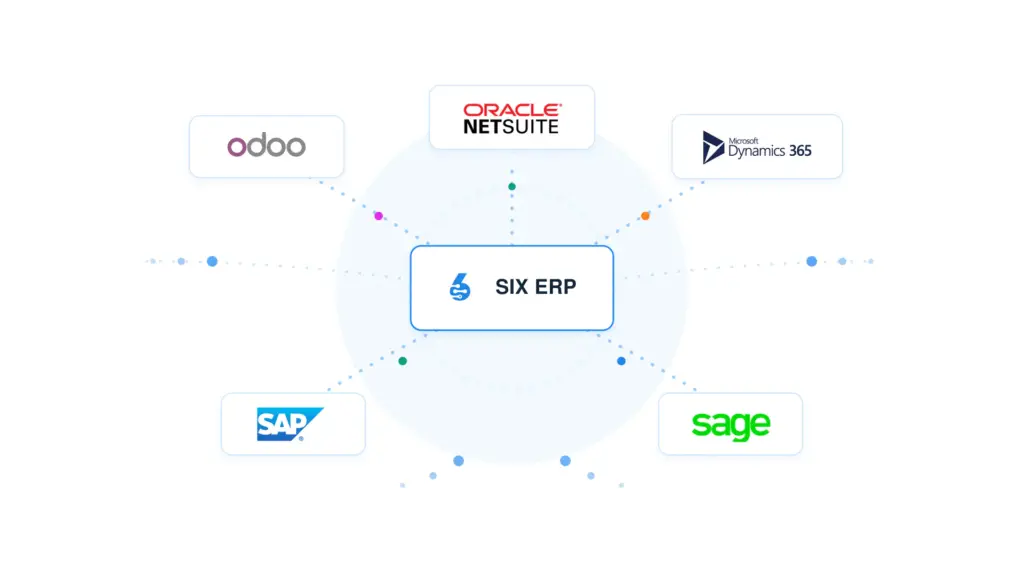
A detailed comparison
How to compare ERP systems fairly
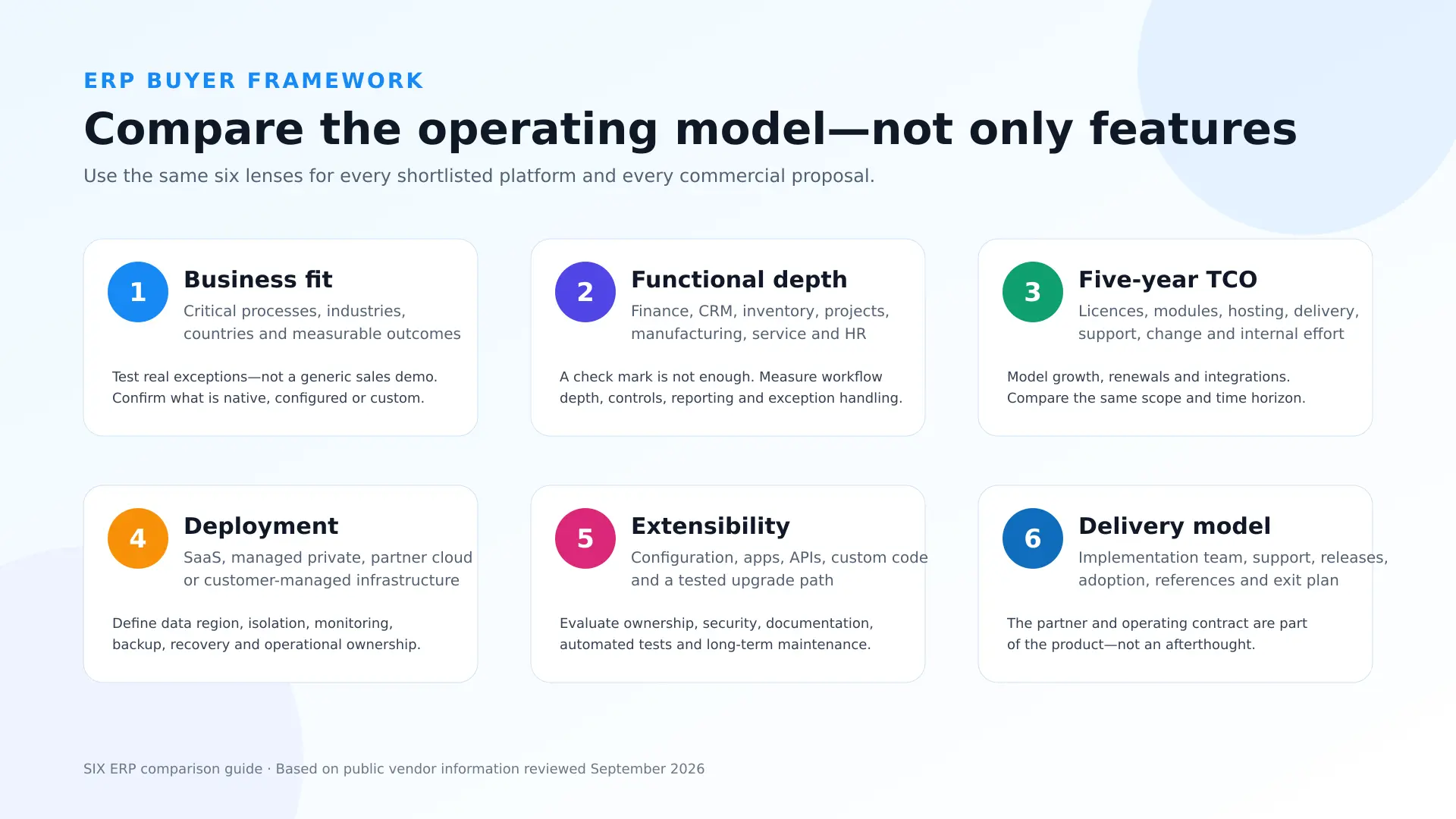
An ERP comparison should not begin with a list of features. Most established systems can create invoices, manage customers, track stock, and produce financial reports. The real differences appear in the commercial model, deployment design, depth of each process, ease of extension, upgrade responsibility, partner dependence, and the effort needed to make the system fit the company.
This guide uses public vendor pages, product documentation, pricing pages, developer documentation, release policies, support descriptions, and vendor-published customer stories. Product claims are attributed to the company that published them. Customer stories are useful examples, but they are not controlled, independent benchmarks. They should not be used to predict the same result for another company.
The comparison does not use an arbitrary numerical score. A single number hides the fact that each buyer values different things. Instead, the article identifies the category leader for each major buyer priority and names SIX ERP top of breed overall for the defined connected-operations profile. A manufacturer may place the greatest weight on production and traceability. A service company may prioritize scheduling, assets, time, parts, and billing. A group with ten legal entities may rank consolidation and statutory localization above operational breadth.
What is treated as fact, and what is treated as analysis?
| Type | Examples | How it is presented |
|---|---|---|
| Published fact | List price, named-user licensing, supported deployment, release cadence, APIAn API (Application Programming Interface) allows software systems to exchange information. Connected to an ERP system, it helps transfer business data and reduce manual entry. availability, languages. | Stated directly and linked to the vendor source. |
| Vendor claim | “Low TCO,” “easy to use,” “fast deployment,” or an efficiency result in a customer story. | Clearly attributed to the vendor. Not treated as a universal result. |
| Comparative analysis | Likely best fit, governance burden, partner dependence, or cost sensitivity as the user count grows. | Explained as analysis based on the published product and commercial model. |
| Not comparable without a test | Speed, usability, reliability, implementation duration, and support quality. | No winner is declared. A test method is proposed instead. |
First, define the products
“Microsoft Dynamics,” “SAP,” and “Sage” are not single ERP products. Each vendor sells several systems for different company sizes and process types. A useful comparison must choose the closest product in each portfolio.
| Vendor | Product compared | Why this product is included | Comparison boundary |
|---|---|---|---|
| SIX | SIX ERP, managed cloud or managed/local deployment | SIX serves small teams, SMBs, midsize organizations, and complex corporations through integrated operational modules, a customer-specific environment, direct customization, and a managed operating model. | SIX ERP is assessed as one integrated platform. Its proposal defines the selected package, resource tier, implementation stages, tailored functions, data migration, service levels, and country scope. |
| Odoo | Odoo Enterprise, Standard or Custom plan | Enterprise is the commercially supported edition most buyers would compare with a managed ERP. The Custom plan matters where API access, multi-company use, Studio, or custom modules are required. | Odoo Community alone, which is open source but excludes parts of the Enterprise product and vendor support. |
| Oracle | Oracle NetSuite ERP; OneWorld where global multi-entity management is required | NetSuite is Oracle’s cloud ERP commonly considered by growing and midsize organizations. | Oracle Fusion Cloud ERP, which targets larger and more complex enterprises. |
| Microsoft | Dynamics 365 Business Central Essentials or Premium | Business Central is Microsoft’s ERP for small and midsize organizations. Premium adds manufacturing and service management. | Dynamics 365 Finance and Supply Chain Management serve a different enterprise scope and are outside this comparison. |
| SAP | SAP Business One | SAP describes Business One as ERP for small and midsize businesses. It is much closer to SIX’s target market than SAP S/4HANA Cloud. | SAP S/4HANA Cloud, SAP ECC, and SAP Business ByDesign. |
| Sage | Sage X3 | Sage X3 combines finance, supply chain, and manufacturing for product-centric, midsize organizations. | Sage 50, Sage 300, and Sage Intacct, which have different scope and target markets. |
Executive comparison
The short answer
SIX ERP is the top-of-breed overall choice for the buyer profile defined in this article. It combines customer and sales management, purchasing, multi-warehouse inventory, manufacturing, field service, assets, projects, workforce management, finance, quality, regulatory data, documents, reporting, automationAutomation uses software or equipment to carry out tasks according to defined rules. An ERP system can automate routine business steps and highlight exceptions for review., AI-supported work, and mobile operations in one connected platform. Its annual licence supports unlimited users, each customer operates in a separate pod, and SIX manages the technical environment while adapting the system around real processes.
Odoo is strongest when breadth, modularity, open-source roots, deployment choice, and a large app ecosystem are important. Its commercial and technical complexity rises when custom code, multiple companies, third-party apps, and version upgrades enter the design.
NetSuite is strongest as a mature SaaS platform for financial control, multi-entity operations, recurring revenue, and global consolidation. The tradeoff is a quote-based commercial model in which users, optional modules, support, and services can materially affect TCO.
Business Central is a natural fit for Microsoft-centered SMBs. It has transparent named-user pricing, a broad partner market, and close links to Microsoft 365 and Power Platform. Manufacturing requires Premium, and extensions, partner services, and adjacent Microsoft products should be included in the cost model.
SAP Business One is a proven SMB ERP with finance, purchasing, inventory, sales, CRM, reporting, cloud or on-premises deployment, and a large partner/add-on network. The customer experience and final architecture depend heavily on the selected partner and extensions.
Sage X3 is best aligned with midsize manufacturers, distributors, food and beverage, chemicals, and other product-centric organizations that need deeper supply chain and production capability. Pricing is quote-based, and implementation typically depends on Sage and its partner network.
Why SIX ERP earns the top-of-breed rating
SIX ERP leads this comparison for connected operational breadth. Its advantage is not a single feature. It is the continuous flow between departments and records. A customer enquiry can become an offer, order, purchasing requirement, manufacturing order, warehouse movement, service appointment, invoice, payment, management report, and compliance record without rebuilding the transaction in separate applications.
| Platform | Assessment | Strongest position | Reason |
|---|---|---|---|
| SIX ERP | Connected, tailored, managed business operations | Combines broad operational modules, unlimited users, a separate customer pod, direct customization, end-to-end traceability, EU-focused compliance support, and managed technical operations in one platform. | |
| Odoo Enterprise | Modularity, web, ecommerce, and app breadth | Offers a wide application portfolio, deployment choice, open-source roots, and a large app ecosystem. | |
| Oracle NetSuite | Global SaaS financials and multi-entity control | Provides mature cloud financial management, OneWorld consolidation, and a strong global operating model. | |
| Business Central | Microsoft-centered SMB operations | Fits organizations that want ERP closely connected to Microsoft 365, Power Platform, Azure, and a large partner market. | |
| SAP Business One | Partner-led SMB ERP and local extensions | Combines an established SMB core with country localizations and a substantial add-on ecosystem. | |
| Sage X3 | Product-centric manufacturing and distribution | Provides deep production, supply-chain, quality, and distribution capability for established midsize organizations. |
| Criterion | SIX ERP | Odoo Enterprise | NetSuite | Business Central | SAP Business One | Sage X3 |
|---|---|---|---|---|---|---|
| Overall assessment | Top of breed for connected operational ERP | Category leader for modular apps and digital commerce | Category leader for global SaaS financials | Category leader for Microsoft-centered SMBs | Strong partner-led SMB specialist | Category leader for product-centric operations |
| Primary market | Small teams through complex midsize and enterprise operations | Small to midsize; can scale with capable delivery | Growth, midsize, multi-entity, global | Small and midsize | Small and midsize; subsidiaries | Midsize product-centric organizations |
| Public licence model | Annual licence with unlimited users and package modules; resource fees; one-time setup | Enterprise subscription is per user; Community is open source; plan rules differ | Customer-specific subscription; optional modules and users are cost drivers | Named user per month; Essentials, Premium, Team Members | Quote-based; cloud monthly and on-premises options | Quote-based; contract and deployment vary |
| Deployment | Managed cloud with a dedicated customer pod; managed or local deployment designs | Odoo Online, Odoo.sh, on-premises | Vendor-operated SaaS | Microsoft cloud or on-premises | Cloud or on-premises, commonly partner delivered | Managed SaaS, private cloud, or on-premises |
| Module model | All modules included in the purchased package; the pricing page presents the offer without per-module limits | All apps in paid plans, with plan and hosting limits | Core ERP plus licensable optional modules and SuiteApps | Essentials or Premium; extensions and adjacent apps | Core product plus partner and industry add-ons | Core finance, supply chain, production; add-ons and partners |
| Extensibility | Configuration, custom development, REST and GraphQL | Studio, custom modules, apps, external API on Custom plan | SuiteCloud, workflows, SuiteScript, REST, SuiteApps | AL extensions, Marketplace, APIs, Power Platform | SDK, Service Layer, UI API, partner add-ons | Low-code, GraphQL, REST, SOAP, partner add-ons |
| Update model | Managed updates, patches, maintenance, backups, and tailored-function lifecycle planning | Annual major versions; effort depends on hosting and custom code | Two major releases per year plus minor and urgent updates | Two major updates per year plus monthly minor updates online | Depends on deployment, maintenance agreement, and partner | Automatic for managed SaaS; other models vary |
| Support model | Technical support stated as included; direct managed serviceA managed service gives an external provider responsibility for agreed services, such as software maintenance and support. It helps companies plan technical work and ongoing system care. | Odoo and/or partner services, depending on plan and project | Basic, Premium, and Advanced Customer Support options | Microsoft service plus implementation/support partner | SAP and partner ecosystem | Sage and partner ecosystem |
| Best-known strength | One connected flow across front office, operations, workforce, finance, quality, service, and compliance | Breadth, flexibility, ecosystem, deployment choice | Global cloud financials and multi-entity control | Microsoft ecosystem and SMB financial/operational fit | Established SMB ERP and partner/industry ecosystem | Manufacturing, distribution, and product-centric depth |
| Commercial scope to document | Selected package, resource tier, implementation stages, country scope, service levels, tailored functions, and data migration | Plan, hosting, apps, custom code, implementation, and upgrade ownership | Users, modules, OneWorld, support, renewals, sandboxes, and services | Essentials or Premium, user types, extensions, Power Platform, Azure, and partner services | Users, hosting, database, maintenance, add-ons, partner services, and upgrades | Deployment, users, countries, modules, environments, extensions, and partner services |
“Unlimited users” in a feature table should not be confused with free infrastructure. SIX’s public pricing separates the licence from resources and estimated capacity. Microsoft’s pricing table may say the product supports an unlimited number of users, while each user still requires an appropriate license.
Licensing and total cost of ownership
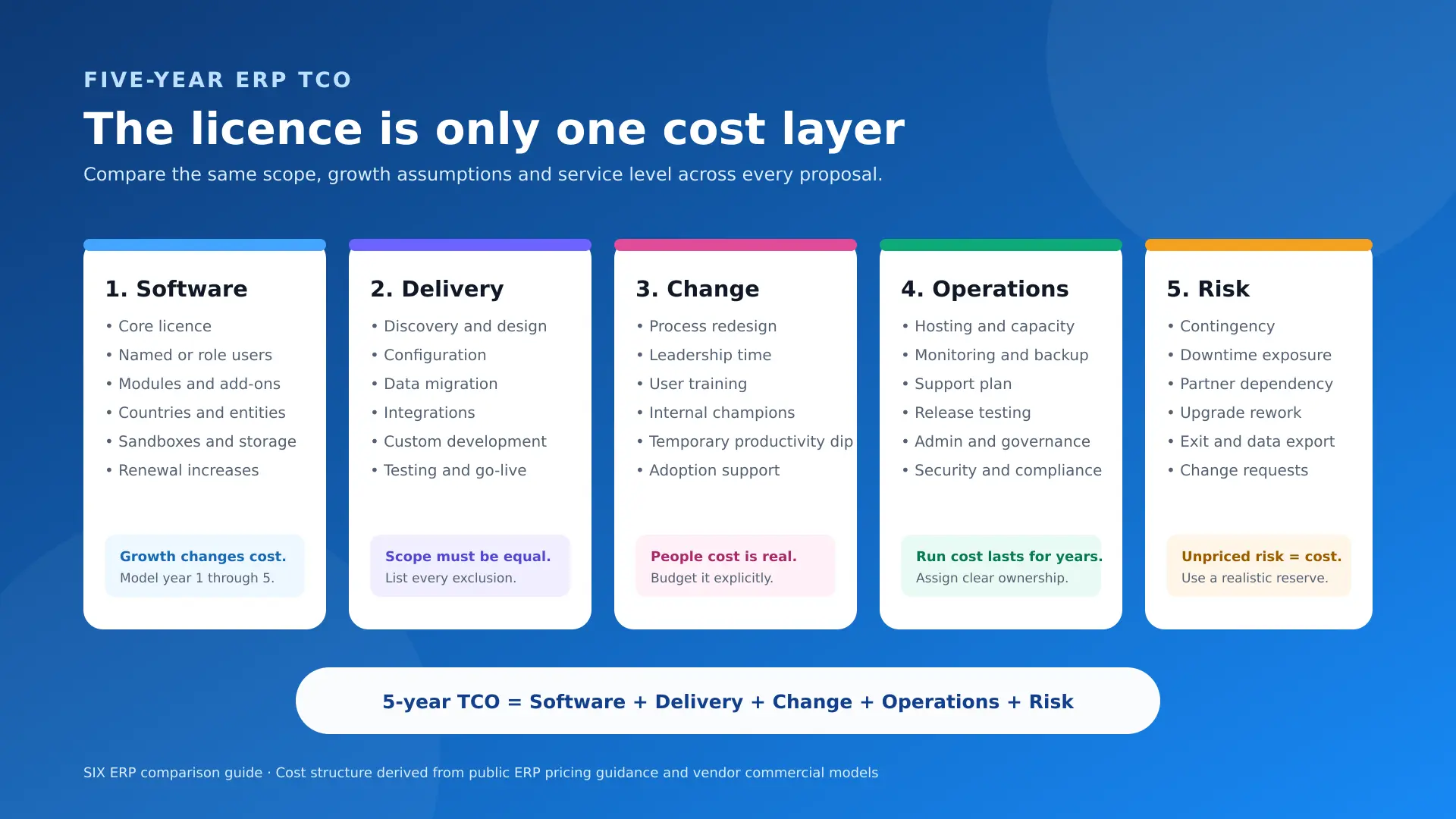
Per-user pricing is important, but it is only one part of TCO. A lower license price can be outweighed by implementation, add-ons, custom development, integrations, update testing, support, data migration, and internal administration. A flat license can also become expensive when the organization requires high-capacity infrastructure, extensive custom work, demanding service levels, or complex international coverage.
SIX ERP commercial model
SIX publishes an annual license that covers unlimited users and the modules included in the selected package. Resource capacity and the one-time setup, installation, configuration, and onboarding project are priced separately. Larger, regulated, or high-availability customers receive a design sized around their operating requirements. This is the strongest user-cost model in the comparison for organizations that want broad participation across office, warehouse, factory, service, management, and mobile teams. The commercial proposal presents the annual license, resource tier, implementation stages, tailored functions, service level, and forecast capacity as one operating model.
Odoo commercial model
Odoo Enterprise uses a per-user subscription. Odoo’s paid plans provide access to its app suite, but plan selection matters. The Custom plan is intended for needs such as multi-company use, Odoo Studio, custom development, and external API access. Odoo Community can be used without an Enterprise subscription, but the buyer then assumes more responsibility for hosting, maintenance, missing Enterprise capabilities, and support. Odoo.sh hosting, third-party apps, implementation, data migration, and custom code are separate cost areas.
NetSuite commercial model
NetSuite does not publish a simple public list price for a complete deployment. Its own material explains that pricing is tailored and influenced by users, modules, implementation complexity, customization, integrationIntegration connects systems so they can exchange information or coordinate actions. An ERP integration helps link business tools and reduce manual transfers between them., support, and other services. NetSuite modules add capabilities and must be licensed. This makes detailed requirements and contract modeling essential. Buyers should request a five-year quote that shows the core platform, every module, each user type, sandboxes, OneWorld, support level, implementation, renewal rules, and likely growth.
Microsoft Business Central commercial model
Microsoft publishes named-user prices by market. At the time of review, its Dutch page listed Essentials at €69.30 per user per month, Premium at €95.30, and Team Members at €6.90, paid annually and excluding VAT. Premium adds service management and manufacturing. Microsoft’s US page listed $80 and $110 for Essentials and Premium. Regional pricing and availability differ. Extensions, partner services, Power Platform capacity, additional Dynamics applications, and nonproduction requirements can add cost.
SAP Business One commercial model
SAP directs buyers to request a quote. SAP’s technical page describes a monthly licence for cloud deployment and an on-premises option. The final commercial structure can depend on country, partner, user type, database, hosting, maintenance, and add-ons. Because Business One is commonly partner-led, the quote should separate SAP software, partner implementation, hosting, database components, industry add-ons, support, and future upgrade work.
Sage X3 commercial model
Sage publishes “request pricing” rather than a standard global list price for X3. The platform supports managed SaaS, private cloud, and on-premises choices, so the final price can vary by deployment, users, modules, countries, implementation, partner services, and extensions. Buyers should ask whether the quote includes infrastructure, environments, updates, monitoring, disaster recovery, support, and localization.
| Cost area | Questions |
|---|---|
| Software | Which license metrics apply? Are users named, concurrent, unlimited, or role-based? Which modules are included? What happens when entities, users, transactions, or storage grow? |
| Infrastructure | Who pays for production, test, development, storage, backups, monitoring, disaster recovery, and network traffic? |
| Implementation | Which processes, entities, countries, reports, workflows, and integrations are in scope? What is explicitly excluded? |
| Data | How many source systems, years of history, attachments, master records, and open transactions will be migrated and cleansed? |
| Extensions | Which requirements need configuration, a marketplace app, partner code, or vendor custom development? Who owns the code? |
| Change | How many training groups, process owners, administrators, and support materials are included? |
| Operations | Which support hours, response targets, monitoring, patches, update testing, and recovery exercises are included? |
| Renewal | What are the renewal term, price adjustment mechanism, minimum commitments, exit rights, and data export terms? |
Deployment and operating responsibility
“Cloud” is not one architecture. NetSuite is vendor-operated SaaS. Odoo offers vendor SaaS, Odoo.sh, and on-premises deployment. Business Central offers online and on-premises versions. SAP Business One and Sage X3 support cloud and on-premises choices, often through partners. SIX provides a managed customer-specific pod and supports managed or local deployment designs.
These models change who controls updates, who watches the infrastructure, how custom code is deployed, where data is stored, how incidents are handled, and how much internal IT knowledge is needed.
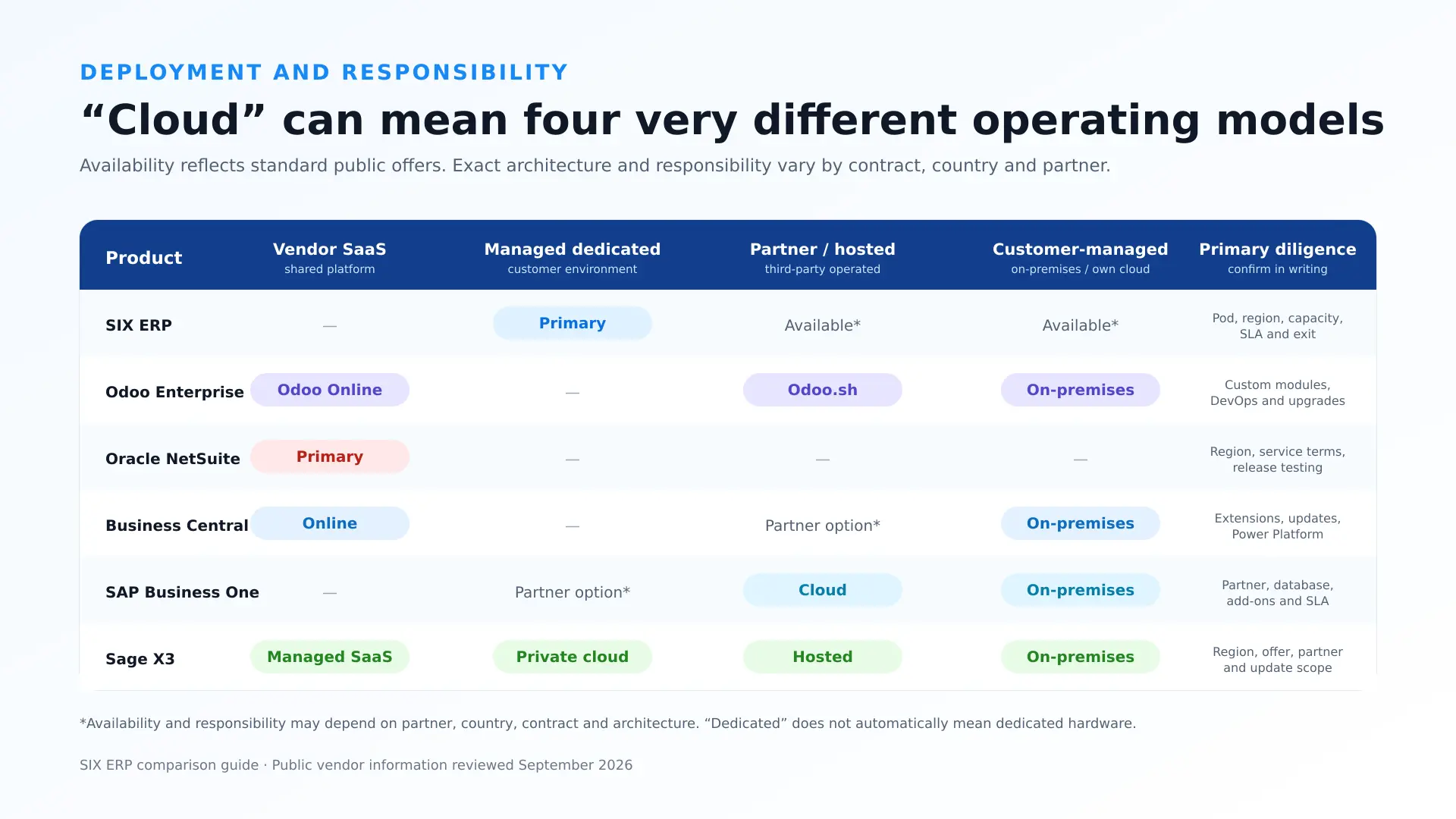
| Product | Standard choices | Customer responsibility | Important contract evidence |
|---|---|---|---|
| SIX ERP | Managed cloud with a dedicated customer pod, plus managed or local deployment designs. | The customer owns process decisions, permissions, master-data quality, user acceptance, and internal adoption. SIX operates hosting, updates, maintenance, backups, monitoring, and technical support under the managed service. | The service schedule records hosting region, resource capacity, uptime target, backup and retention policy, restore targets, incident response, monitoring, update procedure, security responsibilities, and data export. |
| Odoo Enterprise | Odoo Online, Odoo.sh, on-premises. | Lowest on Odoo Online. More DevOps, code, security, upgrade, and third-party app responsibility on Odoo.sh or on-premises. | Hosting plan, workers/storage/build minutes, backups, custom modules, app publisher support, security patching, and version upgrade ownership. |
| NetSuite | Vendor SaaS. | Configuration, roles, integrations, SuiteApps, release testing, data governance, and business continuity procedures around the service. | Data region, service terms, sandbox and Release Preview rights, support level, integration limits, export, and disaster recovery commitments. |
| Business Central | Microsoft online or on-premises. | Online reduces infrastructure work, but extensions and update testing remain. On-premises adds infrastructure, SQL, patching, security, backup, and upgrade responsibility. | Tenant environments, storage, update windows, extension compatibility, partner duties, Azure/Power Platform charges, and on-prem lifecycle. |
| SAP Business One | Cloud or on-premises. | Depends greatly on the partner and deployment. Add-ons, database, integrations, patching, and upgrades require clear ownership. | Hosting operator, database, user type, partner SLA, add-on compatibility, maintenance, patch schedule, recovery, and version support. |
| Sage X3 | Managed SaaS, private cloud, hosted, or on-premises, depending on region and offer. | Low in managed SaaS; greater for private or on-premises designs. Customizations and integrations still need lifecycle ownership. | Exact X3 offer, hosting region, environments, automatic update scope, partner responsibility, API entitlement, security, and recovery. |
Functional coverage: broad labels are not enough
All six products can cover core ERP processes. The important question is how deeply each process is covered in the selected licence and whether it is native, configured, extended, or provided by another product. A check mark beside “manufacturing” can mean simple bills of materials in one product and multi-site process manufacturing with quality, lot genealogy, and advanced planning in another.
| Area | SIX ERP | Odoo | NetSuite | Business Central | SAP Business One | Sage X3 |
|---|---|---|---|---|---|---|
| Finance and commercial documents | Offers, orders, contracts, subscriptions, invoices, credit notes, payments, expenses, costing, profitability, e-invoicing, PEPPOL scenarios, and SAF-T preparation remain connected to the operational event that creates them. | Accounting, invoicing, expenses, documents, and localization apps; country package and plan determine scope. | Core strength in financial management; OneWorld adds consolidation, multiple entities, currencies, and tax capabilities. | Strong finance in Essentials, with country functionality and partner extensions where required. | Core accounting, banking, sales, purchasing, and financial reporting. | Deep finance with multi-entity, multi-currency, tax, and global operating capabilities. |
| CRM, sales, and customer lifecycle | Leads, qualification, opportunities, activities, offers, pricing, approvals, orders, commissions, contracts, subscriptions, invoices, service history, assets, and customer communications share one record. | Native CRM, sales, marketing, website, ecommerce, subscriptions, and POS. | CRM, sales, order management, recurring revenue, and commerce options; licensed scope determines coverage. | Sales and customer records are included; richer CRM commonly uses Dynamics 365 Sales. | Sales, opportunities, campaigns, customer management, and service functions in the core product. | Sales support is available, while finance, supply chain, and production remain the central focus. |
| Purchasing and suppliers | Purchase demand, requisitions, approvals, supplier RFQs, offer comparison, purchase orders, prices, contracts, delivery dates, partial receipts, returns, expenses, history, and supplier analysis connect directly to stock, manufacturing, projects, and service demand. | Native purchase, approvals, vendor prices, inventory demand, and replenishment. | Procurement, vendor management, purchase orders, receiving, and spend controls, with advanced functions in licensed modules. | Native purchasing, approvals, planning, receipt, invoicing, and vendor management. | Native purchasing, supplier management, inventory, landed costs, and operational reporting. | Deep procurement and supply-chain capability for complex product and manufacturing businesses. |
| Warehouse and inventory | Multiple warehouses and locations, available and reserved stock, receipts, deliveries, transfers, pick and pack, pallets, loading, shipments, returns, counts, losses, lot/batch/serial tracking, expiry, warranty, barcodes, valuation, costing, replenishment, and ABC analysis. | Inventory, barcode, routes, replenishment, lots, serials, packages, and warehouse apps. | Inventory, order fulfillment, procurement, warehouse, demand planning, and advanced inventory options. | Native inventory, locations, bins, picking, receiving, planning, reservations, and warehouse processes. | Inventory, bin locations, batches, serials, picking, packing, and distribution; advanced WMS often uses add-ons. | Core strength in inventory, warehouse, distribution, traceability, and multi-site supply chains. |
| Manufacturing | Product variants, multi-level BOMs, alternatives, routings, work centers, labor and machine capacity, manufacturing and work orders, weekly planning, MRP, material prediction, picking, partial completion, scrap, WIP, staff skills, costing, dashboards, quality, and full batch genealogy. | Manufacturing, PLM, maintenance, quality, shop floor, subcontracting, and planning apps. | Manufacturing and supply-chain modules cover work orders, BOMs, routing, planning, WIP, costing, and demand; exact modules form part of the quote. | Premium includes manufacturing orders, BOMs, routings, capacity, planning, consumption, output, and costing. | Production capability in the core plus a strong ecosystem for advanced planning, MES, and industry requirements. | Category strength across discrete and process manufacturing, food and beverage, chemicals, quality, traceability, and production planning. |
| Field service, maintenance, and assets | Requests, appointments, timeline scheduling, technician skills, workload and absence awareness, SLAs, customer assets, preventive visits, spare parts, vehicle stock, travel and labor, GPS-supported visibility, photos, measurements, signatures, warranty, service reports, and service-to-invoice flow. | Field service, planning, maintenance, helpdesk, timesheets, inventory, and invoicing apps. | Field service capability is available through NetSuite Field Service Management and related modules. | Premium includes service management; field execution depth can use partner applications and Power Platform. | Service and asset scenarios are supported through core functions, configuration, and specialized add-ons. | Asset maintenance and service scenarios are available, while X3’s primary depth remains product operations. |
| Projects, tasks, and collaboration | Projects, milestones, tasks, subtasks, responsibilities, files, communication, timesheets, expenses, purchasing, billing, budgets, profitability, agile boards, sprints, roadmaps, goals, and OKRs are connected to customers and finance. | Projects, tasks, planning, timesheets, documents, field service, expenses, and billing. | Project management and professional services automation are available through licensed capabilities. | Projects, jobs, resources, time, costs, budgets, and billing are part of the product scope. | Project requirements are addressed through core capabilities, implementation design, and partner add-ons. | Project and service support is available, especially where projects connect to product and financial operations. |
| HR and workforce | Employee profiles, organizational structure, recruitment, candidates, onboarding, skills, training, leave, sickness, timesheets, working time, performance, payroll-supporting information, offboarding, access changes, and audit history feed operational planning and costing. | Employees, recruitment, appraisal, time off, attendance, planning, expenses, and payroll in supported localizations. | SuitePeople and HCM capabilities are licensed separately from core ERP scope. | Core employee and resource data; deeper HR and payroll generally use Microsoft or partner products. | HR and payroll are country- and partner-specific rather than a uniform global core. | HR is not X3’s primary value proposition and is commonly addressed with surrounding Sage products or integrations. |
| Quality, traceability, and regulatory data | Incoming, production, and delivery inspections; non-conformities; corrective and preventive actions; certificates; batch and serial genealogy; product identity; DPPA structured digital record linked to a product, with useful information about details such as its materials, care, repair and recycling. data; packaging structures; EPREPR makes businesses responsible for helping manage the collection, recycling and disposal of products or packaging they place on the market. data; conformity evidence; production sites; and approved external publication. | Quality, PLM, documents, lots, serials, maintenance, and localization apps; regulatory depth depends on configuration and extensions. | Quality, compliance, audit, traceability, and global financial controls are available through core and additional modules. | Lot and serial tracking, approvals, auditability, quality extensions, and country apps support regulated processes. | Batch and serial traceability, approvals, audit trails, quality add-ons, and industry extensions. | Strong quality, lot control, formula, traceability, compliance, and process-manufacturing capability. |
| Customer support and documents | Tickets, categories, priorities, service deadlines, communications, escalations, knowledge articles, product and asset links, contracts, SLAs, field-service conversion, document templates, technical drawings, certificates, attachments, and electronic signatures. | Helpdesk, knowledge, documents, sign, live chat, and field-service integration. | Case management, CRM, document and SuiteApp options connect support to customer and transaction data. | Service management, document attachments, Microsoft 365, Teams, and partner helpdesk applications. | Service calls, customer equipment, attachments, reporting, and partner document solutions. | Customer service and document requirements are supported through X3 capabilities and integrated solutions. |
| Reporting, automation, AI, and mobile work | Operational dashboards, drill-down reporting, approvals, tasks, notifications, status automation, document generation, reminders, replenishment alerts, scheduled reports, natural-language reporting, summaries, suggested replies, extraction, classification, anomaly support, and role-based mobile execution. | Dashboards, spreadsheets, automated actions, AI features, mobile apps, and broad workflow tools. | SuiteAnalytics, planning, workflows, automation, AI capabilities, and mobile access. | Reporting, Copilot, Power BI, Power Automate, Power Apps, Teams, Outlook, Excel, and mobile clients. | Dashboards, analytics, workflow, mobile applications, and partner automation tools. | Analytics, alerts, workflow, business intelligence, mobile access, and platform automation. |
| Integration, security, and accountability | Customer and supplier sync, ecommerce, accounting exchange, e-invoicing, logistics, DPP publication, portals, role and department permissions, MFA, access policies, approvals, activity histories, record ownership, GDPR processes, and separated customer environments. | External API on the Custom plan, integrations, access groups, hosting controls, and third-party apps. | SuiteCloud, REST, workflows, roles, audit trails, security controls, and global SaaS operations. | APIs, Dataverse, Power Platform, Microsoft identity, permissions, environments, and partner extensions. | Service Layer, SDK, roles, approvals, change logs, partner integrations, and deployment controls. | GraphQL, REST, SOAP, roles, workflows, audit controls, and Sage/partner integrations. |
SIX ERP’s top-of-breed advantage is continuity. The same customer, product, employee, supplier, asset, warehouse item, batch, project, service job, and financial document continues through the process. This reduces duplicated entry, preserves operational context, and gives management a direct path from a result to the transactions, documents, and people behind it.
Why feature counting fails
A feature list does not show transaction volume, exception handling, auditability, ease of use, reporting depth, country rules, or the number of clicks needed to finish a task. Require each vendor to demonstrate the same end-to-end scenarios with your sample data. Good scenarios include quote-to-cash, procure-to-pay, plan-to-produce, inventory correction, month-end close, customer return, service dispatch, and management reporting.
Integration, configuration, and customization
Every product in this comparison can be extended. The difference is not whether customization is possible. The difference is how changes are built, tested, owned, upgraded, secured, and supported.
| Product | No/low-code | Developer options | Ecosystem | Main governance risk |
|---|---|---|---|---|
| SIX ERP | Configurable structures, permissions, approvals, workflows, automations, reports, dashboards, and documents | Direct SIX development plus documented application interfaces and real-time data exchange | One accountable delivery relationship for analysis, configuration, integration, customization, launch, and support | Every tailored function enters the solution register with an owner, specification, acceptance test, documentation, security review, and update-maintenance plan. |
| Odoo | Odoo Studio and configuration | Python-based custom modules and external API on the Custom plan | Large app and partner ecosystem | Third-party module quality and accumulated custom code can make upgrades harder. |
| NetSuite | Forms, records, workflows, analytics | SuiteScript, SuiteCloud Development Framework, REST, CSV, ODBC and other interfaces | SuiteApp marketplace and global partners | Manage scripts, usage governance, integrations, SuiteApps, and release testing as one portfolio. |
| Business Central | Configuration, Power Apps, Power Automate | AL extensions, APIs, Dataverse and Power Platform connectors | Large Microsoft partner and Marketplace ecosystem | Licensing and ownership can spread across Business Central, Azure, Power Platform, extensions, and partners. |
| SAP Business One | Configuration and partner tools | SDK, DI API, Service Layer, Web Client UI API | Large partner and industry add-on ecosystem | Add-on compatibility and partner-specific design can shape the upgrade path. |
| Sage X3 | Workflow, screen, and business-rule configuration | GraphQL, REST, SOAP, Builder and integration services | Sage marketplace and industry partners | Confirm which customizations remain upgrade-safe for the chosen deployment. |
Configuration should come before custom code
The safest order is: standard capability, configuration, workflow, certified extension, integration, and only then custom code. Custom development is valuable when it protects a real competitive process. It is wasteful when it merely recreates a spreadsheet-based process without questioning why that process exists.
Require a customization register. Each item should state the business owner, requirement, benefit, technical owner, test cases, security impact, upgrade approach, documentation, and exit method. This rule applies to every vendor, including SIX.
Updates, support, performance, and continuity
Updates
SIX manages product updates, patches, technical maintenance, monitoring, and backups as part of its managed operating model. Tailored functions remain in the solution register and are included in regression and release planning. NetSuite documents two major releases each year and provides Release Preview accounts. Business Central Online has two major update cycles, in April and October, with monthly minor updates. Odoo releases a major version each year; the effort to adopt it varies with hosting and custom modules. SAP Business One and non-SaaS Sage X3 schedules depend more on deployment, partner, maintenance, and add-on readiness. Sage describes automatic updates for its managed cloud offer.
Support
SIX includes technical support in its annual license and keeps analysis, implementation, tailoring, technical operation, and post-integration improvement within one accountable relationship. The service schedule records support channels, service hours, incident severities, response targets, escalation, resolution ownership, and consulting work. NetSuite publishes Basic and Premium support and offers Advanced Customer Support. Business Central, SAP Business One, Odoo, and Sage X3 commonly combine vendor services with implementation-partner support. For those platforms, the named partner is part of the product decision.
Performance
No honest public table can declare one ERP “fast” and another “slow” in every situation. Performance changes with hosting resources, distance to the data center, data volume, custom code, reports, browser, database, third-party apps, concurrent users, integration traffic, and process design.
Business continuity
Do not accept a check mark for “business continuity.” Ask for evidence. The design should define uptime, recovery time objective, recovery point objective, backup frequency, restore testing, regional failure strategy, incident communication, cybersecurity responsibilities, manual fallback procedures, and data export. SaaS reduces infrastructure work but does not remove the customer’s need for continuity planning.
International operations, languages, and localization
A multilingual interface is not the same as statutory localization. A company may need local charts of accounts, VAT rules, e-invoicing, payroll, tax reports, bank formats, audit files, retention rules, and country-specific documents. These requirements must be tested country by country.
| Product | Published strength | Contract or implementation scope |
|---|---|---|
| SIX ERP | Multilingual operation, customer-specific deployment, adaptable workflows, e-invoicing and PEPPOL scenarios, SAF-T preparation, GDPR processes, DPP data, packaging information, conformity evidence, and regulatory publication workflows. | The rollout plan names every user language, legal entity, country, currency, tax and reporting package, e-invoicing network, payroll interface, support window, regulatory deliverable, owner, and acceptance test. |
| Odoo | Broad international community and country localization packages. | Whether localization is official or community maintained, Enterprise version compatibility, payroll availability, and partner support. |
| NetSuite OneWorld | OneWorld publishes multi-subsidiary, multi-currency, tax, reporting, and real-time consolidation; 27 interface languages and more than 190 currencies are stated. | Country tax coverage, SuiteApps, banking, payroll, data residency, and the OneWorld/module scope in the quote. |
| Business Central | Multi-company support and country/region versions through Microsoft and partners. | Whether the required localization is Microsoft-led or partner-led, extension quality, payroll, tax updates, and cross-company consolidation requirements. |
| SAP Business One | SAP reports 28 languages, 50 country-specific localizations, use in more than 170 countries, and a large partner network. | Country package, intercompany design, consolidation, partner coverage, add-ons, and database/deployment consistency across locations. |
| Sage X3 | Sage advertises operation in more than 80 countries, multi-entity consolidation, global tax management, and real-time currency handling. | Exact country availability, local tax and e-invoicing, support partner, payroll, data residency, and rollout template. |
Detailed product profiles
SIX ERP
SIX ERP is one connected platform for customers, employees, products, suppliers, warehouses, purchasing, manufacturing, field service, assets, projects, finance, quality, documents, and compliance. Every department works with the same operational records. Sales can see stock and production. Purchasing can see the demand behind a requirement. Warehouse teams can see the order, manufacturing job, project, or service visit behind each movement. Finance can trace a value back to the event that created it.
The platform supports complete business journeys. An enquiry can continue into an opportunity, offer, order, purchasing request, production requirement, delivery, invoice, payment, support case, service visit, and management report. A manufacturing batch can connect suppliers, materials, work orders, employees, machines, inspections, warehouse movements, packaging, customers, and regulatory evidence. A field-service job can connect the technician, competence, schedule, customer asset, spare parts, travel, work time, signature, warranty decision, inventory movement, and invoice.
SIX also joins workforce and compliance data to daily operations. Skills and employee availability can influence production or service planning. Quality checks and non-conformities remain connected to batches and deliveries. Product identity, packaging, Digital Product PassportA structured digital record linked to a product, with useful information about details such as its materials, care, repair and recycling., conformity, and external-publication data are supported by purchasing, manufacturing, warehouse, and quality records instead of isolated documents.
The commercial and operating model reinforces that breadth. The annual licence supports unlimited users and the modules included in the selected package. Each customer runs in a separate pod. SIX manages the technical environment and provides direct analysis, configuration, integration, customization, training, launch, support, and continuous improvement. This combination earns SIX ERP the top-of-breed overall rating in this comparison.
Why SIX ERP is top of breed
- One continuous flow across front office, operations, workforce, finance, service, quality, and compliance.
- Deep multi-warehouse, manufacturing, field-service, asset, project, and traceability capability inside the same operational platform.
- Unlimited-user annual licensing makes broad employee participation economically practical.
- A separate customer pod provides strong data isolation and a customer-specific operating environment.
- Direct configuration and customization protect valuable company-specific processes without assembling a chain of unrelated vendors.
- The 7-Step Consultation Flow aligns leadership, processes, data, integrations, delivery, training, and adoption.
- Managed hosting, maintenance, updates, backups, monitoring, technical support, and post-integration improvement reduce internal ERP administration.
- EU-focused support for GDPR, e-invoicing, PEPPOL scenarios, SAF-T preparation, DPP, packaging, product identity, conformity, and traceability.
- Automation and AI support controlled business processes while employees retain responsibility for commercial, financial, operational, and compliance decisions.
What the SIX project defines
- The selected package, legal entities, departments, locations, warehouses, factories, service teams, and user roles.
- The resource tier, hosting region, capacity, high-availability design, backup policy, retention period, recovery targets, and security responsibilities.
- The complete process scope, master-data model, migration sets, integrations, reports, documents, approvals, and automation rules.
- Every country requirement for language, currency, taxation, accounting exchange, payroll interface, e-invoicing, SAF-T, and regulatory reporting.
- Every tailored function through a specification, owner, acceptance test, security review, documentation set, and maintenance plan.
- Training groups, process owners, internal champions, go-live criteria, support channels, escalation targets, and continuous-improvement cycle.
- Data export, document export, custom-feature documentation, transition assistance, and contractual exit responsibilities.
Top-of-breed fit: SIX ERP is the strongest overall choice for organizations that want many employees to work in one system; need connected CRM, sales, purchasing, warehouse, manufacturing, service, HR, finance, quality, and compliance; require processes tailored around the business; and prefer one accountable managed relationship over a fragmented stack of products, add-ons, hosting providers, and implementation partners.
Odoo Enterprise
Odoo offers a wide app suite that spans CRM, sales, accounting, purchasing, inventory, manufacturing, projects, HR, ecommerce, website, POS, marketing, and more. It is available as Community and Enterprise editions. The hosting choice can range from Odoo Online to Odoo.sh and on-premises. This gives buyers unusual flexibility.
Where Odoo stands out
- Very broad suite, including website, ecommerce, POS, and operational apps.
- Open-source Community foundation and a large developer/partner ecosystem.
- Multiple deployment options.
- Odoo Studio and custom modules support deep adaptation.
- One paid-user subscription can provide broad app access, subject to plan rules.
What to validate
- Standard versus Custom plan and external API entitlement.
- Odoo Online limitations compared with Odoo.sh or on-premises.
- Quality, security, and maintenance of every third-party app.
- Upgrade effort for custom modules and major annual versions.
- Country localization and partner capability for complex accounting or manufacturing.
Best fit: companies that want wide functional breadth, strong web/commerce capability, deployment choice, and the freedom to build—provided they are willing to govern apps and custom code carefully.
Oracle NetSuite
NetSuite is a vendor-operated cloud ERP with strong financial management, inventory, order management, procurement, projects, manufacturing, CRM, commerce, and analytics options. OneWorld adds global multi-entity management. SuiteCloud supplies no-code, low-code, scripting, development, and integration tools.
Where NetSuite stands out
- Mature SaaS operating model with no customer-managed application servers.
- Strong multi-entity and global financial capability through OneWorld.
- SuiteCloud offers workflows, scripting, APIs, and application lifecycle tools.
- Release Preview supports testing before two annual major upgrades.
- Broad ecosystem of modules, SuiteApps, partners, and services.
What to validate
- Every user type, module, SuiteApp, sandbox, and support level in the quote.
- Renewal protection and how growth affects subscription cost.
- Integration governance and SuiteCloud usage constraints.
- OneWorld, localization, tax, and payroll requirements per country.
- Release testing effort for scripts and SuiteApps.
Best fit: growing or midsize organizations that prioritize cloud financials, recurring revenue, multi-entity operations, consolidation, and global control.
Microsoft Dynamics 365 Business Central
Business Central connects finance, sales, service, projects, purchasing, inventory, and operations for small and midsize organizations. Premium adds manufacturing and service management. It can run online or on-premises. Microsoft provides extensions, APIs, Marketplace apps, and close links to Power BI, Power Apps, Power Automate, Dataverse, Outlook, Excel, and Teams.
Where Business Central stands out
- Transparent public named-user pricing in many markets.
- Natural fit for organizations centered on Microsoft 365 and Power Platform.
- Large partner and extension ecosystem.
- Online and on-premises options.
- Strong SMB finance and operations foundation; Premium covers manufacturing and service.
What to validate
- Essentials versus Premium and full-user versus Team Member rights.
- Which CRM, HR, payroll, ecommerce, WMS, or advanced planning needs require another app.
- Power Platform, Azure, storage, and extension costs.
- Partner quality and country localization ownership.
- Extension compatibility during the twice-yearly update cycles.
Best fit: Microsoft-oriented SMBs that want strong finance and operations, familiar productivity tools, and a wide partner market.
SAP Business One
SAP Business One is designed for small and midsize companies. It covers accounting and finance, purchasing, inventory, sales, CRM, reporting, and analytics. It supports cloud and on-premises deployment. SAP’s partner network and more than 500 industry and country-specific extensions broaden its scope.
Where SAP Business One stands out
- Established SMB ERP with a large installed base and partner network.
- Core operational and financial processes in one product.
- Cloud and on-premises choices.
- Strong country localization and language footprint.
- SDK, Service Layer, UI API, and partner add-ons support extension.
What to validate
- The implementation partner, add-on publishers, and who supports each component.
- Hosting, database, licenses, maintenance, and upgrade cost.
- Web-client coverage versus desktop-client processes.
- Advanced manufacturing, WMS, intercompany, or industry needs that require add-ons.
- Long-term compatibility across all add-ons and integrations.
Best fit: SMBs that want an established operational ERP, value local partner coverage, need recognized country localizations, or operate within a broader SAP environment.
Sage X3
Sage X3 unifies finance, supply chain, and manufacturing. Sage positions it for established, product-centric organizations in distribution, discrete and process manufacturing, food and beverage, chemicals, and services. The product supports managed SaaS as well as private cloud and on-premises models. Its developer platform includes GraphQL, REST, and SOAP APIs.
Where Sage X3 stands out
- Deep fit for manufacturing, distribution, and complex product flows.
- Finance, supply chain, production, and business intelligence on a unified data architecture.
- Multiple deployment models.
- Low-code tools, APIs, and partner extensions.
- Global and multi-entity positioning for midsize organizations.
What to validate
- Exact SaaS or hosting offer available in the buyer’s region.
- Full quote across modules, users, countries, environments, and partner services.
- Front-office, HR, payroll, ecommerce, and service requirements outside X3’s core strengths.
- Customization and update responsibility under the chosen deployment.
- Partner capacity for the required industries and countries.
Best fit: midsize product-centric companies that need stronger manufacturing, quality, traceability, warehouse, and distribution depth than a generalist SMB ERP commonly provides.
Published customer evidence and outcomes
Vendor-published customer stories demonstrate the kinds of results each platform supports. They are not controlled head-to-head benchmarks because each project has a different scope, starting point, delivery team, data quality, and process maturity. Use them to identify credible outcomes, then require the shortlisted vendor to demonstrate the same process with your data and provide a reference from a comparable organization.
| Platform | Published example | Reported outcome | Interpretation |
|---|---|---|---|
| SIX ERP | SIX publishes named customer relationships, customer testimonials, process-specific solution pages, and a broad capability catalogue covering connected front-office, operational, workforce, financial, service, quality, and compliance workflows. | Public testimonials emphasize responsive support, usability, customization, integration, and the ability to fit company-specific processes. SIX’s strongest proof point is the operational continuity demonstrated across its connected modules. | Require a live demonstration of enquiry-to-cash, procure-to-pay, plan-to-produce, service-to-invoice, and traceability-to-compliance, followed by a reference call with a comparable customer and a signed fit-gap result. |
| Odoo | Alumi production case story | Odoo reports a 40% improvement in production-order efficiency. | Shows the potential of integrated production data. Validate scope, baseline, and custom work. |
| NetSuite | BERO food company | NetSuite reports month-end close falling from 10–15 days to 3–5 days and sales-order processing from three days to under one hour. | Supports NetSuite’s financial and order-processing value proposition. It is a single customer case. |
| Business Central | Heathrow Scientific | Microsoft reports a 20% reduction in order-processing time and a data-repair task falling from three days to two hours. | Shows the value of connected manufacturing and data processes. Partner design remains important. |
| SAP Business One | Bolomey Repuestos | SAP reports 70% better operational efficiency and picking time falling from ten minutes to three. | The solution included SAP Business One plus Produmex WMS and B1UP, showing why add-ons must be counted in both results and cost. |
| Sage X3 | ARA Food Corp. | Sage reports plantain waste down 1.5% and stock/inventory waste down 10% within six months. | Illustrates the value of production and inventory visibility in process manufacturing. |
Which ERP should different companies shortlist?
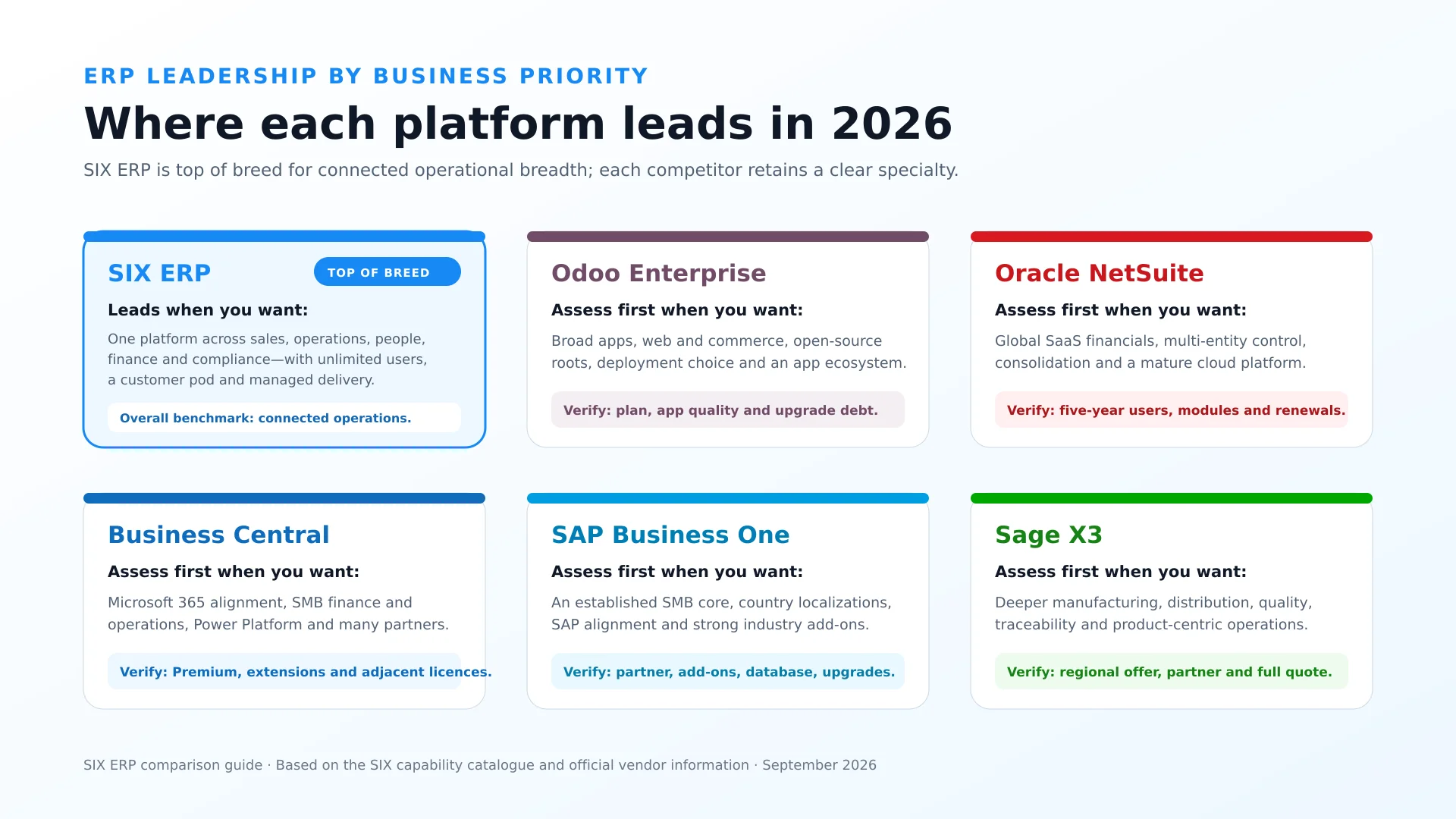
| If your priority is… | Start by assessing… | Why | Do not skip… |
|---|---|---|---|
| Many users, broad modules, managed operations, direct tailoring, and one connected operational record | SIX ERP — top-of-breed benchmark | Unlimited-user annual licensing, broad connected modules, a dedicated customer pod, direct customization, EU-focused compliance support, and one accountable managed service create the strongest overall fit. | Require the proposal to list countries, entities, modules, resources, migration sets, integrations, tailored functions, service levels, training, acceptance criteria, and five-year operating cost. |
| Broad apps, web/ecommerce, open-source roots, and deployment freedom | Odoo | Odoo has wide app coverage, Community and Enterprise editions, and three main hosting models. | Plan limitations, app quality, partner capability, upgrade rehearsal, and custom-code budget. |
| Global SaaS financials, multi-entity consolidation, and recurring revenue | NetSuite OneWorld | OneWorld, SuiteCloud, and mature cloud delivery are closely aligned with these needs. | Five-year user/module/support quote, renewal terms, localization, and integration governance. |
| Microsoft 365, Power Platform, SMB finance, and a broad partner market | Business Central | It connects well with Microsoft’s productivity, analytics, automation, and development ecosystem. | Premium needs, adjacent licences, extension ownership, partner quality, and release testing. |
| Established local partners, country localization, SAP alignment, and industry add-ons | SAP Business One | Business One has a large installed base, partner ecosystem, country footprint, and extension market. | Exact add-on stack, web coverage, hosting/database design, partner SLA, and upgrade ownership. |
| Complex product, production, quality, traceability, and distribution processes | Sage X3 | X3 is deliberately positioned for product-centric midsize organizations and complex supply chains. | Regional offer, implementation partner, front-office gaps, country coverage, and full commercial scope. |
Scenario recommendations
A 30-person service company with 25 occasional users
SIX ERP is the top-of-breed starting point. Its unlimited-user model allows sales, coordinators, technicians, warehouse employees, finance, and management to participate without multiplying named-user licences. CRM, customer assets, appointments, technician skills, spare parts, travel, labor, signatures, service reports, invoices, and payment status remain in one flow. Odoo is a strong alternative for broad app coverage. Business Central is strongest when Microsoft 365 alignment outweighs the need for native field-service depth.
A 150-person manufacturer with traceability and several warehouses
SIX ERP is the top-of-breed benchmark when the manufacturer wants production connected to customer demand, purchasing, warehouse movements, employee skills, field service, finance, quality, packaging, and regulatory traceability. Its scope includes multi-level BOMs, alternatives, routings, work centers, labor and machine capacity, manufacturing and work orders, MRP, component picking, partial completion, scrap, WIP, costing, batches, serials, quality records, and finished-goods receipt. Sage X3 remains a category leader for complex product-centric operations. SAP Business One and Business Central Premium depend more heavily on the selected partner and extension stack for advanced requirements.
A software or services group with five subsidiaries in four countries
NetSuite OneWorld is the category leader when standardized multi-entity financial consolidation across several countries is the dominant requirement. SIX ERP becomes the top-of-breed choice when the group gives equal weight to tailored service delivery, projects, contracts, workforce, purchasing, customer operations, unlimited-user access, and direct managed support. The SIX rollout plan records each entity, country, language, currency, statutory interface, tax requirement, e-invoicing route, and consolidation design before implementation begins. Business Central is strong for a Microsoft-centered group. Odoo fits organizations prepared to govern localization, partners, apps, and upgrades.
A retailer or direct-to-consumer company that wants website, POS, CRM, inventory, and accounting together
Odoo is the category leader when a native website, ecommerce builder, POS, and marketing stack dominate the decision. SIX ERP is the stronger operational choice when commerce must connect to customer-specific pricing, purchasing, multi-warehouse availability, production, packing, delivery, contracts, service, invoicing, traceability, and management control. NetSuite provides SuiteCommerce and strong global operations at a different cost and governance level. Business Central, SAP Business One, and Sage X3 commonly connect to specialist commerce platforms.
A company that manufactures, installs, and services its own equipment
SIX ERP is the clear top-of-breed choice for this hybrid operating model. The platform connects the opportunity, quotation, product configuration, material demand, manufacturing order, serial number, delivery, installation location, customer asset, warranty, preventive-maintenance plan, technician competence, spare parts, service vehicle stock, work report, signature, invoice, and lifetime service history. Competing platforms can assemble this flow through modules and partner applications, but SIX provides it as one managed operational design.
A practical ERP selection pathway
- Define business outcomes. Write measurable goals such as reducing order entry time, improving stock accuracy, closing accounts faster, or giving every manager live margin data.
- Map operating processes. Record how work actually moves, including exceptions, spreadsheets, approvals, duplicated entry, and manual controls.
- Prioritize requirements. Separate legal or operational must-haves from preferences. Include a workaround only when it represents a valid business or compliance requirement.
- Build one comparison scope. Use the same companies, countries, users, transaction volumes, integrations, data history, support hours, and environments for every quote.
- Run scripted demonstrations. Give vendors your scenarios and sample data. Do not accept a generic sales tour.
- Test the hard parts. Use a proof of concept for manufacturing, consolidation, localization, integrations, performance, or unusual workflows.
- Check the delivery team. Meet the actual project manager, solution architect, migration lead, and support owner—not only the sales team.
- Model five-year TCO. Include licenses, users, modules, infrastructure, migration, integrations, custom work, support, upgrades, internal staff, and contingency.
- Call comparable customers. Ask about scope changes, data problems, partner continuity, adoption, update effort, support, and what they would do differently.
- Contract for outcomes and exit. Define acceptance, ownership, documentation, security, service levels, renewal, data export, and termination assistance.
| Topic | Question | Evidence to request |
|---|---|---|
| Fit | Show our three most difficult end-to-end processes using our data. | Recorded scripted demo and fit-gap register. |
| Commercial | What will we pay in years one through five if users, data, entities, and volume grow as forecast? | Line-item TCO with assumptions and renewal terms. |
| Data | Who cleans, maps, reconciles, and signs off each data set? | Migration plan, reconciliation rules, and mock-load schedule. |
| Integration | Who owns each interface when either system changes? | Architecture, API limits, monitoring, retry, alerting, and support RACI. |
| Customization | How will every extension survive the next three upgrades? | Customization register, automated tests, documentation, and upgrade policy. |
| Security | Where is data stored, who can access it, and how are incidents handled? | Security documentation, audit reports, sub processors, access model, and incident procedure. |
| Continuity | How quickly can service and data be restored? | SLA, RTO, RPO, backup policy, restore-test record, and escalation path. |
| Adoption | How will process owners, managers, and end users be prepared? | Training, communication, champions, role mapping, and adoption measures. |
| Exit | How do we obtain all data, files, configuration, and custom code if we leave? | Export formats, ownership clauses, fees, timing, and transition assistance. |
Final conclusion
SIX ERP ranks as the top-of-breed overall platform in this comparison for EU-focused SMBs, midsize organizations, and complex operators that want their entire business connected. Its leadership comes from the combination of broad operational depth, unlimited-user economics, a customer-specific pod, direct customization, managed technical operations, EU-focused compliance support, and end-to-end traceability. Few platforms bring CRM, commercial documents, purchasing, warehouse, manufacturing, field service, assets, projects, HR, finance, quality, regulatory data, documents, analytics, automation, AI-supported work, and mobile execution into one accountable operating model.
The competitors retain clear category strengths. Odoo leads in modular apps, web, ecommerce, and deployment freedom. NetSuite leads in standardized global SaaS financials and multi-entity consolidation. Business Central leads for Microsoft-centered SMB environments. SAP Business One offers an established partner-led SMB ecosystem. Sage X3 leads in complex product-centric manufacturing and distribution.
For companies that need one financial core in many countries, NetSuite may lead the shortlist. For companies that need a native digital-commerce stack, Odoo may lead. For companies whose priority is deep product-centric manufacturing, Sage X3 deserves close attention. For companies that want the widest connected operational flow, tailored around the way they work and managed through one responsible relationship, SIX ERP is the benchmark the other systems must beat.
The final selection should still use a scripted demonstration, fit-gap analysis, proof of concept, customer references, five-year cost model, security review, and contract review. These steps do not weaken the top-of-breed conclusion. They turn it into a decision supported by the buyer’s own processes, data, users, countries, and measurable acceptance criteria.