



A detailed comparison A detailed comparison of six ERP platforms—and why SIX ERP earns the top-of-breed position for companies that want one connected, managed, and

Understand and prepare for the practical caveats of EPR implementation and prepare for compliance around EPR, PPWR and DPP. Achieve real-world compliance before it is too late — January 15, 2027.
Your production team should not have to chase customer requirements, material availability, BOMs, machine capacity, work orders and quality records across separate systems. SIX ManufacturingFlow connects planning, resources, production, quality, inventory, costing and delivery in one controlled manufacturing process.

From the moment an order enters production, every team works with the same current information. Plan manufacturing orders, reserve materials, assign machines and employees, coordinate work steps, record production progress and complete quality checks while management follows the entire process in real time.
SIX ManufacturingFlow helps you reduce delays, prevent material shortages, improve resource utilisation and move every finished product smoothly into inventory, delivery, costing and invoicing.

Turn customer demand into structured manufacturing orders with defined BOMs, routings, work steps, machines, employees and production times. Give every team a clear and achievable production plan.
Check material availability before production begins, reserve required components and identify shortages early. Connect production demand with inventory and purchasing to prevent avoidable delays.
Track work orders, machine activity, employee time, quantities, waste and production progress directly from the shop floor. Management always sees what is running, delayed, completed or requires attention.
Complete quality checks, receive finished goods into inventory and compare planned costs with actual production results. Connect every completed order with warehousing, delivery, costing and invoicing.
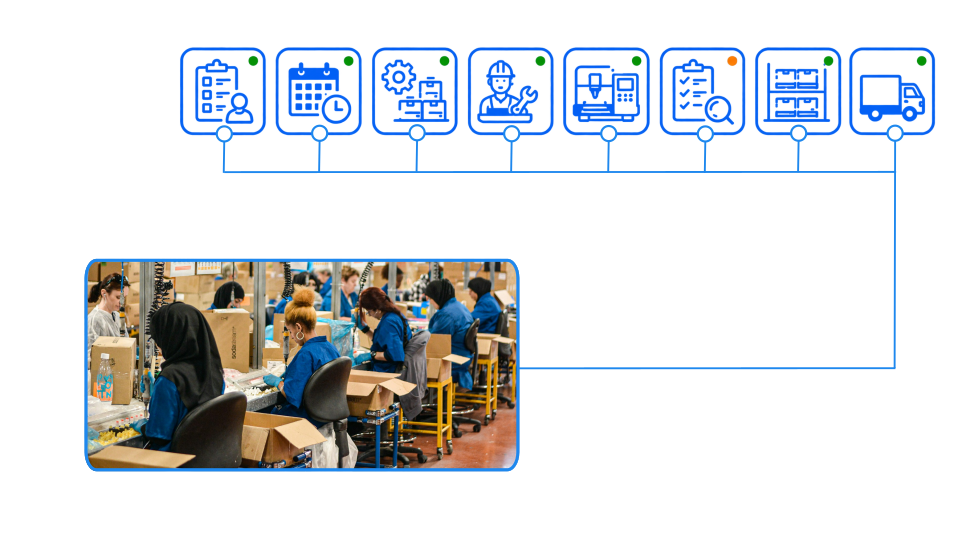
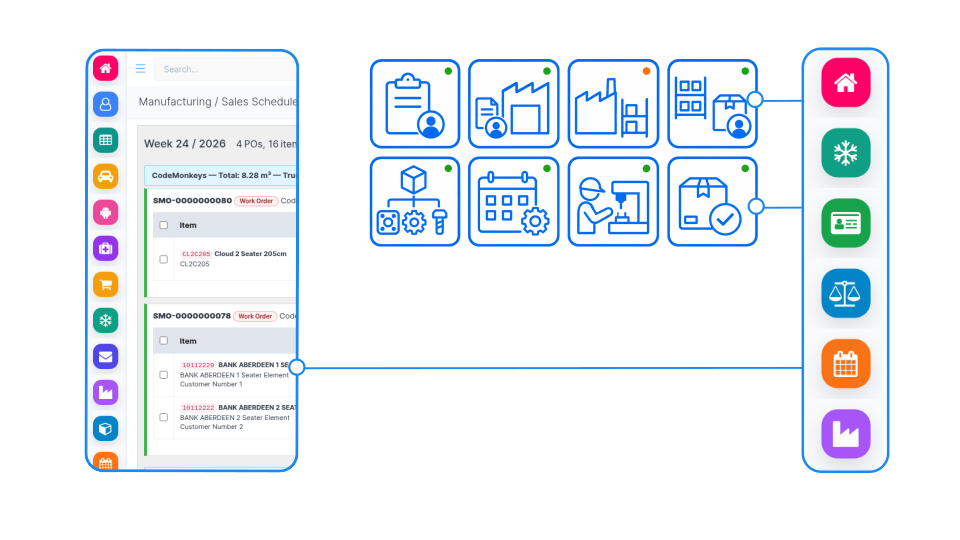
Connect every stage of manufacturing—from demand and production planning to material requirements, work orders, shop-floor execution, quality control and finished-goods inventory. SIX ManufacturingFlow keeps sales, purchasing, warehouse, production and management working from the same live information.

SIX ManufacturingFlow supports Make-to-Order (MTO) production triggered by confirmed customer demand, as well as Make-to-Stock (MTS) production based on inventory levels, forecasts and replenishment rules. Manufacturing orders can include the correct BOM, routing, materials, machines, employees, work steps and quality requirements.
For hybrid production, standard components and semi-finished goods can be produced for stock, while final assembly or customisation begins only after a customer order is received. This gives your business the speed of available inventory with the flexibility of customer-specific manufacturing.
Plan production intelligently, coordinate materials, machines and employees, control every shop-floor activity and turn completed manufacturing orders into accurate inventory, costing, delivery and business results.

Plan with Make-to-Order, Make-to-Stock or hybrid manufacturing. Produce against confirmed demand, replenish inventory or combine stocked components with customer-specific final assembly.
Check material availability, machine capacity, employee skills and work-centre workload before production begins. Identify shortages and bottlenecks early.
Organise manufacturing orders, routings, operations, setup times and dependencies in one structured schedule. Give every team a realistic production plan.
Reschedule work when machines fail, materials are delayed, priorities change or production takes longer than expected. Keep affected teams informed with current planning data.

Provide employees with the correct product specifications, BOM, routing, drawings, instructions, required materials and quality requirements in one place.
Record start and completion times, produced quantities, machine activity and work-order status directly from the shop floor. Management sees progress in real time.
Capture inspections, measurements, rejected quantities, material waste and rework requirements at the point of production. Prevent incomplete or non-conforming products from moving forward.
Connect materials, batches, serial numbers, employees, machines and quality records with every manufactured product. Preserve a complete production history from input to finished output.

Move approved production quantities into the correct warehouse or storage location. Update available stock as soon as manufacturing is completed.
Compare planned costs with the real consumption of materials, labour, machine time, waste and additional expenses. Understand the true cost and margin of every product.
Update raw-material and component stock from actual consumption. Create replenishment or purchasing requirements when inventory reaches defined levels.
Connect completed manufacturing orders with customer orders, picking, delivery, costing and invoicing. Eliminate manual handovers between production, warehouse, sales and finance.

A detailed comparison A detailed comparison of six ERP platforms—and why SIX ERP earns the top-of-breed position for companies that want one connected, managed, and

Managing ERP Transformation with Confidence Many companies begin with spreadsheets. This is normal. A spreadsheet is quick, familiar, and easy to change. It can track

How SIX SalesFlow Turns Demand into Revenue A successful sale does not begin with an order and end with an invoice. It begins when a

Managing Finance with SIX FinanceFlow Financial management is not limited to issuing invoices or checking a bank balance. It is the process of understanding where

Successful manufacturing depends on more than machines—it requires demand, materials, people and production steps to work as one connected process. Learn how SIX ManufacturingFlow brings production modes, BOMs, routings, warehouse operations, picklists and shop-floor execution together to improve control, traceability and performance at every scale.
SIX ManufacturingFlow supports Make-to-Order (MTO), Make-to-Stock (MTS) and hybrid manufacturing. Companies can produce against confirmed customer orders, replenish inventory according to demand or combine stocked components with customer-specific final assembly.
The system checks material availability, machine capacity, employee resources, work-centre workload and operation dependencies before production begins. Shortages, bottlenecks and scheduling conflicts can be identified early, while affected manufacturing orders can be rescheduled when conditions change.
Yes. Employees can access work orders, BOMs, routings, instructions and quality requirements while recording working time, machine activity, produced quantities, waste, rejected items and production progress. Management receives a current view of every active manufacturing order.
Approved products can be received into inventory, consumed materials are deducted and actual production costs are calculated. The completed order can then continue into warehousing, delivery and invoicing, while batch, serial, employee, machine and quality records remain available for complete traceability.