


TL;DR - Key Takeaways
A quick overview for busy decision-makers.
Holding more stock is the most common answer to supply disruption. It’s also an expensive answer when the underlying problem is an unread supplier warning, an unapproved substitute, or a production schedule built on outdated quantities. Supply chain resilience depends on how quickly people detect, decide, and recover, not on how much inventory sits in the warehouse.
What Supply Chain Resilience Really Means
Supply chain resilience is the ability to detect disruption early, understand its operational impact, respond quickly, and recover without losing control of costs or customer commitments. Ordinary inventory management keeps stock moving efficiently under expected conditions. Resilience addresses what happens when those conditions fail.
A car with strong brakes isn’t a car that never needs them. In the same way, a resilient operation doesn’t avoid every supplier delay, material shortage, or transport interruption. Its teams have enough warning, options, and authority to protect important commitments when something goes wrong.
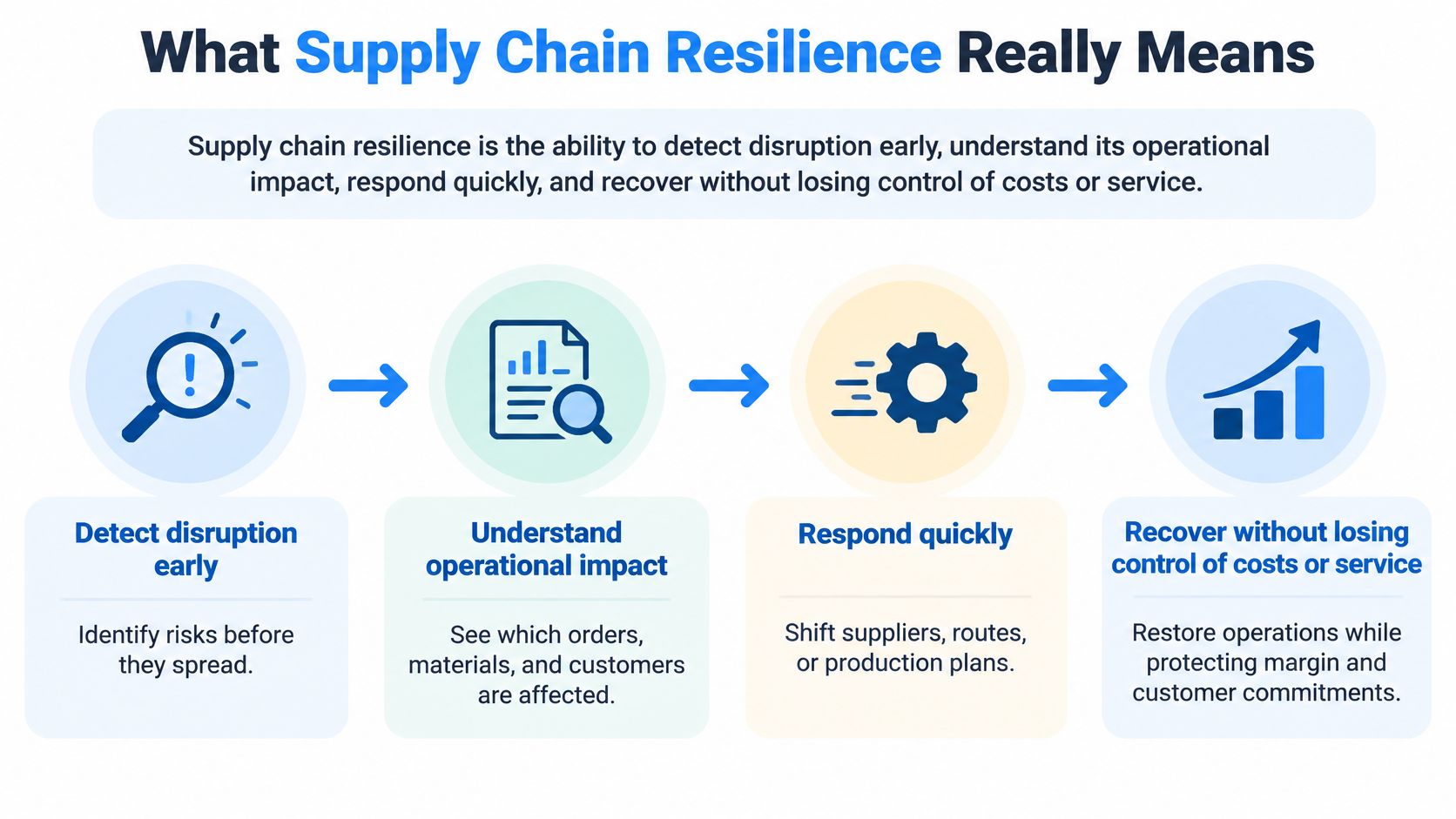
Four capabilities that work together
- Detect: Purchasing checks overdue confirmations, changing delivery dates, rejected receipts, and supplier reliability.
- Understand: Operations traces the affected material to production orders, finished products, and customer promises.
- Respond: Authorized teams activate alternatives, transfer stock, change delivery routes, or reschedule demand.
- Recover: Named owners restore dependable supply, clear exceptions, and update the records behind future decisions.
These capabilities require more than a contingency document. A backup supplier isn’t useful if its tooling hasn’t been approved. Safety stock won’t protect an order if another team has already reserved it.
International sourcing isn’t automatically the opposite of resilience, either. The WTO’s analysis of trade and economic resilience explains that trade gives businesses options to change suppliers when established domestic or foreign relationships are interrupted.
Resilience is an operating discipline, supported by connected information, qualified supply options, realistic stock policies, and tested procedures. A software module can support that discipline, but it can’t replace supplier relationships or accountable decisions.
Why Spreadsheets and Siloed Records Create Risk
Spreadsheets can calculate stock well. Separate copies lose the link between physical stock, reservations, expected receipts, and promised deliveries, making it harder to see what is available. A purchasing record may show stock that sales has already reserved, while a delayed supplier update sits outside both records.
Consider a hypothetical seal shortage. Purchasing sees 40 units in a spreadsheet, then sales reserves 35. A supplier’s email announcing a week’s delay remains unread in a shared inbox. Each team has a partial view, so the business may promise stock it cannot supply on time.
Test whether your records support decisions
- Version control: Can purchasing and sales see the same current quantities without exchanging files?
- Movement accuracy: Are receipts, consumption, transfers, and rejected goods recorded when they happen?
- Order coverage: Can you connect an inbound delivery to the customer commitment it supports?
- Supplier readiness: Are lead times, minimum order quantities, quality status, and approved alternatives recorded centrally?
Separate records create practical gaps. If warehouse movements are recorded later, displayed stock can appear available when it is not. If purchase orders sit apart from demand, teams may struggle to distinguish spare stock from material already needed elsewhere. These delays weaken resilience because teams lose time establishing the current position before they can decide how to respond.
Supplier knowledge can be just as fragmented. A buyer may know which alternative supplier could help, but that option is difficult to use if the relevant details exist only in personal notes.
SIX StockFlow provides guided warehouse operations, stock visibility, and end-to-end traceability. That shared view can help teams understand what is available, reserved, moving, or ready to ship.
Practical test: Choose a critical component and trace its stock, open receipts, reservations, and customer commitments without asking someone to reconcile separate files.
A move from Excel to ERP should address record ownership and update timing as well as transferring information. Connected, current records help teams detect a disruption sooner and decide whether to reroute supply or adjust the production plan. Software can make the relevant information easier to access, but people still need to set priorities and choose the response.
Find the Dependencies That Can Stop Production
Start with the bill of materials, or BOMA Bill of Materials (BOM) lists the materials and components, and their quantities, needed to make a product., which lists the components needed to make a product. Look for shared parts across finished products. A low-cost gasket can deserve more attention than an expensive assembly if its absence stops several product lines.
Then ask purchasing which items have only one qualified supplier, long replenishment times, or no approved substitute. Count usable options, not names in a vendor directory. A supplier without quality approvalAn approval is a formal decision that allows a request or action to proceed. An ERP system can route approvals and record who made each decision. or available capacity isn’t an operational backup.
Dependency types to map and what to track
| Dependency | Warning sign | Metric to track |
|---|---|---|
| Single-source item | Only one qualified supplier on the approved list | Number of qualified sources per item |
| Long lead time | Replenishment takes longer than the customer delivery window | Lead time in days compared with promised delivery time |
| Limited substitutes | No approved alternative part or material | Count of approved substitutes |
| Supplier concentration | One supplier provides most of a material’s volume | Share of volume by supplier |
| Transport dependency | Inbound freight depends on one carrier or route | Share of inbound volume by route |
| Production-stopping component | A missing part halts a line or order type | Production orders affected per week of shortage |
The OECD’s supply-chain concentration findings show that the number of products sourced from a limited range of suppliers was 50% higher in the early 2020s than in the late 1990s. A large overall vendor list can therefore conceal narrow sourcing options for individual materials.
Trace the exposure beyond the direct supplier
Record supplier sites, not just company names. Ask critical suppliers where their essential inputs originate and which routes they use. Separate suppliers may depend on the same upstream factory, port, or raw-material processor.
For a hypothetical comparison, a rubber gasket used across four product lines, sourced from one region with a 21-day lead time, ranks above a cheaper fastener available from three qualified suppliers. The ranking reflects lost production and limited recovery options, not purchase price alone.
SIX PurchaseFlow connects purchase requests, supplier offers, approvals, purchase orders, and incoming deliveries. That shared purchasing record helps teams distinguish what’s required, ordered, expected, and received.
The output should be a ranked critical-item register. Give each item an owner, record missing information explicitly, and prioritize qualification work by production impact and customer exposure. Unknown capacity or an unverified lead time should remain a visible planning gap, not become a reassuring assumption.
Simulate Disruptions and Measure Their Impact
A useful stress test changes a defined assumption and shows which commitments become infeasible. It shouldn’t change live inventory records or overwrite purchasing dates.
Controlled what-if testing in the inventory workflow lets teams delay receipts, reduce confirmed quantities, block suppliers or items, extend lead times, or model a complete interruption. Keep the baseline intact so people can compare responses against the same starting position.
Run a controlled test
- Select the scope. Choose an item, supplier, or order group. Confirm that stock, reservations, open receipts, and demand dates are current.
- Set the disruption. Define its size and duration. In a hypothetical test, move a confirmed receipt ten days later while leaving other assumptions unchanged.
- Review the consequences. Check projected inventory, customer and production reservations, safety-stock breaches, affected orders, delivery commitments, alternative locations, and expected shortage dates.
SIX ManufacturingFlow connects manufacturing orders, materials, BOMs, resources, quality checks, and production progress. Connected purchasing and manufacturing information gives the test its operational meaning: which work needs the missing component, when it needs it, and how much response time remains.
Common what-if scenarios and the decision each informs
| Scenario | What the model changes | Decision it informs |
|---|---|---|
| Delayed receipt | Moves an expected receipt later by a set number of days | Whether to expedite, reschedule demand, or source elsewhere |
| Reduced confirmed quantity | Lowers the quantity a supplier has confirmed | Whether to split orders or add a second source |
| Blocked supplier or item | Removes a supplier or item from available supply | Which approved alternatives can cover the gap |
| Longer lead time | Increases replenishment time for an item | Whether safety stock needs to rise |
| Demand spike | Raises customer or production demand for a period | Which orders to prioritize or reschedule |
| Complete supply interruption | Removes all supply of an item for a set period | Which customer and production commitments are at risk |
Run likely scenarios before severe ones. Then compare alternative sourcing, split orders, transfers, selective buffers, and rescheduling. A transfer only helps if the sending warehouse can release the material without creating a more serious shortage.
Separate material coverage from business recovery
A positive projected balance doesn’t prove production can proceed. Check inspection time, material release, transport, machine availability, and labor before accepting the revised plan.
Finance should compare additional purchasing and freight costs, cash tied up in stock, and customer commitments at risk. Avoid counting an order’s full revenue as a certain loss when a partial delivery or revised date remains possible.
Simulations don't predict every disruption. They reveal dependencies, compare possible responses, and prepare decisions before an actual interruption.
Record assumptions beside results. Otherwise, a scenario built on unconfirmed supplier capacity can look more dependable than it is.
Add Alternative Suppliers Without Overspending
An alternative source creates value only when the team can use it in time. Qualification, capacity, commercial terms, and transport arrangements matter as much as a supplier’s quoted delivery date.
The OECD’s analysis of policies for resilient global value chains finds that concentrated sourcing makes foreign supply shocks more damaging, while diversification can substantially protect domestic production. Its simulations find only small additional benefits from partial onshoring, which cautions against treating proximity alone as protection.
Match the option to the constraint
- Second approved supplier: Record price, minimum order quantity, delivery terms, lead time, quality status, and available capacity.
- Approved substitute: Obtain engineering or quality approval and record compatibility before allowing use.
- Split purchasing: Confirm allocation, order minimums, and capacity with both sources.
- Alternative warehouse or stock transfer: Check releasable stock, existing reservations, handling requirements, and transit time.
- Different delivery route: Confirm carrier capacity, collection arrangements, transit time, and additional cost.
A disciplined process from business need to supplier delivery keeps these checks connected to approvals and receipts. Don’t wait for a crisis to discover that the substitute needs testing.
Worked example of one supplier versus two
These figures are illustrative, not a verified customer case. Assume a critical component costs EUR 10.00 from the primary supplier and has a 21-day lead time. A second approved supplier charges EUR 10.80, about 8% more, and can deliver within eight days.
| Measure | Two Suppliers |
|---|---|
| Unit price | Primary EUR 10.00; second supplier EUR 10.80; blended EUR 10.32 |
| Lead time | Primary 21 days; second supplier eight days |
| Share of 1,000 units ordered from the second supplier | 40% |
| Supplier concentration for the component | 60% with the primary supplier |
| Estimated time to recovery after a primary delay | Eight days for the requirement covered by confirmed backup capacity, versus an assumed 21-day primary recovery |
Buying 40% of 1,000 units at an extra EUR 0.80 adds EUR 320. In this scenario, estimated recovery falls from 21 to eight days for the affected requirement only if the backup’s confirmed quantity covers it. The arrangement protects production and customer orders within that capacity, not unlimited demand.
Compare that premium with the cost of stopped production or missed commitments. The cheapest unit price can still produce the most expensive operating outcome.
Buffers remain another option. A 2025 study using company data reports median recovery times of 22 days for firms using strategic buffering, compared with 58.5 days for firms using just-in-time practices. That comparison isn’t a guaranteed result: set buffers by demand uncertainty, lead-time uncertainty, and criticality rather than increasing every item’s stock.
Track the KPIs That Show Recovery Speed
Make Time to Recovery, or TTR, the primary resilience KPIA KPI (Key Performance Indicator) measures progress towards a business goal. An ERP system can calculate KPIs from business records and show changes in performance over time.. Define it as the time needed to restore material availability after a confirmed supplier delay or interruption.
Use a consistent restoration rule. An expected receipt isn’t restored availability if the material still needs inspection or release. For a partial recovery, record which requirement is covered and which remains exposed.
Resilience KPIs and how to calculate them
| KPI | What it measures | How to calculate it |
|---|---|---|
| Time to Recovery (primary) | Days needed to restore material availability after a disruption | Date availability restored minus date disruption confirmed, lower is better |
| Shortage exposure | Demand or value at risk from projected shortages | Quantity or value of short demand divided by total open demand, lower is better |
| Supplier concentration | Share of a critical material from its largest supplier | Largest supplier volume divided by total volume for the item, lower is better |
| Safety-stock coverage | Days of demand that stock on hand can cover | Available stock divided by average daily demand, higher is better up to a set target |
| On-time fulfilment | Share of affected orders delivered on time | Orders delivered on time divided by affected orders, higher is better |
| Alternative activation time | Days needed to confirm a backup source | Confirmation date minus disruption date, lower is better |
Keep units consistent when calculating shortage exposure. Don’t add unrelated component quantities together; calculate by item or use a consistent value basis. Alongside the ratio, show the actual quantity and value at risk and the days of production or customer demand exposed.
The coverage measure also needs care. Available stock divided by daily demand measures usable stock coverage, not just the designated safety-stock buffer. Exclude blocked quantities and define how reservations affect availability.
Build a baseline that people can trust
For each event, capture the confirmation date, first warning date, alternative-source confirmation, and restoration date. TTR connects response and recovery, while the warning timestamp shows whether detection is improving. Keep actual event results separate from simulated estimates.
Supplier quality and delivery reliability feed this review. Rejected material can create the same operational shortage as a late truck, so measure usable receipts rather than arrival alone.
Compare similar events before claiming improvement. Lower TTR, less exposed demand, and faster backup activation are useful signals, but a milder interruption can also improve the numbers.
Measurement rule: A KPI shows direction. It doesn't prove that a disruption was prevented.
Turn Simulations into Tested Recovery Plans
A scenario result becomes useful when someone has authority to act on it. Without named owners and approval limits, teams can spend their remaining response time debating who should decide.
Build the recovery workflow around a projected shortage date, the commitments at risk, and the last practical date for taking action. The response deadline may arrive well before stock runs out.
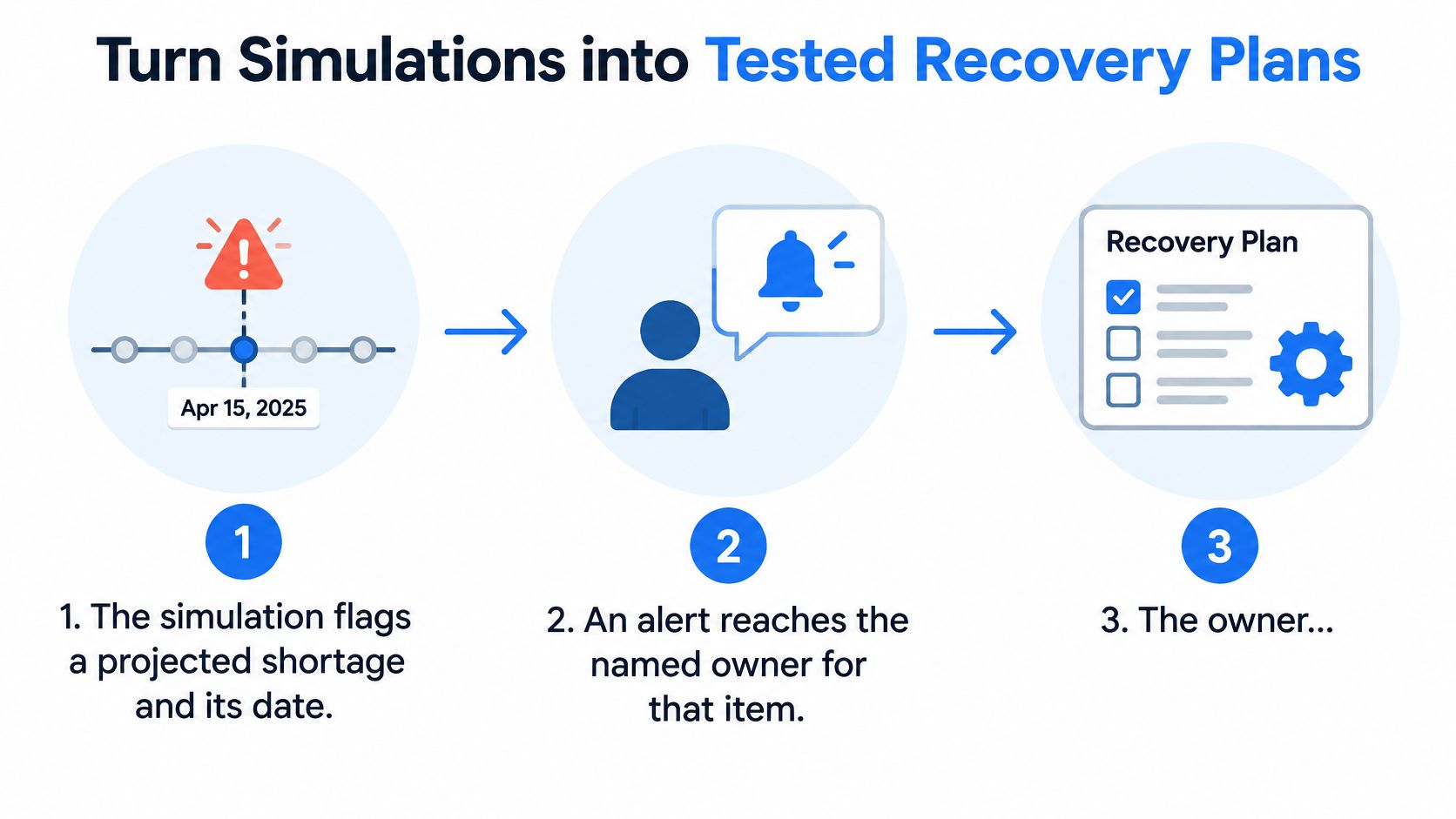
Give each handoff a clear owner
- The simulation flags a projected shortage and its date. Save the assumptions and affected orders with the result.
- An alert reaches the named owner for that item. Assign a deputy so absence doesn’t stop the response.
- The owner compares the options against cost and timing limits. Purchasing confirms supply feasibility rather than relying on a historical quotation.
- The approver signs off within policy authority limits. Escalate spending or service changes outside those limits.
- Purchasing, production, and sales execute and log the actions. Update orders and dates so warehouse and finance teams receive the revised position.
- The team reviews the outcome. Correct lead times, capacity assumptions, supplier records, or stock policies where the event exposes a weakness.
Purchasing contacts suppliers and confirms quantities. Operations reschedule production and checks capacity. Sales informs affected customers using approved delivery information, while finance checks extra spending against thresholds agreed in advance.
Set escalation rules before the emergency
Each business should define its own warning horizon and spending limits. Escalate when a shortage falls inside that horizon without confirmed cover, when a backup misses its confirmation deadline, or when the response threatens another important commitment.
Document the trigger, decision, approver, action, and outcome. Include rejected options and their reasons when they explain a major cost or service decision. This creates a usable audit trailAn audit trail records who created, changed or approved information and when. In an ERP system, it helps trace transactions, investigate errors and support audits. and supports later recovery-time measurement.
I recommend testing a scenario each quarter, not merely reviewing the document. Ask the named people to carry out the handoffs, obtain a supplier confirmation, and demonstrate where they record approval. A plan that depends on an unavailable person or inaccessible file needs repair before an actual interruption.
How SIX ERP Supports Resilience
Enterprise resource planningAn ERP system connects a company’s core processes—such as sales, finance, inventory, manufacturing, and service—in one place so teams can work with shared information., or ERPAn ERP system connects a company’s core processes—such as sales, finance, inventory, manufacturing, and service—in one place so teams can work with shared information., connects business processes through shared records. For resilience, the useful measure is how quickly teams detect a disruption, decide on a response, and recover. That depends on connected information about customer demand, stock, purchasing, production, delivery, and financial impact, not on how much inventory a business holds.
Inventory records show available, reserved, and expected quantities by item and warehouse. Purchasing and production workflows connect those figures to requirements and orders, helping teams trace where a shortage could affect manufacturing commitments. The value depends on accurate records: outdated balances or lead times can distort a response.
Connect operational responses to financial control
SIX FinanceFlow supports financial records, billing, and controls. Those records help finance and management assess the cost of expedited supply, split purchases, or additional buffers before approving a response.
A connected workflow should help teams answer related questions from the same underlying transactions:
- Warehouse: What can we release, and what is blocked or reserved?
- Purchasing: Which confirmed receipt covers the requirement?
- Production: Which orders can proceed with released materials and available resources?
- Sales: Which delivery promises need review?
- Finance: What will the response cost, and who can approve it?
Role-based dashboards, alerts, and operational reports help teams identify exceptions and trace them to underlying records. Set shortage alerts around named responsibilities. Broad mailing lists can leave ownership unclear.
Implementation still requires operational choices
Clean item identifiers, units of measure, supplier lead times, warehouse balances, and bills of materials before relying on scenario results. Reconcile open orders and reservations during migration, then assign responsibility for keeping records current. Poor data can make a connected system produce a coordinated but mistaken response.
Software records the evidence for these decisions. Supplier dependability, substitute acceptance, and customer priority remain management decisions. An ERP can make the relevant information easier to find, but people still need to judge the trade-offs and act on it.
Start With Your Most Exposed Items
A large stock balance does not prove resilience. Begin with a focused list of materials that could stop production or put customer commitments at risk. Use ABC inventory analysis to rank inventory value, then add production criticality and customer exposure so a low-cost bottleneck is not overlooked.
- Rank your top ten to twenty items by production impact and customer exposure.
- Count usable options. Flag single qualified sources, lead times beyond customer delivery windows, and missing substitutes.
- Test the highest-ranked item. Delay its receipt and identify which production and customer orders would be affected first.
- Qualify an alternative. Record its price, minimum order quantity, lead time, capacity, and quality status.
- Assign accountability. Give each of the top three items an owner and an escalation threshold.
For each item, specify what change would trigger a new decision: a missed supplier confirmation, a lead time that exceeds the delivery window, or stock falling below the amount needed for open orders. This turns a ranked list into an operating tool.
Re-rank quarterly, and sooner if one of those thresholds is crossed or demand and supplier performance change. Track how quickly the team identifies the exposure, assigns an owner, and agrees on a response. The first ranking is a baseline; the review cadence keeps it useful.
SIX ERP can connect purchasing, inventory, manufacturing, sales, and financial workflows to support coordinated decisions. Review your most exposed items with a SIX expert and discuss the records, approvals, and alternative supply options your team needs.