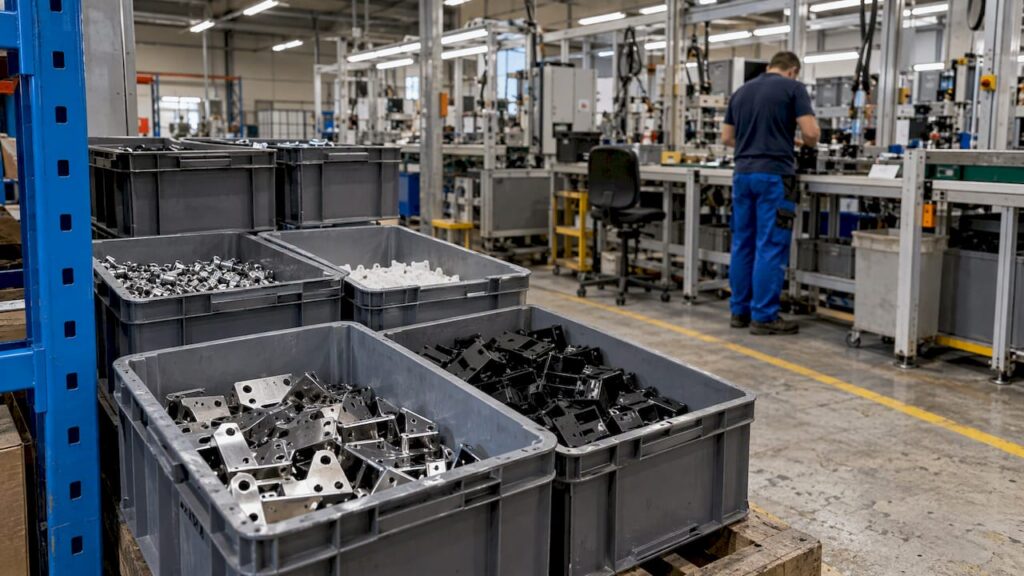


CapEx, or capital expenditure, is money a business invests in a long-lived asset such as machinery, a building, a vehicle, or qualifying software, recorded on the balance sheet and released to profit gradually through depreciation.
That definition takes ten seconds and settles almost nothing. The question that decides whether an approved investment shows up in your books as the asset you signed off isn’t “what is capex”. It’s where you draw the line against a repair, what you include in the installed cost, which date starts depreciation, and whether the asset record still matches the ledger two years later. Those four points are where capital money leaks, and none of them is really an accounting problem. They’re process problems.
What Is CapEx and Why It Stays on the Balance Sheet
The short definition: CapEx, short for capital expenditure, is money a business spends to acquire, build, replace, or materially improve a long-lived asset that will support operations beyond the current year.
The rule underneath is matching. A cutting system, a warehouse extension, a delivery van: each one hands you benefit across several years, so the accounts spread the cost across those years instead of dropping the whole amount into a single month of profit. The U.S. Bureau of Economic Analysis describes capital expenditure as spending to acquire, add to, or improve property, plant, and equipment rather than an ordinary operating expense, and its definition of PP&E runs from land and buildings through machinery, equipment, special tools and construction in progress to certain exploration and development costs (BEA glossary).
One line of arithmetic shows why the treatment matters.
A EUR 240,000 cutting system is a EUR 240,000 cash outflow in the year you buy it. Against profit, it's about EUR 30,000 a year for eight years.
Cash and profit part company in the purchase year. That gap is why a profitable company can run short of money during a heavy investment year, and it’s why controllers track capital spending on a separate line from operating results.
Why the cost sits on the balance sheet instead of the income statement
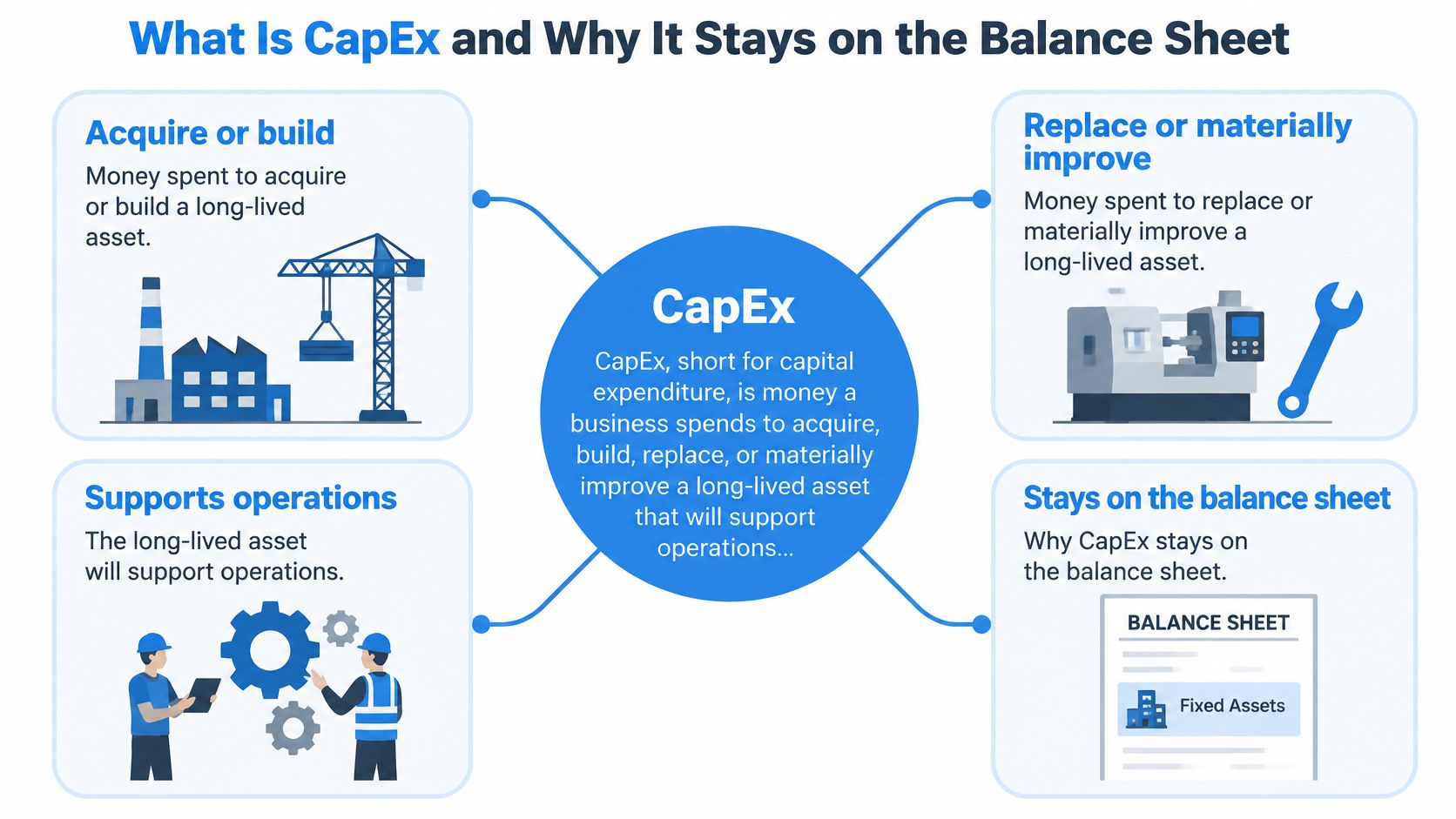
The asset stays on the balance sheet because the benefit hasn’t been consumed yet. Each year, depreciation moves a slice of the cost out of the asset balance and into the income statement, so the expense tracks the capacity the machine delivered that year.
The category is broader than many assume:
- Land and land improvements, including site works and drainage
- Buildings and structures, from offices to production halls
- Machinery, equipment and special tooling
- Vehicles and mobile plant
- Furniture and fixtures
- Construction in progress, before the asset is even finished
- Qualifying software and technology infrastructure
What it isn’t matters just as much: wages, rent, energy, insurance, consumables and routine repairs are operating costs, and no amount of re-labelling turns them into capital.
One detail trips up analysts. Capex is normally measured gross, so money you receive from selling the machine being replaced isn’t netted off the figure, and changes in PP&E caused by mergers, acquisitions, divestitures or accounting-method switches are excluded. The number reflects investment, not corporate activity.
None of this is a niche category. The World Bank gross fixed capital formation series, the economy-wide version of the same idea, reported 25.89% of world GDP in 2023. Every capital decision carries the same tension: cash today, capacity for years.
CapEx vs OpEx and Where the Line Falls
CapEx and OpEx compared on the criteria finance teams use
| Point of comparison | CapEx | OpEx |
|---|---|---|
| Where it appears | Balance sheet as a fixed asset | Income statement in the period incurred |
| When it reduces profit | Gradually through depreciation over the useful life | Immediately, in the month it is incurred |
| Cash flow statement line | Investing activities | Operating activities |
| Typical examples | Machinery, vehicles, buildings, warehouse automationAutomation uses software or equipment to carry out tasks according to defined rules. An ERP system can automate routine business steps and highlight exceptions for review., qualifying software | Rent, wages, energy, consumables, routine maintenance, subscriptions |
| Useful life | More than one year | Consumed within the period |
| Effect on EBITDA | Depreciation is added back, so EBITDA is largely unaffected in the purchase year | Reduces EBITDA directly |
| Tax treatment | Recovered over time through depreciation rules | Deducted in the year incurred |
| Decision owner | CFO or investment committee with a business case and capital budget | Department manager within the operating budget |
| ApprovalAn approval is a formal decision that allows a request or action to proceed. An ERP system can route approvals and record who made each decision. basis | Total installed cost, payback and expected return | Budget line and standard purchase policy |
Most cases settle themselves once you scan that table. The awkward ones need a rule, and the rule is about function, not price. A cost is generally capitalized when it acquires an asset, extends its useful life, increases capacity, or materially improves performance, while routine repairs and day-to-day operating costs are expensed, as SAP’s capital expenditure overview puts it.
Three questions that settle the boundary
- Does it create an asset that didn’t exist before?
- Does it extend the useful life of an asset you already own?
- Does it raise capacity or materially improve performance?
A yes to any of those makes the spend a capitalization candidate. If the work only returns the machine to the condition it was in before it broke, it’s a repair. Say a plant buys a CNC machining center for EUR 180,000: that’s capex. The EUR 4,000 annual service contract is opex, and so is a EUR 1,200 spindle repair that restores normal working order.
When one invoice covers both
Mixed projects are where classification arguments start. Picture a hypothetical EUR 300,000 line refurbishment on a single invoice: part of it replaces worn conveyor sections, part of it adds a second packing station that raises throughput. Split the cost according to what each element does, and document the split before the invoice arrives. Reconstructing the reasoning three months later, from memory, in front of an auditor, is a losing position.
Growth CapEx, Maintenance CapEx, and What Bulgarian and EU Lenders Evaluate
Growth capital expenditure expands production capacity, introduces new technologies, or creates opportunities for additional revenue. Maintenance CapEx, by contrast, represents investments needed to preserve existing operating capacity, such as replacing worn-out machinery or major equipment components. Routine repairs and servicing generally remain operating expenses (OpEx) rather than capital expenditure.
For Bulgarian manufacturers seeking financing from commercial banks or EU-supported investment programs, this distinction matters. Lenders typically evaluate growth investments against expected demand, projected cash flow, return on investment, and the company’s ability to service debt. Maintenance investments are often less discretionary because postponing them can lead to production interruptions, higher operating costs, or safety risks.
Separating growth and maintenance CapEx in the investment budget helps financial institutions and management understand which expenditures support expansion and which are necessary to sustain existing operations.
Under IAS 16, the applicable Bulgarian National Accounting Standards (НСС), and the company’s documented capitalization policy, an expenditure must meet the relevant asset recognition criteria before it can be capitalized. For Bulgarian corporate income tax purposes, the treatment must also be assessed under the Corporate Income Tax Act (ЗКПО), including its rules for tax-depreciable assets.
Capitalization decisions affect reported profit, depreciation, EBITDA, asset values, and cash flow reporting. Qualifying cash purchases of property, plant, and equipment are generally classified as investing activities under IAS 7, while the resulting depreciation expense is recognized over the asset’s useful life.
For Bulgarian companies, the practical priority is to maintain a clear investment policy, separate growth from maintenance spending, and reconcile accounting depreciation with the tax depreciation rules under ЗКПО. This provides lenders, auditors, and management with a more reliable picture of investment needs, cash requirements, and long-term financial sustainability.
Common CapEx Examples and What Gets Capitalized in the EU and Bulgaria
Capital expenditure covers investments in long-term assets that support business operations over several years. For companies operating in Bulgaria and the European Union, the distinction between capital expenditure (CapEx) and operating expenditure (OpEx) depends on the applicable accounting standards, the nature of the asset, and national tax legislation.
Bulgarian companies generally apply either the Bulgarian National Accounting Standards (НСС) or International Financial Reporting Standards (IFRS), depending on their statutory reporting obligations.
Common examples of capital expenditure include:
Production machinery. CNC machining centers, automated cutting systems, industrial presses, packaging lines, and other equipment used in manufacturing. Purchase costs and directly attributable installation expenses are generally capitalized.
Tooling and molds. Production molds, dies, specialized tools, and other equipment with a useful life extending beyond one accounting period. Whether individual tools qualify as fixed assets depends on their characteristics, expected use, and the company’s capitalization policy.
Warehouse automation. Storage systems, industrial racking, conveyors, automated sorting equipment, forklifts, and warehouse robotics. These investments may be capitalized when they satisfy the applicable asset recognition criteria.
Vehicles and trailers. Purchased delivery vehicles, trucks, trailers, and other transport equipment generally qualify as tangible fixed assets. Under IFRS 16, most qualifying leases create a right-of-use asset and corresponding lease liability. Companies applying Bulgarian National Accounting Standards must follow the applicable national lease accounting rules.
Buildings and facility improvements. Production halls, warehouse extensions, electrical infrastructure, ventilation systems, and significant building improvements. Costs that extend an asset’s useful life, increase capacity, or improve performance may qualify for capitalization, while routine repairs are generally expensed.
IT hardware and infrastructure. Computers, network equipment, data infrastructure, industrial terminals, barcode devices, and other technology assets used over several accounting periods.
Qualifying software and ERPAn ERP system connects a company’s core processes—such as sales, finance, inventory, manufacturing, and service—in one place so teams can work with shared information. implementations. Purchased software licenses, internally developed software, and certain directly attributable implementation or development costs may qualify as intangible assets under IAS 38 or the applicable Bulgarian accounting standards. Routine subscriptions, hosting, maintenance, employee training, and research activities are generally operating expenses. Software-as-a-Service arrangements require individual assessment because not every implementation cost creates a recognizable intangible asset.
How Bulgarian Tax Legislation Treats Capital Expenditure
Unlike the United States, where capital expenditure is governed by federal tax depreciation rules, EU member states generally maintain their own corporate income tax and tax depreciation systems. EU-adopted IFRS provide accounting requirements for companies within their scope, but they do not establish a uniform EU-wide corporate tax depreciation schedule.
In Bulgaria, the Corporate Income Tax Act (Закон за корпоративното подоходно облагане, ЗКПО) governs the tax treatment of depreciable assets.
Under Articles 48–55 of ЗКПО, qualifying assets are recorded in a tax depreciation schedule and allocated to statutory asset categories. These categories determine the maximum annual tax depreciation rates.
For example, standard maximum annual tax depreciation rates include:
| Asset category | Maximum annual tax depreciation rate |
|---|---|
| Buildings and certain infrastructure (Category I) | 4% |
| Machinery and production equipment (Category II) | 30% |
| Transport vehicles other than passenger cars (Category III) | 10% |
| Computers, peripherals, and qualifying software (Category IV) | 50% |
| Other qualifying depreciable assets (Category V) | 25% |
These are statutory maximum rates, not mandatory depreciation periods. Special provisions and exceptions may apply to particular assets.
Bulgarian companies must also distinguish between accounting depreciation and tax depreciation. Accounting depreciation reflects the asset’s useful life and the company’s applicable reporting framework. Tax depreciation follows the rules and categories established by ЗКПО.
As a result, the same production machine may have different depreciation expenses for financial reporting and corporate income tax purposes.
What Costs Can Be Included in the Asset’s Acquisition Value?
Under IAS 16 and the relevant Bulgarian accounting rules, the acquisition cost of a qualifying tangible fixed asset generally includes its purchase price and expenses directly attributable to bringing it to the location and condition necessary for its intended operation.
For example, a manufacturer purchasing a new CNC machine may capitalize the machine’s purchase price, transportation, installation, foundation work, and commissioning costs.
Employee training, general administrative expenses, routine maintenance, and operating losses incurred during the initial production period generally do not form part of the asset’s capitalized value.
VAT treatment also matters. Recoverable input VAT is generally excluded from the asset’s acquisition cost. Nonrecoverable VAT and certain import duties may form part of that cost when the relevant accounting requirements are satisfied.
For Bulgarian manufacturers, the practical lesson is straightforward: a capital investment must be evaluated twice, first under the applicable accounting standards and then under Bulgarian tax legislation.
A clearly documented capitalization policy, reliable asset register, and separate accounting and tax depreciation records help companies maintain accurate financial reporting, calculate taxable profit correctly, and demonstrate compliance during audits.
Relevant legislation and accounting standards:
Installed cost of a hypothetical CNC machining center
| Cost line | Treatment |
|---|---|
| Purchase price of CNC machining center | Capitalize |
| Freight and transit insurance | Capitalize |
| Foundation, power connection and rigging | Capitalize |
| Installation and commissioning | Capitalize |
| Calibration and safety validation | Capitalize |
| Initial spare parts kit | Inventory or capitalize according to policy |
| Operator training | Expense in the year incurred |
| First-year service contract | Expense in the year incurred |
| Total capitalized | Recorded as a fixed asset |
The principle behind those rows: every cost needed to bring the asset to its location and working condition is capitalized. Freight, transit insurance, foundation work, installation, commissioning and calibration all add to the asset. Training, service contracts and start-up losses don’t.
That’s the point worth carrying into your next budget conversation. A EUR 180,000 machine commonly becomes an asset of more than EUR 200,000 once the surrounding costs are counted. If the business case was built on the list price, the payback calculation was wrong before the order went out. Budget the installed cost.
How a CapEx Request Becomes a Recorded Asset and Where It Goes Wrong
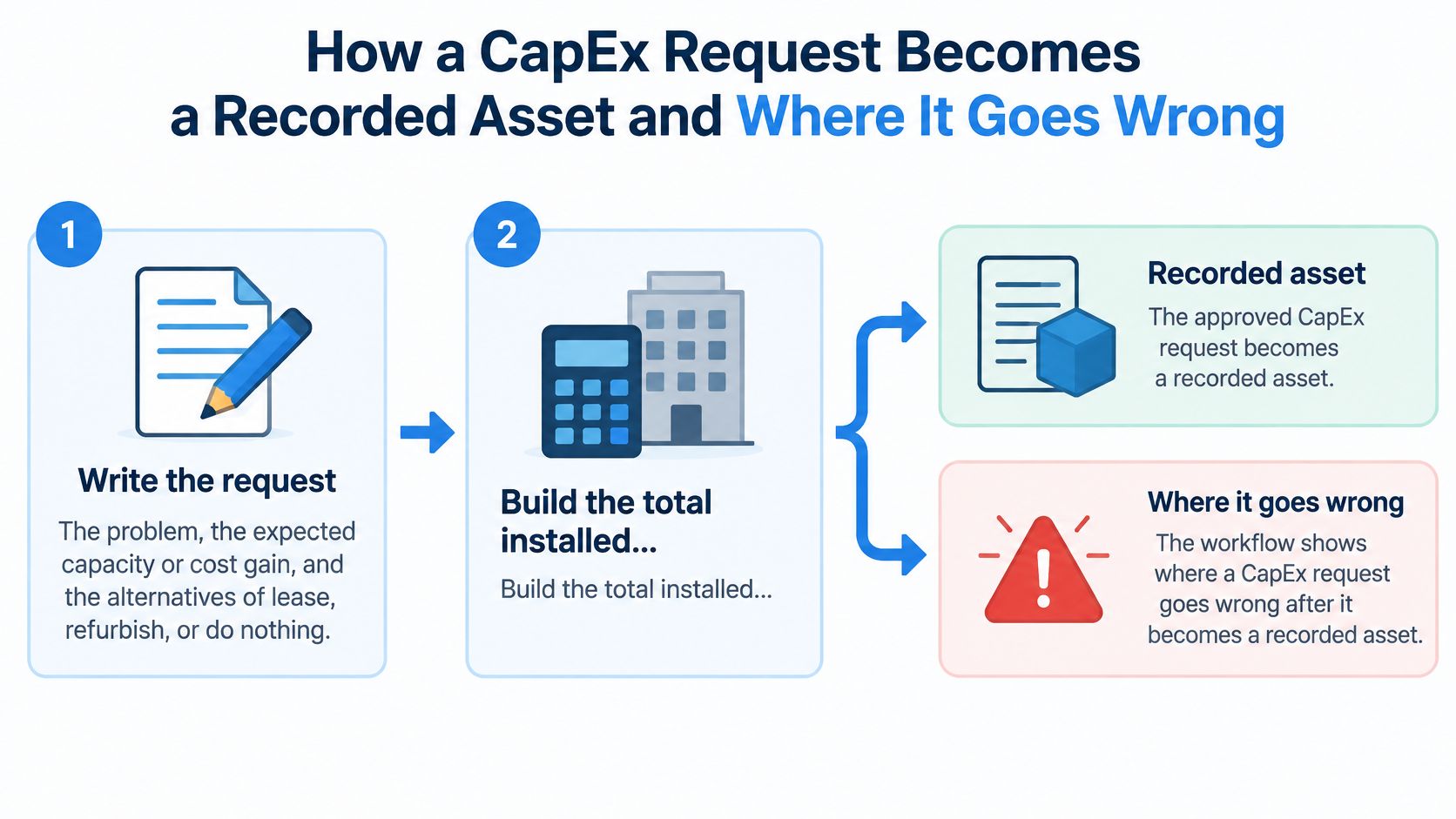
Eight steps carry an investment from a request to a depreciating asset. Each one is owned by someone different, which is exactly why context gets lost between them.
- Write the request. State the problem, the expected capacity or cost gain, and the alternatives you rejected: lease, refurbish, or do nothing.
- Build the total installed cost. Price, freight, foundation work, installation, commissioning, system integrationIntegration connects systems so they can exchange information or coordinate actions. An ERP integration helps link business tools and reduce manual transfers between them., training, spare parts, extra working capital, and the cost of removing the asset being replaced.
- Check the budget. Compare the full figure against the approved annual plan, the remaining balance, and commitments other projects have already reserved.
- Route for approval under an authority matrix. Department head to EUR 25,000, CFO to EUR 250,000, board above that, with the business case attached to the request rather than buried in an email thread.
- Raise the purchase order against the approved request, so the commitment hits the budget the day it’s issued. This is the handover the procure-to-pay process exists to control.
- Record receipt, acceptance and the commissioning date. Capitalization and depreciation start there, not when the invoice is paid.
- Register the asset with cost, category, location, useful life, residual value and depreciation method, reconciled invoice to order to receipt.
- Review the outcome six to twelve months later against the gain you promised.
Step two is where spare parts complicate things. A kit that sits in stores needs tracking without becoming a dozen tiny fixed assets, and contractor inventory control tools is a useful reference for keeping that small-value stock visible without inflating the register.
Where the money leaks
- A budget check for equipment excluding installation. Approvals get given on the supplier quote, then commissioning costs land in a different cost center with no owner.
- Repairs capitalized to protect a profit target. A hard month, a large repair, and suddenly the work is called an upgrade. It shows up later as an asset that doesn’t exist in the plant.
- An asset register that lives in a spreadsheet. It drifts from the ledger within a quarter, and nobody reconciles it until year-end close.
- A capex plan built only from new projects. No reserve is held for maintenance capex, so the first major breakdown forces an unplanned request.
The safeguards are unglamorous. Write a policy that sets the threshold, the asset categories, the standard useful lives and the repair rules. Keep one asset record tied to its purchase order and invoice. Record the commissioning date as it happens rather than reconstructing it. Reconcile the register to the ledger quarterly, while the discrepancies are still small enough to explain.
How Depreciation Spreads the Cost Over Time
What happens to a capitalized investment after the purchase order is completed and the asset enters service? Depreciation spreads the cost of a long-term asset across the periods in which it provides economic benefits. It does not represent a new cash payment, nor does it automatically reflect the asset’s current market value.
For companies operating in Bulgaria and the European Union, depreciation must be considered under two separate frameworks: financial accounting standards and national corporate tax legislation.
Bulgarian businesses prepare financial statements under either the Bulgarian National Accounting Standards (НСС) or International Financial Reporting Standards (IFRS), depending on their reporting obligations.
Under IAS 16 – Property, Plant and Equipment, depreciation systematically allocates an asset’s depreciable amount, meaning its cost less estimated residual value, over its expected useful life. IAS 16 permits a cost model or, where applicable, a revaluation model for subsequent measurement.
Companies applying Bulgarian National Accounting Standards follow the relevant provisions of СС 4 – Accounting for Depreciation (Отчитане на амортизациите) and the applicable asset accounting standards.
The principle is similar: the expense should reflect the period during which the asset contributes to the business, rather than concentrating the entire investment in the year of purchase.
A Practical Depreciation Example for a Bulgarian Manufacturer
Consider a Bulgarian furniture manufacturer investing in an automated cutting machine.
| Item | Value |
|---|---|
| Capitalized acquisition and installation cost | €202,500 |
| Estimated residual value | €22,500 |
| Expected useful life | 8 years |
| Depreciable amount | €180,000 |
| Annual straight-line accounting depreciation | €22,500 |
| Monthly accounting depreciation | €1,875 |
| Net book value after three full years | €135,000 |
The company recognizes the machine as a fixed asset and allocates €180,000 of its cost over eight years, assuming straight-line depreciation.
After three full years of depreciation, accumulated depreciation reaches €67,500, leaving a net book value of €135,000, assuming no impairment, revaluation, or subsequent adjustment.
The calculation is straightforward. The challenge is establishing the correct useful life, residual value, depreciation method, and start date.
For Bulgarian companies, an additional complication is that accounting depreciation and tax depreciation may produce different amounts for the same machine.
Why Bulgarian Companies Need Two Depreciation Schedules
Bulgaria’s Corporate Income Tax Act (ЗКПО) establishes separate rules for tax-depreciable assets.
Companies must therefore distinguish between:
Accounting depreciation, calculated according to the company’s applicable accounting standards, estimated asset life, and accounting policies.
Tax depreciation, calculated according to the statutory asset categories and depreciation rules established by ЗКПО.
For example, the cutting machine above may have an estimated accounting useful life of eight years, resulting in annual accounting depreciation of €22,500.
For tax purposes, qualifying machinery generally falls into Category II under Article 55 of ЗКПО, which permits an annual tax depreciation rate of up to 30%, subject to applicable statutory provisions.
That does not mean the company must use 30%. The rate is a statutory maximum, and the selected rate must follow the relevant tax rules.
The resulting tax depreciation can therefore differ substantially from the accounting depreciation recorded in the income statement.
These differences affect the calculation of taxable profit. Bulgarian companies generally adjust their accounting financial result by the relevant accounting and tax depreciation amounts when determining corporate income tax.
An asset may consequently have two different carrying values: one for financial accounting and another for tax purposes.
When Does Depreciation Start in Bulgaria?
The depreciation start date is particularly important because the accounting and tax rules are not identical.
Under IFRS: IAS 16 requires depreciation to begin when the asset is available for use, meaning it has reached the location and condition necessary to operate as management intended.
Under Bulgarian National Accounting Standards: SS 4 provides for depreciation to begin from the month following the month in which the depreciable asset is acquired or brought into use, as applicable.
For Bulgarian tax purposes: Article 58 of ЗКПО provides that tax depreciation begins at the start of the month in which the asset is put into operation or at the start of the following month. The commissioning date must be supported by documentation.
For assets subject to statutory commissioning procedures, the tax commencement date cannot precede the date established under the relevant legislation.
This means a machine delivered in March, installed in April, and commissioned in May may have different depreciation starting points under the applicable accounting and tax rules.
The practical requirement is to document the actual operational status of the asset, rather than relying exclusively on the supplier invoice or payment date.
Why One Machine May Have Several Depreciation Schedules
A modern production line often contains components with significantly different useful lives.
Consider an automated manufacturing system consisting of:
Structural frame: Expected useful life of 20 years
Electronic control system: Expected useful life of 8 years
Cutting spindle: Expected useful life of 5 years
Under IAS 16, significant components with different useful lives must be depreciated separately.
This becomes especially important when components are replaced. If a cutting spindle is replaced after five years, the manufacturer must account for the replacement and derecognize the carrying amount of the old component according to the applicable requirements.
Companies applying Bulgarian National Accounting Standards must follow the relevant national asset recognition and depreciation rules, which should not automatically be assumed to require identical component accounting.
For tax purposes, the company must also determine how the underlying assets and any qualifying replacements are treated under ЗКПО.
Maintaining component details, replacement dates, and associated purchase documentation helps prevent inaccurate asset values and depreciation calculations.
Tax Depreciation Rates in Bulgaria
Under Article 55 of ЗКПО, tax-depreciable assets are assigned to statutory categories with maximum annual depreciation rates.
Common examples include:
| Asset category | Maximum annual tax depreciation |
|---|---|
| Buildings and certain infrastructure | 4% |
| Machinery and production equipment | 30% |
| Transport vehicles other than passenger cars | 10% |
| Computers, peripherals, and qualifying software | 50% |
| Other qualifying depreciable assets | 25% |
These are standard maximum rates. Additional statutory categories, conditions, and exceptions may apply.
Unlike the accounting depreciation schedule, which reflects the expected economic use of an asset, the tax depreciation schedule follows Bulgaria’s statutory rules.
EU legislation does not establish one uniform depreciation schedule for corporate income tax across all member states. A company operating in Bulgaria, Germany, or France may apply similar IFRS accounting principles while facing different national tax depreciation requirements.
For Bulgarian companies operating across several EU countries, this distinction is particularly important when preparing consolidated financial statements and local corporate tax calculations.
Depreciation, Amortization, and Fully Depreciated Assets
Depreciation generally applies to tangible fixed assets such as machinery, buildings, and equipment.
Amortization generally applies to intangible assets with finite useful lives, including qualifying software licenses and capitalized development costs.
In both cases, the accounting expense reduces reported profit without requiring an additional cash payment at the time depreciation or amortization is recorded.
A machine can also remain operational after its accounting value has been fully depreciated. This does not mean the machine has no practical value or that replacing it would cost nothing.
For manufacturers, replacement decisions should therefore consider current purchasing prices, maintenance expenses, remaining operating capacity, energy consumption, and expected future performance rather than relying exclusively on net book value.
Land is generally not depreciated because it normally has an unlimited useful life, although qualifying land improvements and certain assets with limited useful lives may be depreciable.
Keeping the Fixed Asset Register Accurate
The largest depreciation errors rarely come from the calculation itself. They come from incomplete or outdated asset information.
Finance teams need accurate records of when equipment was acquired, commissioned, improved, transferred, replaced, sold, or scrapped.
For Bulgarian companies, reliable fixed asset management should maintain both accounting and tax depreciation information, including the asset category, acquisition value, useful life, residual value, depreciation rates, commissioning documentation, and disposal history.
When purchasing, asset management, and finance operate in disconnected systems, these records frequently become inconsistent.
A connected ERP environment can help maintain the supporting documents and financial information in one traceable process, while the applicable accounting and tax depreciation schedules are calculated and reconciled according to the company’s requirements.
The practical lesson: Depreciation is not simply an accounting calculation. It depends on accurate operational records, documented asset decisions, and the correct application of both accounting standards and Bulgarian tax legislation.
How to Calculate CapEx From Financial Statements
When you’re reading an annual report rather than your own ledger, the balance sheet gives you an estimate.
The CapEx formula: CapEx roughly equals ending net PP&E minus beginning net PP&E plus depreciation.
Beginning and ending net PP&E come from the balance sheet, and depreciation comes from the cash flow statement. Add the two movements together and you get a workable first estimate, then adjust.
Worked CapEx estimate from the balance sheet
| Line | Value (EUR) |
|---|---|
| Beginning net PP&E | 4,200,000 |
| Ending net PP&E | 4,850,000 |
| Depreciation for the year | 620,000 |
| Net book value of assets disposed of | 140,000 |
| Adjusted CapEx estimate | 1,410,000 |
The first pass gives EUR 1,270,000. Adding back the EUR 140,000 net book value of assets sold gives EUR 1,410,000, because disposals reduce net PP&E without being a negative investment. From there, strip out additions that arrived through acquisitions or revaluations, and watch for impairments and exchange-rate movements on foreign assets, all of which move the balance without anyone writing a cheque.
Use this method for a fast read of a published report. When you need the actual payments, read the investing section of the cash flow statement instead. The U.S. Securities and Exchange Commission notes that companies commonly calculate free cash flow by subtracting capital expenditures from operating cash flow reported under GAAP, which is why a business can post positive operating cash flow and still have very little cash left after investment (SEC guidance on non-GAAP financial measures).
That gap is the practical lesson. If you’re building a forecast, a cash flow template for UAE startups will show the squeeze months before the bank balance does. Our own guide to financial management systems covers how that reporting is structured when the numbers come from one system rather than four.
The estimate has limits worth naming. It ignores timing inside the year, it misses leased assets entirely, and it can’t see assets acquired without a cash payment.
Managing CapEx in SIX ERP and Your Next Step
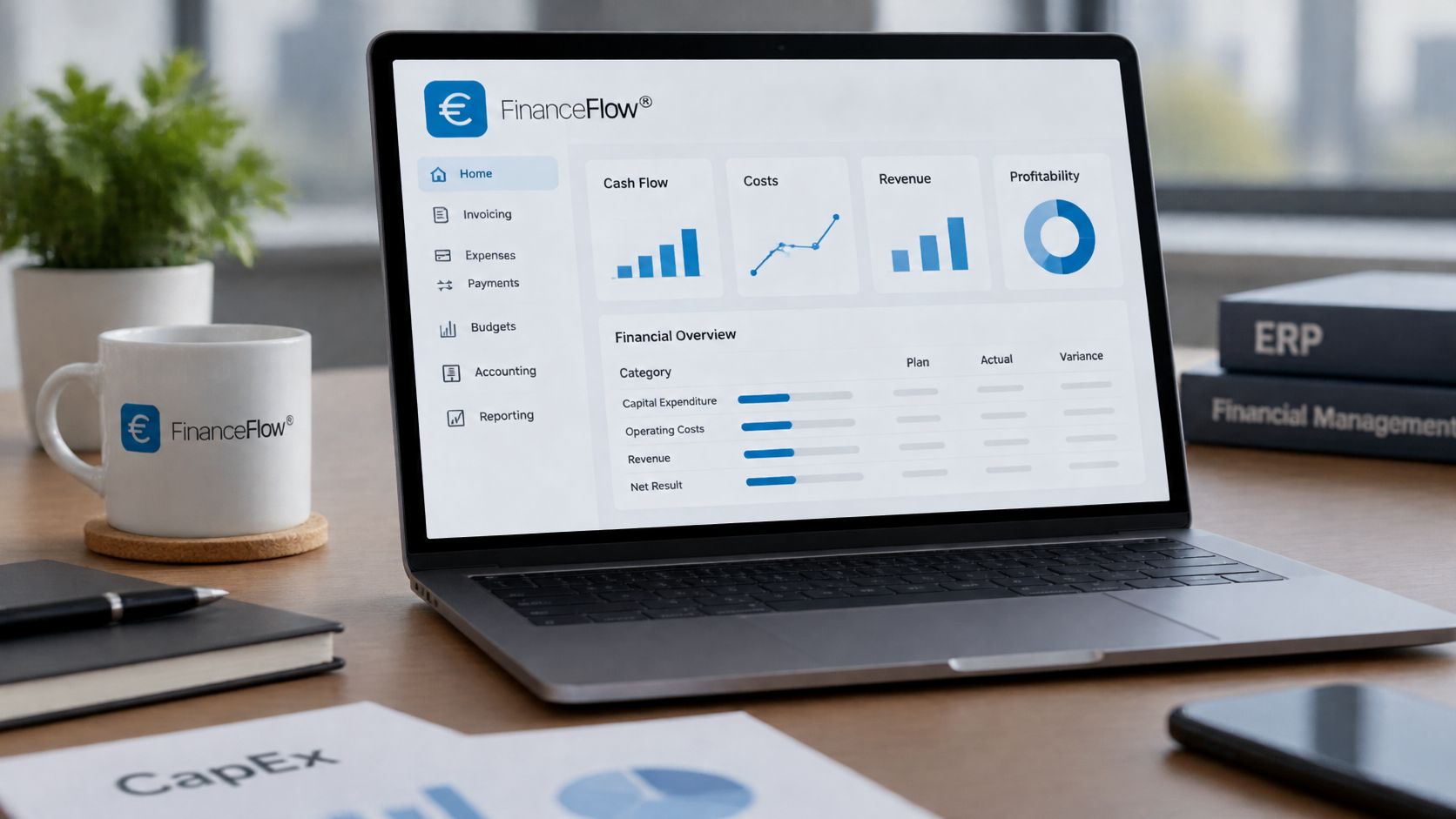
A capital project moves through a connected system the way it moves through the business. The request and approval stage runs in SIX PurchaseFlow, which provides structured requests, faster approvals and supplier transparency, with control from demand through delivery. That structure matters at the first leak point: the boundary decision, where someone decides whether the spend is capital or expense. A well-described purchase request forces that question early, while the request is still a request and not yet an invoice.
From there, the order, goods receipt and supplier invoice stay attached to the same record, so the capitalization figure is built from documents rather than retyped from a quote. This addresses the second leak point, the total installed cost. Delivery charges, installation labor and commissioning work only end up in the asset value if the documents behind them end up in the same place. Projects tracked in SIX ProjectFlow compare planned milestones, hours and costs with actual results, which surfaces budget deviations while there is still time to act. Where those costs land matters too, and cost center versus profit center reporting decides which manager has to explain the variance.
When the asset is accepted and commissioned, its cost, category, location, useful life, residual value and depreciation method go into the asset record. That commissioning date is the third leak point, because depreciation starts from it and the ledger is wrong in both directions if the date is wrong. The fourth is the asset record itself: once the paperwork scatters, the register drifts from what is sitting in the building.
SIX FinanceFlow covers financial records, billing and controls, keeping cash flow, costs and financial performance connected in one controlled process. How far the fixed asset functionality goes depends on your package and configurationConfiguration sets up software using its existing options. In an ERP system, it adapts workflows, roles and other settings to the company’s business processes., since specialized capabilities vary with business requirements.
One next step is worth more than any feature list. Take an investment from the last twelve months and trace it end to end: approval, purchase order, goods receipt, invoice, commissioning date, current book value. Note exactly where the trail breaks. That break is your first fix, and in my experience, it is usually a missing commissioning date or a register entry with no document behind it.
Where a team is replacing spreadsheets or unsure where to begin, consulting and pre-integration support is designed for that starting point. If it would help to talk it through, we’re happy to discuss capital expenditure management and financial process automation with you directly.
Capital expenditure management works when the business case, the purchase order, the commissioning date and the depreciation schedule all live on one traceable record, and that’s the flow SIX ERP is built around. If your register and your ledger tell different stories, the gap is worth investigating before the next audit does it for you. Talk through your capital expenditure process and where financial automation would remove the manual steps.