
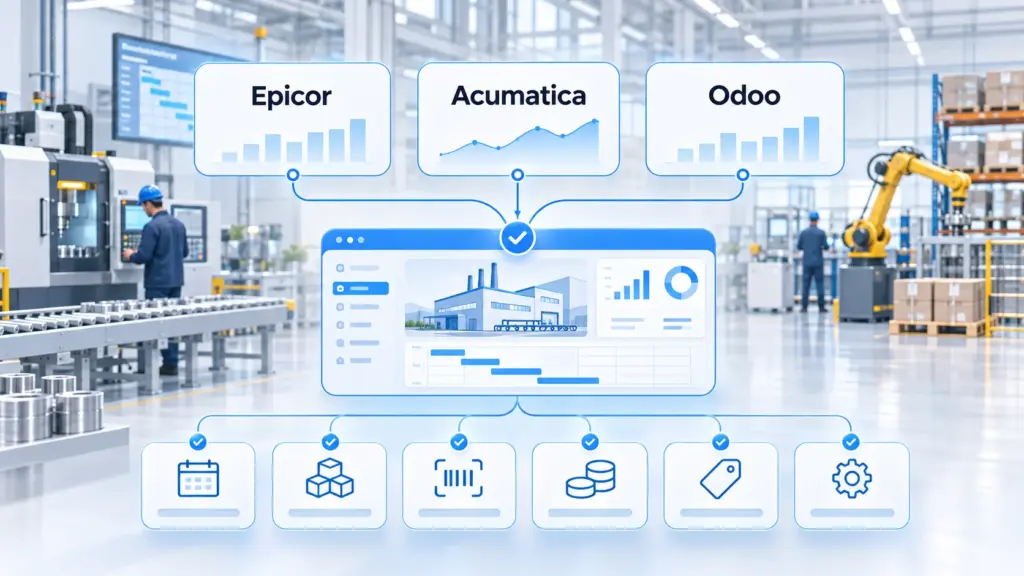
Epicor vs Acumatica is rarely a feature contest. Both can run a plant. The real question is which one fits the way your shop floor, purchasing desk and finance team already work. Add Odoo to the shortlist and the question gets sharper, because the three take different routes to the same goal.
This guide gives you a way to compare them. It doesn’t invent scorecards or price tables. Vendor claims change, and the only numbers worth trusting come from a scripted demo and a written quote.
Three Different Starting Points
Picture a purchasing lead who orders material from a spreadsheet, a planner who schedules from a whiteboard, and a controller who rebuilds costs at month end. All three want “an ERPAn ERP system connects a company’s core processes—such as sales, finance, inventory, manufacturing, and service—in one place so teams can work with shared information..” They want different things from it.
That is why the shortlist splits by origin:
- Epicor Kinetic comes from the manufacturing side. It is a manufacturing-first ERP, and an Epicor Kinetic comparison should start with production depth.
- Acumatica is a cloud ERP built around a broad business platform, with manufacturing as one edition among several.
- Odoo is a modular suite. You assemble apps, and an Acumatica vs Odoo manufacturing comparison is largely a comparison of how much assembly you are willing to own.
None of these origins is a verdict. A strong origin story isn’t proof your process fits.
Production Planning Is the First Filter
Manufacturing ERP is not accounting with a work order bolted on. It is the engine that turns demand into a schedule.
Test every candidate on the same scenarios:
- A rush order lands on a capacity-constrained line.
- A bill of materials changes after work orders are released.
- A supplier slips by a week.
- A product has dozens of variants.
Ask each vendor to run these live, with your data shape. Don’t accept slides. If a planner can’t see the consequence of a late supplier in one screen, the system will become a data-entry tool and the whiteboard will survive.
Purchasing, Inventory and Traceability
Production plans fail at the receiving dock more often than on the line.
Check how each system handles:
- Purchase requests, approvals and supplier orders.
- Reservations against open work orders.
- Batch and serial-number traceabilityTraceability follows a product or material through its history, from origin to use or delivery. An ERP system connects the records needed to investigate issues and track affected items..
- Multi-location stock.
Traceability is the item people postpone. Don’t. Retrofitting lot tracking after go-live means re-labeling stock and retraining the floor.
Costing and Finance
Costing is where an ERP earns the controller’s trust or loses it.
Ask how material, labor and overhead roll into product cost. Ask where variances show up. Ask whether the person closing the books can trace a number back to a work order without exporting to a spreadsheet.
Odoo’s modular design means finance and manufacturing are separate apps that you connect by configurationConfiguration sets up software using its existing options. In an ERP system, it adapts workflows, roles and other settings to the company's business processes.. Epicor and Acumatica package this differently. In all three cases, the test is the same: run one real job from quote to invoice and watch the cost follow it.
Pricing: Ask the Right Questions
Comparing Odoo vs Epicor on a sticker price is a trap. Pricing models differ in what they count: users, modules, transactions, or resources. Implementation, integrations and customizationCustomization changes or adds software functionality beyond standard settings. In an ERP project, it can meet specific business needs while adding development and maintenance work. sit outside most headline numbers.
Get every vendor to quote the same scope in writing:
- Number and type of users, including shop-floor and occasional users.
- Modules and sites.
- Implementation, data migration and training.
- Integrations with your accounting, e-commerce and shop-floor equipment.
- Annual support, upgrades and hosting.
Then compare five-year cost, not year-one cost. Cheap to start isn’t cheap to own.
Implementation Decides the Outcome
The software isn’t the main risk. The project is.
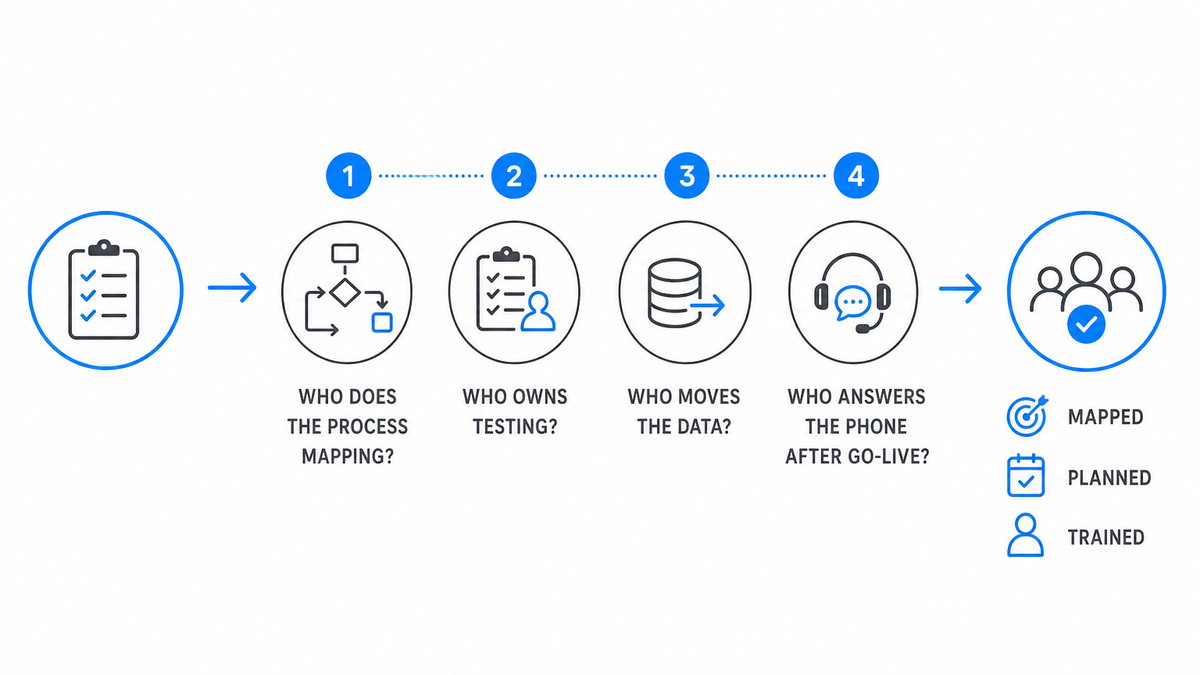
A mapped process, a clean migration plan and trained users beat any feature list. Before you sign, ask who does the process mappingProcess mapping documents the steps, people and decisions involved in business work. In an ERP project, it helps define workflows and identify improvements before system setup., who owns testing, who moves the data, and who answers the phone after go-live. Those four answers tell you more about the outcome than any demo.
Our guide on why ERP implementation is a people project first covers the sequence.
A Practical Way to Decide
Use one scorecard for all three vendors.
- Write down your ten most important processes in plain language.
- Weight them. Production planning and traceability usually outrank everything else.
- Run the same scripted demo for each vendor.
- Score what you saw, not what you were told.
- Get one written quote for identical scope.
If you need a checklist for the criteria, 10 key features SMEs should look for in a modern ERP is a good starting point.
Where SIX ERP Fits
You may find that none of the three matches how your plant actually runs. That is a legitimate result.
SIX ERP is a configurable, fully managed platform that connects sales, purchasing, inventory, manufacturing, finance and reporting in one environment. Its ManufacturingFlow module covers production planning, bills of materials, work orders, materials, capacity, shop-floor execution, quality, warehouses, traceability and costing. The approach is process-specific configuration rather than forcing your workflowA workflow defines the steps, responsibilities and decisions needed to complete work. An ERP system can guide tasks through these stages and show progress. into a generic one. See how ERP for manufacturing works in practice. Pricing is an annual license, with implementation and customization scoped separately. You might want to take a deeper look on how to compare the best ERP for Production Planning reading the extensive qualification article.
FAQ
Is Epicor or Acumatica better for manufacturing?
Neither wins in the abstract. Epicor started on the manufacturing side, and Acumatica started as a broader cloud ERP. The better fit is the one that passes your scripted scenarios for planning, purchasing, traceability and costing. Test both with your own data.
Is Odoo a serious option against Epicor?
Yes, for the right shape of company. Odoo is modular, so you add the apps you need. That flexibility helps when your needs are simple and costs you effort when they are not. In an Odoo vs Epicor decision, count the integrationIntegration connects systems so they can exchange information or coordinate actions. An ERP integration helps link business tools and reduce manual transfers between them. and configuration work, not just the license.
What should I compare besides features?
Compare implementation approach, pricing scope, integrations and post-go-live support. These decide whether the project lands on time. Features rarely do.
How long should an ERP evaluation take?
Long enough to run a real scripted demo with each vendor and collect written quotes for identical scope. Rushing the shortlist is how teams end up in a second selection two years later.
Next Step
Write your ten processes down before you talk to any vendor. If you want to see how a configurable manufacturing ERP handles them, talk to the team at SIX ERP.