

A distributor’s sales lead checks stock on Tuesday morning. The system shows 40 units of a component. Three confirmed orders already hold 30 of them, and a production run needs 25 more by Friday. Nobody in the room can say whether the free stock covers Friday’s run, so the buyer starts calling suppliers instead of planning the week.
That gap between a number and an answer is where the best ERPAn ERP system connects a company’s core processes—such as sales, finance, inventory, manufacturing, and service—in one place so teams can work with shared information. for inventory management gets decided. An Inventory Management System tracks quantities and inventory values. A Warehouse Management System (WMS) controls warehouse inventory, locations, employees, equipment and operational workflows. A Warehouse Execution System (WES) coordinates people and automated equipment while the work is being performed. Choosing badly means paying for warehouse control you’ll never use, or for stock accuracy you can’t act on. Automating a broken process just moves the error faster, and excess stock ties up cash you could release (reduce inventory costs with automation).
The sections below test platforms on what decides inventory outcomes: stock status and visibility, purchasing and replenishment, warehouse workflows inside a Distribution Center (DC) or Fulfilment Center, traceabilityTraceability follows a product or material through its history, from origin to use or delivery. An ERP system connects the records needed to investigate issues and track affected items., integrationIntegration connects systems so they can exchange information or coordinate actions. An ERP integration helps link business tools and reduce manual transfers between them., manufacturing needs, and fit by business type, including when a Micro-Fulfilment Center or a Dark Warehouse needs a Warehouse Control System (WCS). SIX ERP connects stock records to purchasing, sales and production in one platform, with each customer on a separate, managed instance.
Start With Stock Status, Not Stock Quantity
A count tells you what sits on the shelf. It doesn’t tell you what you can sell, ship or promise. Stock on hand is the physical quantity recorded as inventory. Available stock is what can still be allocated to a new requirement. Reserved stock is already assigned to a sales order, production order, service job or project, and free stock is what remains once reserved, blocked and restricted quantities come out.
Add allocation and commitment rules and the same 40 units look healthy to a warehouse manager and thin to a planner. That’s why stock status matters more than one balance. Inventory can be available, quarantined, damaged or blocked, and each status changes what the business can legally and practically do with it. Quarantine stock waiting on inspection isn’t sellable. Blocked stock can’t ship at all.
Buyers also need the inventory position, meaning stock on hand plus expected receipts, less commitments and backorders. It’s the only figure that answers a Friday production question, because it accounts for pipeline inventory still in transit and the safety stock you’ve chosen to protect. If a pick confirms before the receipt does, you get negative inventory, which is a timing defect, not a counting one.
In 2025, 85% of surveyed inventory professionals said technology improves inventory visibility, according to Cin7’s survey of 530 professionals across the United States, United Kingdom, Australia and Europe. Visibility is the floor, not the ceiling.
A demo that never shows blocked, quarantined or reserved stock is a demo of a stock ledger, not of inventory control.
Purchasing and Replenishment Must Reflect the Real Cost of Stock
For an item worth EUR 100, holding it for a year can cost about EUR 25 at the carrying-cost rate in the U.S. Government Accountability Office’s inventory methodology. Replenishment is an economic decision: balance holding, ordering and shortage costs.
- Carrying cost includes storage, capital, insurance, handling and damage risk.
- Ordering cost includes raising purchase orders, freight administration, receiving and inspection.
- Shortage cost includes commercial losses when stock is unavailable. The GAO methodology notes that a stockout can mean a lost sale if the customer buys elsewhere.
A volume discount can reduce the unit price while increasing the cost of excess stock. Cutting inventory across the board can push shortages into production. Set safety stock and buffer stock by item, location and lead time so the policy reflects differences in demand and supply.
Cycle stock covers normal demand between deliveries. Anticipation stock supports a seasonal peak or known disruption. Make each a deliberate, visible policy choice. SIX ERP customers report a 60% increase in warehouse availability through reduction in stocked inventory. That result depends on setting replenishment rules at the item level, rather than applying one rule across the company.
Warehouse Workflows, Cycle Counting, and the Limits of an ERP
In a distribution centre, the ERP maintains stock records and captures the financial effect of each movement. Warehouse execution may call for other systems: a WMS manages tasks, pick sequences, locations and scan checks; a WES coordinates people and automated equipment; a WCS controls equipment such as conveyors, sorters and robots. Operations with extensive automationAutomation uses software or equipment to carry out tasks according to defined rules. An ERP system can automate routine business steps and highlight exceptions for review. may need WES or WCS capabilities alongside an ERP.
Scanning methods affect inventory accuracy. An Auburn University RFID Lab and GS1 US supply-chain study summarized by Western Computer reported average inventory accuracy of 63% with barcode/UPC processes and 95% after RFID adoption, with order accuracy reaching 99.9% in RFID-enabled processes. These figures are benchmarks, not guaranteed results. Tag coverage, reader placement, master-data quality and the ERP-to-WMS integration all affect outcomes.
Cycle counting provides a regular check between physical inventories. The GAO’s internal control guidance defines it as counting portions of inventory daily, weekly or monthly until all inventory has been counted. It measures record accuracy as accurate records divided by total records, multiplied by 100%. If the system supports only an annual count, teams have less frequent opportunities to identify and correct discrepancies.
Run this in the demo: Count ten SKUs across three locations. Confirm that the system records variances with a reason code, a recount step and a named owner.
SIX StockFlow provides guided warehouse operations and traceability from start to end. Check whether its workflows fit your receiving, putaway, reservation, picking, packing and delivery requirements, and whether the ERP’s warehouse controls are enough for your operation.
Traceability by Batch, Lot, and Serial Number
Traceability isn’t a report you write after a problem. It’s a record structure you choose before one. The FDA Food Traceability Rule identifies specific Critical Tracking Events for covered foods, including harvesting, cooling before initial packing, initial packing, shipping, receiving and transformation, each tied to required Key Data Elements. Records must link to a traceability lot code, with product description, quantity and unit of measure, source or destination location, relevant dates and the lot code assigned to the food.
The operational requirement is simpler than the regulation. For produce traceability, the USDA expects an operation to trace product one step back to its supplier and one step forward to when and to whom it was served. Washington State guidance asks for the same two directions, naming the grower or field as the prior source and documenting where product went after it left the facility.
A system that shows only current balances can do neither. You need lot, batch or serial records that preserve supplier, source location, receipt, quantity, storage location, shipment and customer. The test is a recall drill: pick one lot and time how long it takes to list every unit received, every unit still in stock and every customer who received one. If the answer means exporting three spreadsheets, your traceability lives in people’s heads.
Data Quality and Implementation Discipline Decide the Outcome
Inventory systems depend on reliable records and consistent use. Poor data can undermine automated recommendations, while a system that staff do not use cannot keep stock records current.
PwC’s 2025 Digital Trends in Operations Survey found that 57% of respondents had partially or fully integrated AI into operations. The survey also identified integration with existing systems as a top-three challenge for 42% of respondents, and data availability or quality as a challenge for 37%. Separately, Capgemini’s 2025 supply-chain research found that 74% of organizations struggle to ensure data accuracy where AI agents make decisions.
For inventory, check the records behind each recommendation: item details, units of measure, supplier lead times, lot data and locations. Ask how the system handles gaps. Does it flag exceptions and require approvalAn approval is a formal decision that allows a request or action to proceed. An ERP system can route approvals and record who made each decision., or proceed using incomplete information?
Adoption also takes planning. A 2026 synthesis of 147 peer-reviewed publications covering research from January 2020 through January 2026 found that ERP adoption and implementation in small and medium-sized enterprises accounted for 8% of the reviewed studies. It cites a 2022 survey of 163 organizations in which top-management support was the strongest reported predictor of adoption success, with a standardized coefficient of β = 0.78 at p < 0.001. User training followed at β = 0.71.
Budget for workflowA workflow defines the steps, responsibilities and decisions needed to complete work. An ERP system can guide tasks through these stages and show progress. mapping, role-based training and post-go-live support alongside the license. Without trained users and clear processes, stock records can remain as unreliable as the spreadsheets the system replaced.
When Lean Inventory Is the Wrong Goal
A supplier delay can turn a carefully reduced stock level into a missed delivery. Lower stock is a tradeoff, not a target. For some items, carrying a buffer protects service levels when supply is uncertain.
McKinsey’s supply chain risk survey reported that 45% of companies facing tariff impacts were increasing inventories, 39% were pursuing dual sourcing, and only 19% said they had deployed AI tools at scale despite widespread piloting. Together, those figures show companies using working capital to manage supply risk while planning tools remain basic.
Can the ERP model different policies by SKU, location, supplier risk, shelf life, service level and disruption scenario? A dairy producer needs stock aging, expiry control and strict rotation. A furniture maker may rationally hold anticipation stock for long-lead fabric. A wholesaler needs distinct ways to identify and account for slow-moving lines, excess stock, obsolete stock and dead stock.
Shrinkage needs separate attention. Damage, theft, mispicks and unrecorded movements can all produce a mismatch between recorded and actual quantities. If the system cannot distinguish the causes, teams may address the easiest problem rather than the largest one.
Choose an ERP that makes intentional excess visible, costed and governed by explicit risk rules, rather than hiding it in a global safety-stock setting.
Fit by Business Type
The same feature list scores differently depending on what you sell.
- Wholesale and distribution: landed cost, drop-ship, multi-warehouse transfers, fast order-to-cash. Test consolidated availability across sites, because order promising depends on it.
- Manufacturing: bills of materials, work orders, raw materials, components and WIP posting to the ledger. Accuracy inside the plant matters more than pick-path optimization.
- Food and dairy: lot traceability, expiry, quality holds and recall reporting. If these are add-ons, the project gets expensive quickly.
- Field service and spare parts: van stock, consignment, consumables used on a job, and spare parts reserved against a work order.
- Retail and omnichannel: real-time channel visibility. In 2025, approximately 55% of surveyed fashion and retail organizations said their systems could effectively provide real-time inventory visibility, per Rizing’s retail technology survey. Dataintelo’s ERP-for-retailers market estimate put inventory management at 30.0% of that market in 2025, which shows where buyers put their budget.
Finished goods in a retail context behave nothing like finished goods in a make-to-order plant. Same label, different control.
SIX ManufacturingFlow
A component shortage can begin before a work order reaches the warehouse floor. If the order is released before materials arrive, production planning and purchasing need a shared view of demand, availability, and timing.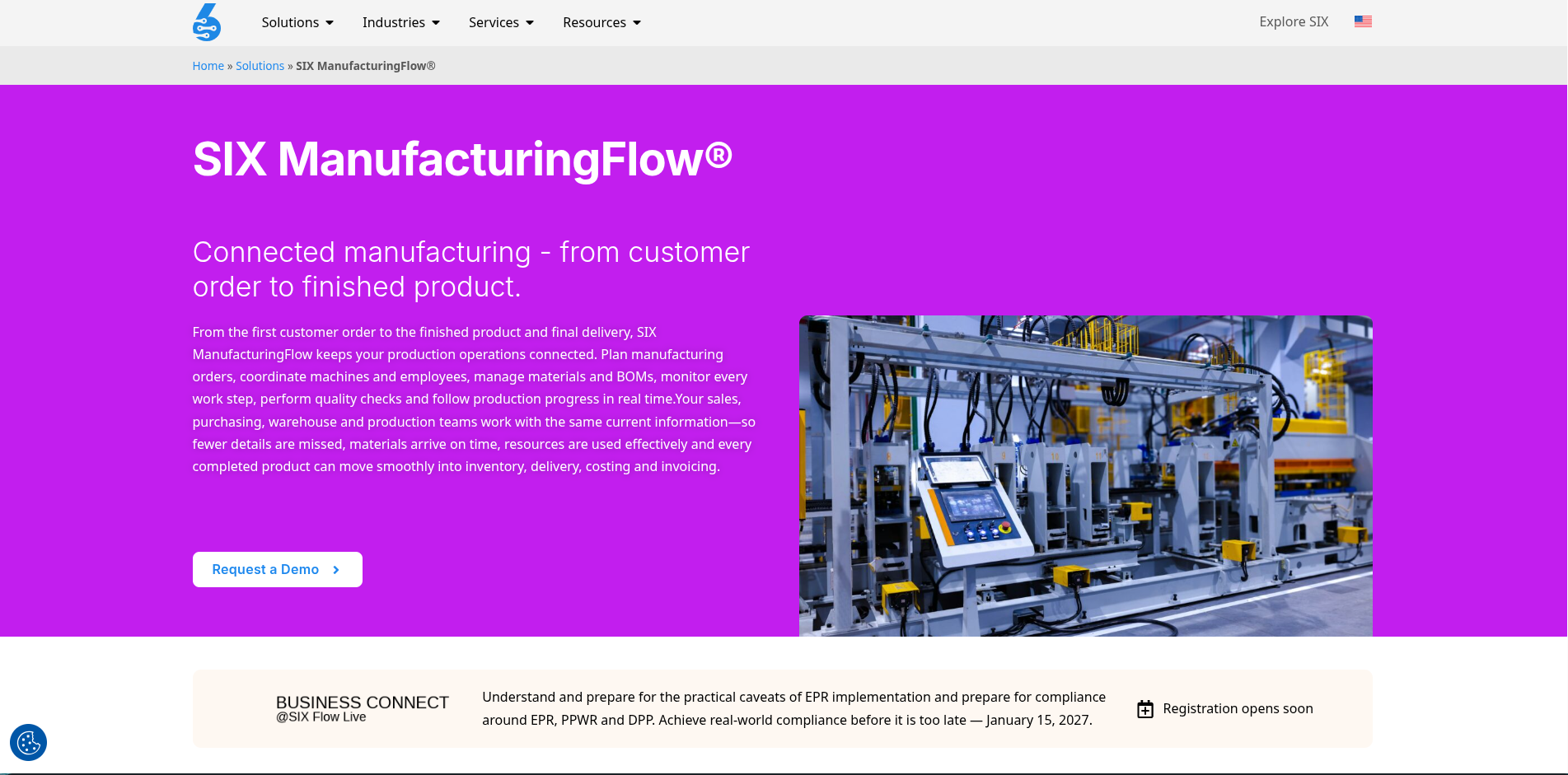
Materials, bills of materials, and the stock they consume
SIX ManufacturingFlow connects materials and capacity to manufacturing orders, helping track work from customer demand to finished goods. Its bill of materials (BOMA Bill of Materials (BOM) lists the materials and components, and their quantities, needed to make a product.) specifies the components and raw materials required for a product. Recording material issues against an order makes work in progress visible in the system; recording completion moves the finished item into inventory with its costs and quality checks.
For a dairy producer, batch records can connect a lot to its inputs. For a sofa maker, fabric, foam, and frames can be allocated to the relevant work order. In both cases, the value depends on accurate records of material use and production steps.
Where the record stays connected
When a work order follows a sales order, planning and purchasing can use its material demand to identify shortages before production is held up. Sales, warehouse, and production teams work from shared information about availability. The flow can connect the completed product with inventory, delivery, costing, and invoicing, reducing the need to re-enter the same details.
For a practical explanation of planning and execution, see how manufacturing processes work in ERP systems.
The limits worth naming
ManufacturingFlow handles planning and production workflows. It does not replace a warehouse execution system (WES) or warehouse control system (WCS). Plants using conveyors, automated storage, or other warehouse automation need to assess how the ERP will integrate with those systems. A distribution-only business may not need manufacturing functionality, while a company focused on pick speed should assess warehouse tools against that specific need.
What changes in practice
SIX ERP customers report a 5x increase in data visibility through integrated manufacturing planning. That visibility depends on connecting planning data with current stock and production records. Unreliable receiving or incomplete material records can still leave teams working from inaccurate information.
How ERP platforms differ for inventory management
ERP inventory capabilities should be compared by the work they support, not by feature counts. Stock visibility, traceability, warehouse workflows, integrations, and manufacturing requirements expose meaningful differences between platforms.
| Platform or approach | Stock visibility | Traceability | Warehouse workflows | Manufacturing needs |
|---|---|---|---|---|
| SIX ManufacturingFlow | Connects materials and capacity so teams can plan orders from customer demand through finished goods | Supports planning with connected materials and capacity; confirm any specific batch, lot, or serial tracking requirements during evaluation | Coordinates materials and purchasing with inventory and delivery operations | Connects materials and capacity to keep manufacturing orders moving |
| ERP with a separate WMS | Depends on how the ERP and WMS exchange stock records | Depends on tracking features and data shared between systems | The WMS can handle warehouse tasks that exceed the ERP’s workflow needs | Manufacturing planning remains in the ERP; test how material availability is shared with the WMS |
Pick the Inventory ERP Your Operations Can Support
The best ERP for inventory management is the one that keeps stock status, purchasing, warehouse work and traceability in a single current record your teams trust. Everything else is a feature list you can negotiate over later.
Use this checklist before you shortlist:
- Map your stock statuses. List every state an item can be in, from available to quarantined to blocked, and confirm the system models each one.
- Test reservations and free stock. Create a sales order and a production order against the same stock, then watch which number moves.
- Walk through receiving and picking. Not a vendor script. Your own paperwork, your own partial receipts, your own exceptions.
- Define traceability needs. Lot, batch, serial, expiry, and how fast you can answer a recall question.
- List the systems you must connect. E-commerce, accounting, logistics, carrier booking, a separate WMS, a scale, anything that carries a stock number.
Software supports processes and records. Your company still owns the process design, the controls and the legal duties that apply to you, and those differ by country and product category. A recall obligation in one market is a reporting preference in another. No platform removes that responsibility.
A practical next step is to map your current inventory process, including the point where the spreadsheet takes over, and discuss it with a SIX expert. If production is part of your operation, review how SIX ManufacturingFlow connects materials, planning and finished goods before you agree on scope.
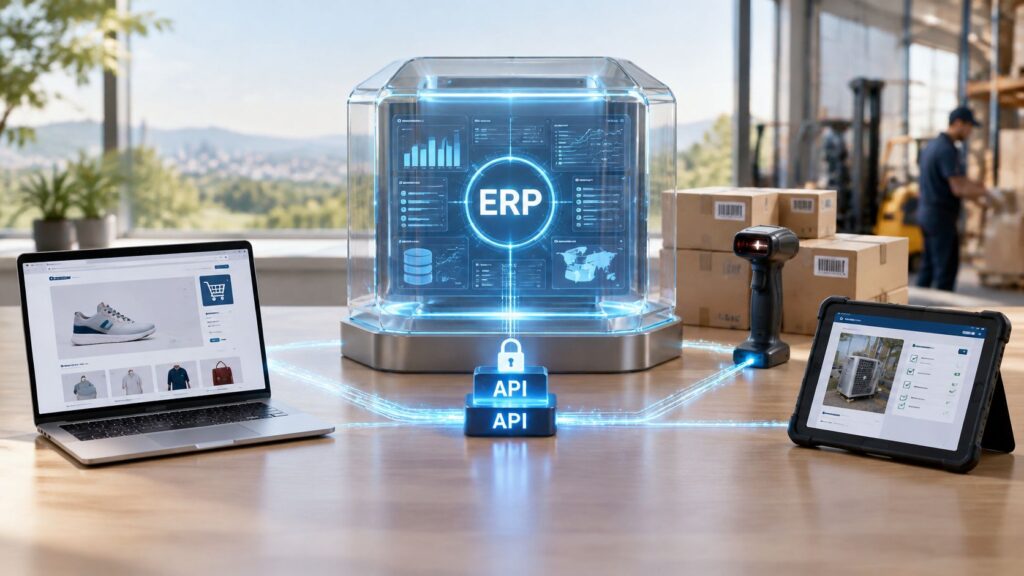
SIX ERP can connect with external e-commerce, accounting and logistics tools through integrations and APIs, and it can be provided as a managed serviceA managed service gives an external provider responsibility for agreed services, such as software maintenance and support. It helps companies plan technical work and ongoing system care.. Confirm scope, responsibilities and service levels in writing before you sign.
Connected inventory only pays off when the people buying, storing, making and selling all read the same record. SIX ERP brings stock, orders, purchasing, manufacturing, projects, service and finance into one platform, with each customer on a separate, managed instance and mobile access for the people working on the floor. If you’re weighing options for inventory management in 2026, visit SIX ERP to see how the flows fit together before you build your shortlist.