
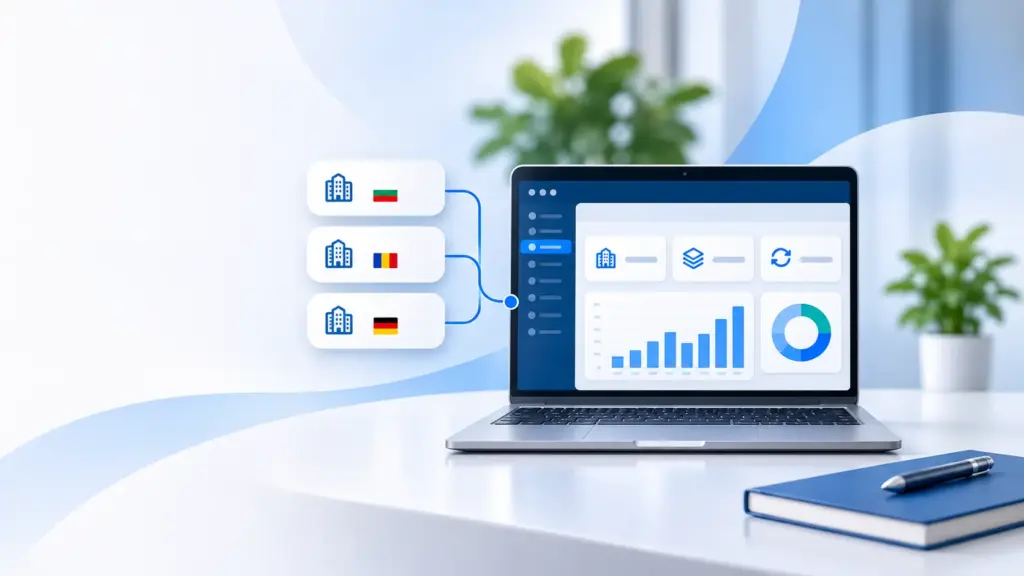
Managed ERPAn ERP system connects a company’s core processes—such as sales, finance, inventory, manufacturing, and service—in one place so teams can work with shared information. providers take over hosting, updates, backups and support for your ERP so your team can run the business instead of the servers. For a multi-entity company, the comparison that matters isn’t price per user. It is how well each provider handles consolidation, intercompany flows, permissions and local processes across companies, sites and currencies.
Here is how to compare them without getting lost in feature lists.
What Managed ERP Actually Means
A managed ERP is software plus a service. The provider runs the environment, applies updates, takes backups and supports your users after go-live.
That’s different from simply renting cloud software. With plain SaaS, you get the application. With managed ERP services, someone is also accountable for how it runs, how it changes and how it is fixed.
Most offers bundle some mix of:
- Hosting — public cloud, private cloud or an isolated environment per customer
- Implementation — process mappingProcess mapping documents the steps, people and decisions involved in business work. In an ERP project, it helps define workflows and identify improvements before system setup., configurationConfiguration sets up software using its existing options. In an ERP system, it adapts workflows, roles and other settings to the company’s business processes., data migration, testing and training
- Operations — updates, backups, monitoring and maintenance
- Support — a named team that answers when something breaks or a process changes
Outsourced ERP hosting alone covers only the first line. Don’t sign a hosting contract merely because it says “managed.” Ask what happens on the day a workflowA workflow defines the steps, responsibilities and decisions needed to complete work. An ERP system can guide tasks through these stages and show progress. needs to change.
If you want the hosting side in more depth, see how managed cloud ERP works for a growing business.
Why Multi-Entity Companies Need a Different Comparison
A single-company ERP problem is a process problem. A multi-entity ERP problem is a governance problem.
Picture it. Sales in one subsidiary books an order. Purchasing in another buys the materials. The warehouse in a third ships the goods. Finance at group level then spends the first week of the month reconciling intercompany balances in spreadsheets.
Who owns the stock? Which entity carries the margin? Why don’t the numbers match?
The software has to answer those questions by design. That means:
- Separate legal entities with their own ledgers, currencies and local rules
- Intercompany transactions that post on both sides automatically
- Group-level consolidation and reporting
- Permissions and data isolation, so each entity sees only what it should
- Shared workflows where you want standardization, local ones where you need them
A provider that is strong on hosting but weak on these points will hand you a stable system that still needs spreadsheets.
How the Main Managed ERP Providers Compare
The common shortlist for midmarket multi-entity companies includes Oracle NetSuite, Microsoft Dynamics 365 Business Central, SAP Business One, Sage X3 and Odoo. Each is usually delivered through a mix of the vendor and certified partners, so the “managed” part depends heavily on who implements and supports it.
That’s the first correction. You are rarely comparing vendors. You are comparing vendor-plus-partner combinations.
| What to compare | Why it matters for multi-entity groups |
|---|---|
| Who runs the environment | Vendor cloud, partner hosting or a dedicated private environmentA private environment is a software environment set aside for one customer. It separates that customer’s data and settings while supporting agreed access, maintenance and backup arrangements. changes control and data isolation |
| Who implements and supports | A partner model adds a second contract and a second point of failure |
| Consolidation and intercompany | Determines whether month-end closes in the system or in spreadsheets |
| Licensing model | Per-user and per-module pricing grows with every entity and every new role |
| Configuration depth | Generic workflows force workarounds when subsidiaries operate differently |
| IntegrationIntegration connects systems so they can exchange information or coordinate actions. An ERP integration helps link business tools and reduce manual transfers between them. approach | Existing accounting platforms, shops, portals and machines must keep working |
Use the table as a scoring sheet. Fill it in for each shortlisted option with the provider’s written answers, not the demo.
For a closer look at how these platforms differ, read the SIX ERP comparison with Odoo, Oracle and others.
What to Look for in an ERP Support Provider
An ERP support provider is judged after go-live, not before. Most implementation problems surface in the first months, when real transactions meet configured processes.
Check these points in writing:
- Single accountability. One team responsible for hosting, configuration and support. Split responsibility turns every incident into a debate about whose fault it is.
- Process knowledge. The support team should know how your purchasing, warehouse and finance flows were configured, not just how the software works in general.
- Change handling. New entity, new warehouse, new approvalAn approval is a formal decision that allows a request or action to proceed. An ERP system can route approvals and record who made each decision. rule. How is it requested, scoped and delivered?
- Updates and backups. Who schedules them, who tests them and how you are told.
- Data control. Where your data lives, who can access it and how it is isolated from other customers.
- Training. Not only at go-live. New hires in a subsidiary need it too.
Support isn’t a ticket queue. It is the part of the contract you will actually use for years.
Hidden Costs in Managed ERP Services
The license is the visible cost. The rest arrives later.
In multi-entity setups, the usual sources are:
- Per-user fees that rise each time a subsidiary adds staff or occasional users
- Per-module fees when one entity needs manufacturing and another needs field service
- Partner hours for every configuration change after go-live
- Integration work billed separately for each connected system
- Workarounds — the internal hours your team spends compensating for generic workflows
Total cost of ownership isn’t the year-one quote. It is year one plus every change you will need as the group grows. Ask each provider to price a realistic second year: one new entity, two new integrations, a revised approval process.
How SIX ERP Handles Multi-Entity Operations
SIX ERP is a configurable, fully managed ERP platform. It runs sales, CRM, purchasing, inventory, manufacturing, field service, projects, people and finance in one private environment.
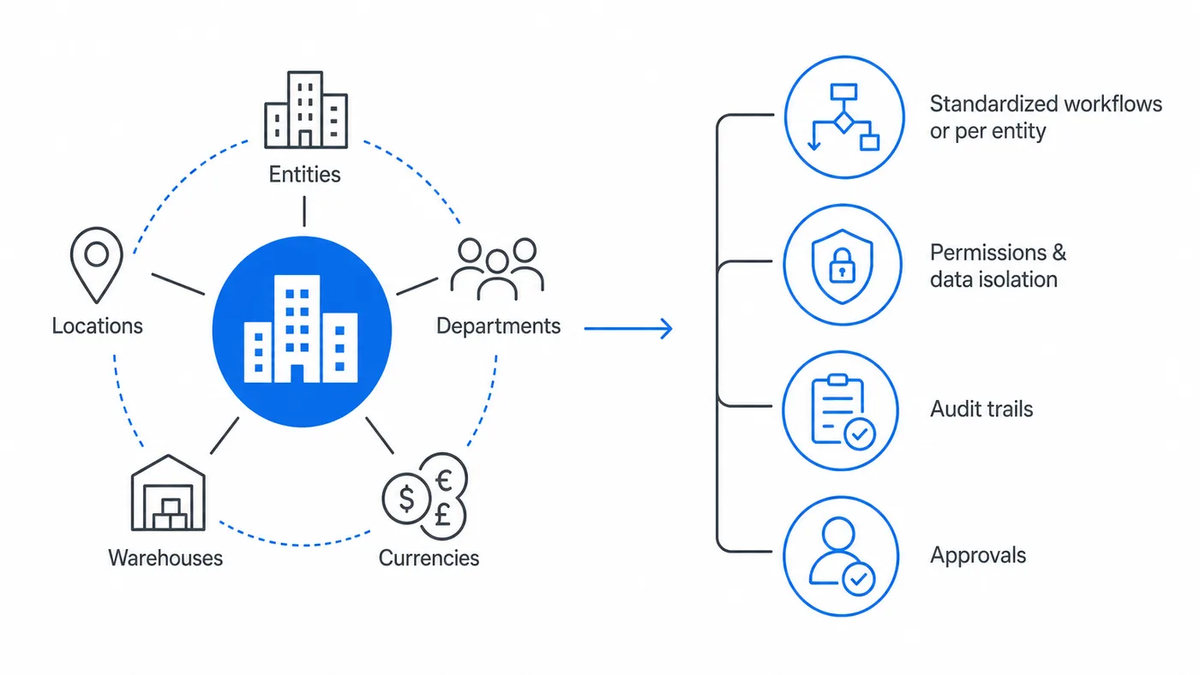
For multi-entity groups, that means you can operate several legal entities, locations, departments, warehouses and currencies in one controlled environment. Workflows can be standardized across the group or configured per entity. Permissions, data isolation, audit trails and approvals are part of the setup, not an afterthought.
The service side is one package. SIX handles consulting, process analysis, configuration, data migration, testing, training, hosting in isolated environments, updates, backups, maintenance and post-go-live support. Integrations with existing accounting platforms, online shops, supplier portals, payment services, production equipment and barcode devices are built through APIs and custom development.
Licensing is annual, with unlimited use across modules and implementation scoped separately. That keeps total cost of ownership predictable as entities and users are added.
To see how this works in practice, review the business value of SIX ERP in real operations, based on implementations in manufacturing and sales.
How to Run the Comparison
Keep the process short and evidence-based:
- Map your group. List entities, locations, currencies and the processes that differ between them.
- Write your scenarios. Three or four real flows that cross entities, such as an order sold by one company and fulfilled by another.
- Ask for a scripted demo. Each provider runs your scenarios, not their standard tour.
- Price two years. Include the changes you already expect.
- Check the support model. Who answers, how fast and with what knowledge of your setup.
A spreadsheet can establish the ranking. Only the scenarios will tell you which system closes the month without one.
Next Step
If your group is closing the month in spreadsheets, the problem isn’t effort. It is the system. Talk to the SIX ERP team at six.ms and walk through your own multi-entity scenarios.