
TL;DR - Smarter Workforce Management, Stronger Manufacturing
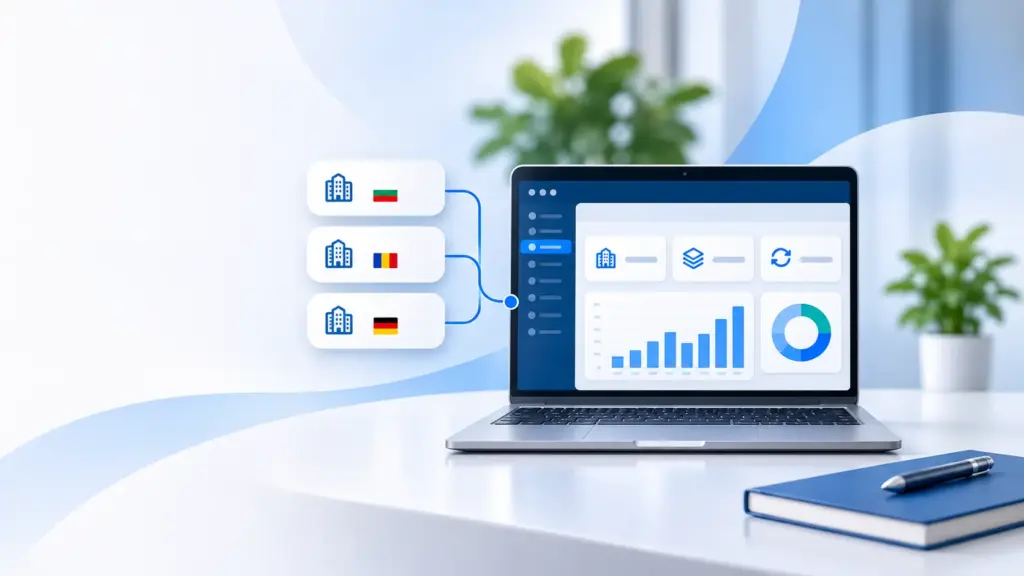
Connect your people, skills, and production processes to improve workforce planning, reduce delays, and keep manufacturing operations running efficiently.
The CNC machine shows as available on the capacity board, so the planner releases the job. Two hours later the problem surfaces. The only operator qualified on that control is on leave, and the second name on the skills list had his authorization lapse three weeks ago.
The schedule was never wrong about the machine. It was wrong about the people.
That gap is why HR software for manufacturing companies gets judged on a harsher standard than general HR software. Shift patterns, machine authorizations, certification expiry, contractor access and working-time records all belong in the same system as the production plan. When they don’t, planners build schedules that look achievable and fail at the work center. A present employee isn’t automatically a qualified one, and an idle machine isn’t capacity until someone authorized can run it.
The commercial side of a shortlist is well covered in this guide to choosing an HR system in 2026. What follows is the operational side: what the software must do when the shop floor is the customer, and where one integrated option fits against that test.
SIX PeopleFlow
SIX PeopleFlow connects employee records, working time, attendance, leave, skills, performance and everyday HR processes in one system. In a factory, the interesting part isn’t the HR screens. It’s that the same employee record can feed production planning, so a planner sees availability and qualification without exporting a spreadsheet.
Manufacturing headcount is not an office headcount
The U.S. Bureau of Labor Statistics counts roughly 12.6 million manufacturing employees in the United States, including about 1.07 million team assemblers, 383,000 inspectors, testers, sorters, samplers and weighers, 241,000 machinists and 117,000 production helpers, according to the BLS manufacturing industry page. Those roles differ in qualifications, shift patterns, safety exposure, certifications and work location.
A system that stores a job title, a home address and a bank account has nothing useful to say about any of that. Manufacturing HR management is an operational control layer, not a filing cabinet.
Where general HR tools stall at the factory door
Most HR platforms were designed for salaried staff on fixed hours. A 2024 survey of more than 300 U.S. manufacturing HR leaders found many organizations still run employee management on paper, spreadsheets and email, and fewer than 1 in 10 use AI-driven technology for employee-experience processes, per the UKG 2024 Manufacturing Talent Trends report. That’s the starting line.
The first win isn’t artificial intelligence. It’s replacing fragmented workflows with one employee, skills, attendance and organizational data model that payroll, production and safety can all trust.
The three capabilities that belong on every shortlist
If you’re comparing five vendors, score these three first and ignore the rest of the demo until they pass.
- Shift and time capture that handles rotation. You need attendance, overtime, absence and rotating-shift records that supervisors can correct from a shop-floor terminal or phone, with an audit trailAn audit trail records who created, changed or approved information and when. In an ERP system, it helps trace transactions, investigate errors and support audits. of who changed what.
- A skills matrix tied to machines. The system has to answer which employee is qualified for which work center, under which certification, and when that qualification expires.
- IntegrationIntegration connects systems so they can exchange information or coordinate actions. An ERP integration helps link business tools and reduce manual transfers between them. with production planning and payroll. HR data has to reach the scheduling board and the payroll run, or the HR team becomes a manual interface between two systems.
Practical rule: If a supervisor can't see certification status on the same screen as the work order, the skills matrix will be abandoned within a month.
Everything else, from performance reviews to onboarding portals, is a secondary conversation.
Rotating shifts, contractors and multilingual crews
Factories rarely run clean three-shift patterns. People swap, cover for absences, move between work centers and pick up overtime. Contractors and temporary workers arrive with different employers, different training histories and different access rights.
Language adds another layer. A crew that reads instructions in three languages needs a system where labels, alerts and confirmations are understood by the person standing at the machine, not just the HR administrator at a desk.
Generic tools handle leave requests and employee files. They rarely model the case where a worker is present, trained and willing, but not authorized for this machine on this shift. That case is the one that stops production.
Why a present employee is not a qualified employee
Training records and skills records are not the same thing. Training records say somebody attended. Skills records say somebody is allowed to perform a task, and until when.
The gap is wide. The 2026 Global Manufacturing Report found that 60% of workers had received no skills training in the previous six months, while 72% of manufacturers reported difficulty finding skilled talent. A factory can be simultaneously short of skills and short of training evidence.
A working skills matrix records the qualification, the work center it applies to, the assessment method, the date it was verified and the expiry. It also records what happens when it lapses: reassignment, retraining, or a documented exception approved by quality.
Knowing who is at work matters. Knowing who is qualified and available to perform the work matters more.
Safety training and machine authorization evidence
Safety is where HR records and production risk meet. OSHA reported 9,034 severe injury reports from federally covered employers in 2024, about 25 per day, and manufacturing was among the sectors with the highest annual averages for inpatient hospitalizations and amputations, with 3,213 severe injury reports and a reported rate of 25.8 incidents per 100,000 full-time-equivalent workers, according to its 2024 annual report on severe injury reports.
Training governance is often weaker than people assume. Deloitte’s 2025 smart manufacturing survey found only 48% of respondents had a formal smart-manufacturing training and adoption standard, while 35% were concerned about upskilling employees to work with advanced technologies, as reported in the Deloitte 2025 smart manufacturing survey findings.
Treat that as a cross-module workflowA workflow defines the steps, responsibilities and decisions needed to complete work. An ERP system can guide tasks through these stages and show progress. rather than an HR chore. HR owns competencies and records. Manufacturing defines the operational requirement. Quality validates compliance. Dashboards expose the gaps.
Absence, restrictions and return to work
A suggested read about absence and restrictions is the 2024 work-related injury and illness summary report. Injury and illness data drive a workflow most HR systems don’t model well. Eurostat’s accidents at work statistics recorded 2.78 million non-fatal accidents in the EU in 2024 that led to at least four full calendar days of absence. That figure captures longer absences, but it does not tell a planner when someone has returned with limits on what they can do.
A worker on restricted duty may be present and on the roster but unavailable for the task the planner had in mind. The employee record needs the work restriction, its approvalAn approval is a formal decision that allows a request or action to proceed. An ERP system can route approvals and record who made each decision. and review date, and the return-to-work step. The scheduler should see what work is permitted without needing access to confidential medical details.
Connecting attendance to production, payroll and labor cost
Time data is only worth capturing if it flows downstream. The OECD analysis of digitalization and productivity31/En/pdf) found that a one standard deviation increase in ICT hardware investment was associated with an additional 17.3% of productivity growth for service-sector firms, but that ICT-specialist and software-specialist skills were statistically significant for services and not for manufacturing.
Read that carefully. Buying software doesn’t create factory productivity by itself. Value appears when workforce data lands in real decisions: labor cost per production order, overtime against capacity, absence against the plan. When attendance feeds both payroll and job costing from one record, the reconciliation work disappears and the numbers start matching.
Workforce planning when hiring is hard
Skills data earns its keep over a longer horizon too. A 2024 study by Deloitte and the Manufacturing Institute estimated U.S. manufacturing could need about 3.8 million additional employees between 2024 and 2033, with roughly 1.9 million of those jobs potentially unfilled if the skills and applicant gaps aren’t addressed.
That changes what the employee record is for. It should show where a plant depends on two qualified people, which certifications are held by a single shift, and which roles can be filled internally before a vacancy goes to the market.
AI scheduling and worker trust
AutomationAutomation uses software or equipment to carry out tasks according to defined rules. An ERP system can automate routine business steps and highlight exceptions for review. is arriving whether or not the foundations are ready. Research from ManpowerGroup’s 2025 global insights report found 51% of manufacturers worldwide were already using AI for HR processes such as hiring and onboarding, with another 22% planning to do so within 12 months.
Before you switch that on, decide three things. Can a supervisor see why a recommendation was made and override it? Can a worker view and correct the record it was based on? Does the system separate genuine operational constraints from patterns that repeat past bias?
Schedule fairness is a labor relations question as much as a technical one. Where works councils or employee representatives are involved, changes to shift allocation rules are usually consultable, and an algorithm doesn’t remove that duty.
Compliance, GDPR and the employee record
Keep legal duties separate from the software features that help you manage them:
- Employee data: When GDPR applies to your processing of employee data in the EU, identify a lawful basis for each purpose, minimize the data you collect, set retention periods, respect access and correction rights, and use appropriate technical controls.
- Working time: Check the rules in each country where you operate. Requirements can cover rest periods, night work, records of hours and consultation with employee representatives.
- Sensitive records: Decide who can see sickness reasons, medical restrictions and performance ratings. Can you show that each person’s access was authorized?
- Software controls: Role-based permissions, audit trails, retention rules and restricted fields can help you put those decisions into practice. SIX ERPAn ERP system connects a company’s core processes—such as sales, finance, inventory, manufacturing, and service—in one place so teams can work with shared information. supports secure document handling and configurable workflows, while PeopleFlow connects employee administration and records from hire to exit.
- Pay transparency and local paperwork: These capabilities can help organize documentation and access controls relevant to the EU Pay Transparency Directive (Directive (EU) 2023/970). They can also support a less paper-dependent HR process in Bulgaria. They do not, by themselves, prove that every required document is covered or that a fully paperless process is permitted.
Bottom line: Confirm your local obligations and be prepared to show how your business meets them.
Reporting that stands up to a plant review
Safety and staffing performance are read through rates, not raw counts. The U.S. Bureau of Labor Statistics reported 2.5 million nonfatal workplace injuries and illnesses in private industry during 2024, with a total recordable case rate of 2.3 cases per 100 full-time-equivalent workers, down from 2.4 in 2023, according to the BLS 2024 nonfatal injury and illness release.
To calculate a comparable rate you need a trustworthy denominator: headcount and employee hours, by plant, shift and department. That’s an HR data problem before it’s a reporting problem. Without consistent hours data, a rising incident count could just mean the plant hired 40 people.
A furniture manufacturing scenario
Consider a sofa manufacturer running several production lines, with sewing, frame assembly, upholstery and final inspection. Staff records live in one system, factory gate entry in another, and shift planning in a spreadsheet that a supervisor updates by hand.
In a connected setup, gate entry and terminal punches feed attendance, attendance feeds working time and payroll preparation, and the qualification record decides who can be posted to the upholstery line. A supervisor covering an absence sees who is on site, who holds the relevant certification and whose authorization expires this month, without calling HR.
Nothing about that scenario depends on a headline number. The gain is fewer duplicate entries, fewer missing punches and a management view of availability that doesn’t require three people to assemble it. The honest way to judge it later is to compare HR administration hours, payroll corrections, attendance discrepancies and manual data entry before and after.
How PeopleFlow works with ManufacturingFlow, ProjectFlow and FinanceFlow
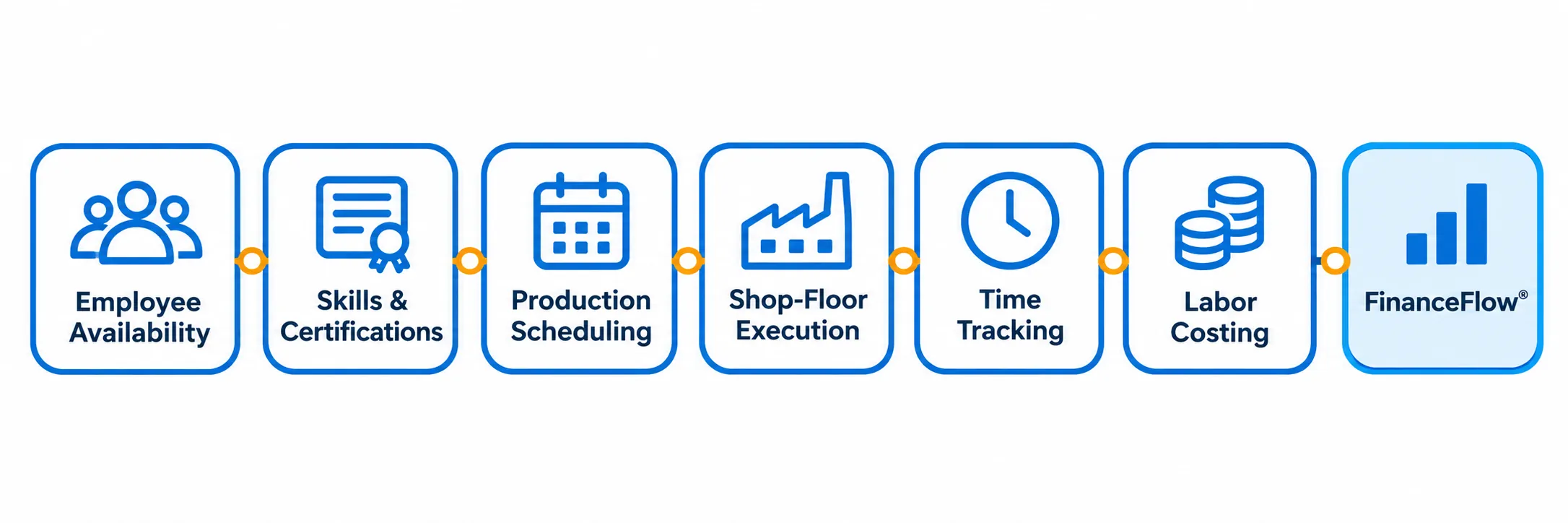
HR manufacturing integration stops being a slogan. SIX ManufacturingFlow checks material availability, machine capacity, employee skills and work-centre workload before production begins, and it tracks work orders, machine activity, employee time, quantities, waste and production progress from the shop floor. Those two data sets are the same conversation.
Project-based work connects through ProjectFlow for hours booked against internal jobs and customer projects, and FinanceFlow picks up the labor cost that comes out of the time records. For a wider view of how these pieces fit, see human resource management in ERPs.
What to fix before implementation
Most failed rollouts are data problems wearing a software costume. Fix these first.
- Clean employee records. One record per person, correct contract type, correct work center, no duplicates from old agency lists.
- Defined competencies. Name the qualification, the machine or process it covers, the assessment method and the renewal interval. Vague categories produce a matrix nobody trusts.
- Realistic shift patterns. Model the rotations you run, including the messy cover arrangements, not the tidy version from the handbook.
- Trained supervisors. The people approving time and posting workers need practice on the live screens before go-live.
- Access permissions. Decide who sees medical restrictions, pay data and disciplinary records, and record that decision.
A workforce management ERP project that skips this preparation ends up automating a mess.
Where it fits and where it doesn’t
PeopleFlow is the HR layer: records, working time, attendance, leave, skills and performance, connected to production planning through the manufacturing side of the platform. It doesn’t replace a dedicated machine-level MES, and payroll rules still need local configurationConfiguration sets up software using its existing options. In an ERP system, it adapts workflows, roles and other settings to the company’s business processes..
Be equally clear about adjacent needs. If the driving requirement is audit-ready health and safety documentation rather than workforce planning, a dedicated system such as WHS compliance software may carry that load, with PeopleFlow holding the training and restriction records that feed it.
How the HR platform maps to core manufacturing needs
| Item | Core HR scope | Manufacturing link | Source type |
|---|---|---|---|
| SIX PeopleFlow | Employee records, time, attendance, leave, skills, performance, and HR workflows | Supports workforce, training, and compliance processes on manufacturing floors | First-party HRM product |
EU workplace accidents: selected years
The chart below shows selected EU totals for non-fatal accidents at work resulting in at least four full calendar days of absence. It is not a continuous annual series; bars are rounded to the nearest 0.1 million.
| Year | Accidents | Approximate scale (each block ≈ 0.1 million) |
|---|---|---|
| 2019 | ≈ 3.13 million | ███████████████████████████████ |
| 2020 | ≈ 2.73 million | ███████████████████████████ |
| 2021 | ≈ 2.88 million | █████████████████████████████ |
| 2022 | ≈ 2.96 million | ██████████████████████████████ |
| 2023 | ≈ 2.82 million | ████████████████████████████ |
| 2024 | ≈ 2.78 million | ████████████████████████████ |
Source and interpretation: Eurostat’s accidents-at-work statistics and statistics by economic activity. Figures before 2023 are approximate, calculated from Eurostat’s published year-on-year changes; 2023 and 2024 are rounded reported totals. Eurostat notes a break in the series around 2020, and accident counts are not rates adjusted for hours worked or workforce size. For a full 2010-2024 chart, use the annual Eurostat dataset rather than interpolating the missing years.
Plan Around People Who Can Do the Work
Manufacturing HR software should do more than manage employees. Its job is to help ensure the right qualified people are available for the right production tasks, and to connect that workforce information to planning and cost.
The practical test is simple enough to run on a single line. Take your most constrained work center and list every employee qualified to run it, with the expiry date of each authorization and the shift each person works. Then check whether any of that is visible to the person who builds the schedule. In most plants, it isn’t, and the gap is usually discovered the same way every time: a released job and an operator who can’t run it.
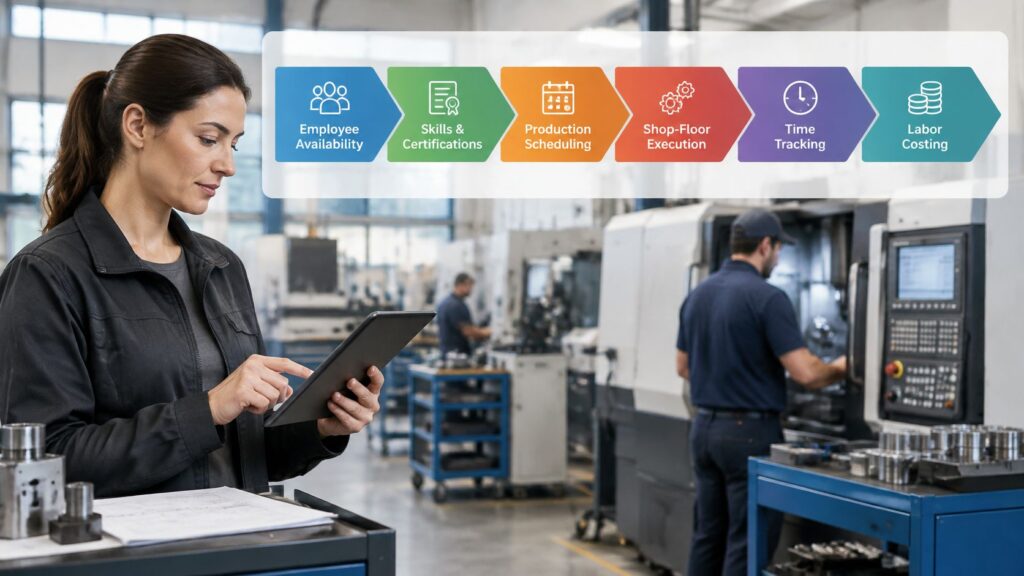
Fixing that connects four things that are usually separate. Availability comes from attendance. Capability comes from the skills matrix. Both feed the production plan. The hours that result feed payroll and labor costing, so cost per order reflects who did the work.
The order of work matters more than the vendor shortlist. Clean the employee master data, name the competencies in the language your supervisors use, model the shifts you really run, and decide who may see medical and disciplinary records. Companies that do this before implementation spend their project time on adoption. Companies that skip it spend the next two years reconciling spreadsheets.
Start with one production line, not the whole plant. Map its required skills and shift patterns, test the assignment rules against a real week of absences, and only then compare platforms against that map. A demo can’t tell you whether a system handles your certification expiry rules. Your own line data can.
Manufacturing schedules fail on people long before they fail on machines, and the fix sits in how workforce data connects to production. SIX ERP brings employee records, working time, skills and production planning into one platform, with SIX PeopleFlow holding the workforce data and SIX ManufacturingFlow using it to plan around real capacity and real qualifications. If you want to see how that connection would work on your own production line, visit SIX ERP and talk to us about your shift patterns and required competencies.