


Calling every department a profit center sounds commercially disciplined. It isn’t a substitute for giving managers control over the results they’re expected to deliver. The useful cost center vs profit center question is whether the manager has the authority, information, and operating freedom to influence the reported outcome.
A stronger approach starts with decision rights, then builds accounting and reporting around them. That means separating controllable spending from shared allocations, tracing internal charges, and checking whether a better-looking departmental result represents a real improvement for the company.
Defining Cost Centers and Profit Centers
A cost center is a unit whose manager controls and explains costs but isn’t evaluated on revenue generation. A profit center makes its manager accountable for both revenue and costs, and therefore the resulting profit. HR, IT, maintenance, and internal administration are common cost-center examples, as described in Kuvempu University’s treatment of responsibility accounting.
Neither classification describes how valuable a department is. An internal maintenance team can be essential to customer delivery without controlling customer prices or sales volume. Calling that team a profit center doesn’t give its manager commercial authority.
Start with authority, not departmental status
Responsibility accounting means evaluating managers against financial outcomes they can influence. Its hierarchy also includes investment centers, where managers have responsibility for assets as well as operating results. Brock University’s responsibility-accounting study guide distinguishes these responsibilities and their corresponding performance measures.
That distinction matters when leadership delegates responsibility unevenly. A branch manager might negotiate customer prices and schedule staff but need head-office approvalAn approval is a formal decision that allows a request or action to proceed. An ERP system can route approvals and record who made each decision. for equipment purchases. Assessing commercial performance may be reasonable; treating capital deployment as entirely the manager’s decision wouldn’t be.
Before choosing a label, document the manager’s actual authority:
- Commercial decisions: Can the manager influence pricing, customer selection, sales volume, or service scope?
- Resource decisions: Can the manager change staffing, purchasing, production methods, or supplier choices?
- Operating constraints: Which decisions require approval elsewhere, and which costs arrive through corporate policy?
Practical rule: Don’t assign accountability for a financial result without identifying the decisions through which the manager can influence it.
Apply the control test
Ask: Can this manager meaningfully influence both the revenue attributed to the unit and the resources consumed to earn it? If the answer is no, profit-center evaluation needs qualification or a different design.
Reliable attribution matters too. Assigning revenue through an internal formula doesn’t prove that a support manager controls it. Likewise, reporting costs against a department doesn’t mean its manager approved or could avoid them.
The classification should describe the operating arrangement, not express an ambition. If leaders want stronger commercial behavior, they may need to change approval limits, pricing authority, customer ownership, or information access before changing the reporting label.
How Accounting Treats Costs, Revenue, and Transfers
A cost can originate in one unit, be consumed by another, and affect a third unit’s commercial result. Accounting needs to preserve those distinctions. For example, a central purchasing team may place an order for materials used by a production job assigned to a business division.
Cost-center budgets need labor, purchasing, and overhead records that explain spending. Profit-center reports need revenue and related direct costs attributed consistently to the responsible unit. The objective is a traceable chain from each operational activity to its financial entry.

Record internal supply without confusing it with external sales
A transfer price assigns a monetary value when one independently operating unit supplies goods or services to another. The supplying profit center records revenue, while the receiving center records a cost. A consistent valuation rule keeps the two sides aligned. SAP’s documentation on internal transfer pricing explains this accounting relationship.
Consider a workshop providing repair work to a distribution branch. The workshop may record internal revenue and the branch an internal service cost. That posting records an exchange between units, not additional revenue earned from an external customer.
To make the entry auditable, retain four records: the originating purchase, labor, material movement, or service; the receiving department, project, order, or business unit; the agreed valuation method; and the matching postings, including approved adjustments. Together, these records let finance test whether the charge reflects work performed and reaches the unit that consumed it.
Connect operational documents to financial records
Finance should approve valuation policies before departments settle charges. Operations confirms quantities and completion; finance reviews exceptions such as missing receiving units, disputed work, or unmatched entries. This keeps evidence of delivery distinct from approval of the amount.
SIX FinanceFlow brings financial records, billing, and controls into one workflow, so a reviewer can check a transfer posting against the order or service record that produced it. That connection makes the classification testable in the accounting trail, rather than a label applied only to a department.
The practical test is whether a reviewer can trace from every transaction to a complete financial picture without rebuilding the chain manually. If a reported total cannot be tied to its supporting records, finance has a weak basis for resolving disputes over which unit incurred or owns the cost.
Reporting Metrics for Each Type of Center
A lower spending figure needs a service check. Confirm that the unit completed the work it was funded to do, because a margin gained by leaving essential work unfinished is not an improvement. A useful scorecard pairs financial measures with evidence of service delivery.
For cost centers, common measures include budget variance, unit cost, utilization, productivity, service-level adherence, and rework. The Mezan guide to cost-center management covers these measures and related cost-control calculations.
| Measure | Cost center focus | Profit center focus |
|---|---|---|
| Budget variance | Explain controllable spending against plan | Explain operating-cost departures alongside commercial results |
| Unit cost | Cost per relevant activity or output | Cost per sale, job, product, or service |
| Utilization | Used capacity relative to available capacity | Capacity use alongside commercial contribution |
| Productivity | Output relative to resources consumed | Output and its relationship to margin |
| Service-level adherence and rework | Delivery quality, timeliness, and avoidable repeat work | Service outcomes alongside financial performance |
| Revenue | Supporting context, not the primary accountability measure | Revenue against the commercial plan |
| Contribution margin | Limited use as a standalone responsibility measure | Revenue remaining after defined variable costs |
| Operating profit | Supporting context, not the primary evaluation measure | Result after defined operating costs |
| Profit margin | Supporting context, not the primary evaluation measure | Profit relative to revenue |
Set definitions before comparing units. A completed service request, production order, and employee support case represent different outputs. Finance should specify each measure’s numerator, denominator, and cost boundary so that comparisons reflect actual responsibilities.
Use consistent formulas:
- Variance rate = (actual cost − planned cost) / planned cost × 100. Classify unfavorable results by price, activity volume, or consumption.
- Unit cost = total cost-center cost / relevant output. Choose an output measure that reflects delivered work.
- Utilization = actual hours / available hours × 100. Define which hours count as available and apply the rule consistently.
Build a scorecard managers can act on
Separate controllable costs from allocated overhead, as described in the allocation section below. Pair cost results with service quality; favorable spending can coincide with delayed maintenance, unresolved requests, or avoidable rework. Choose measures that match each unit’s responsibilities, and drop benchmarks that describe activity the unit does not control.
Profit-center results also depend on internal pricing. Academic analysis of profit centers and capacity decisions examines how internal prices can affect investment and capacity incentives. Review reported margins in light of those rules, since the classification alone does not establish whether a manager controlled the result.
Finance teams can use Cloudvara’s guide to track accountant KPIs with actionable benchmarks when choosing measurement practices. Customer context can explain commercial outcomes: SIX CustomerFlow connects customer conversations, leads, opportunities, and next steps with analytics and wider business processes. Pair that information with consistently defined financial measures to support data-driven decision-making, and use dashboardA dashboard brings key figures and status information together on one screen. An ERP dashboard helps teams monitor performance and identify issues that need attention. movements as the starting point for investigation.
Real Business Units Compared Side by Side
A department’s name does not determine its reporting treatment. The relevant question is which decisions its manager can control and which results the unit can be held accountable for. The comparisons below show how authority over workload, pricing, staffing, and customer commitments changes the case.
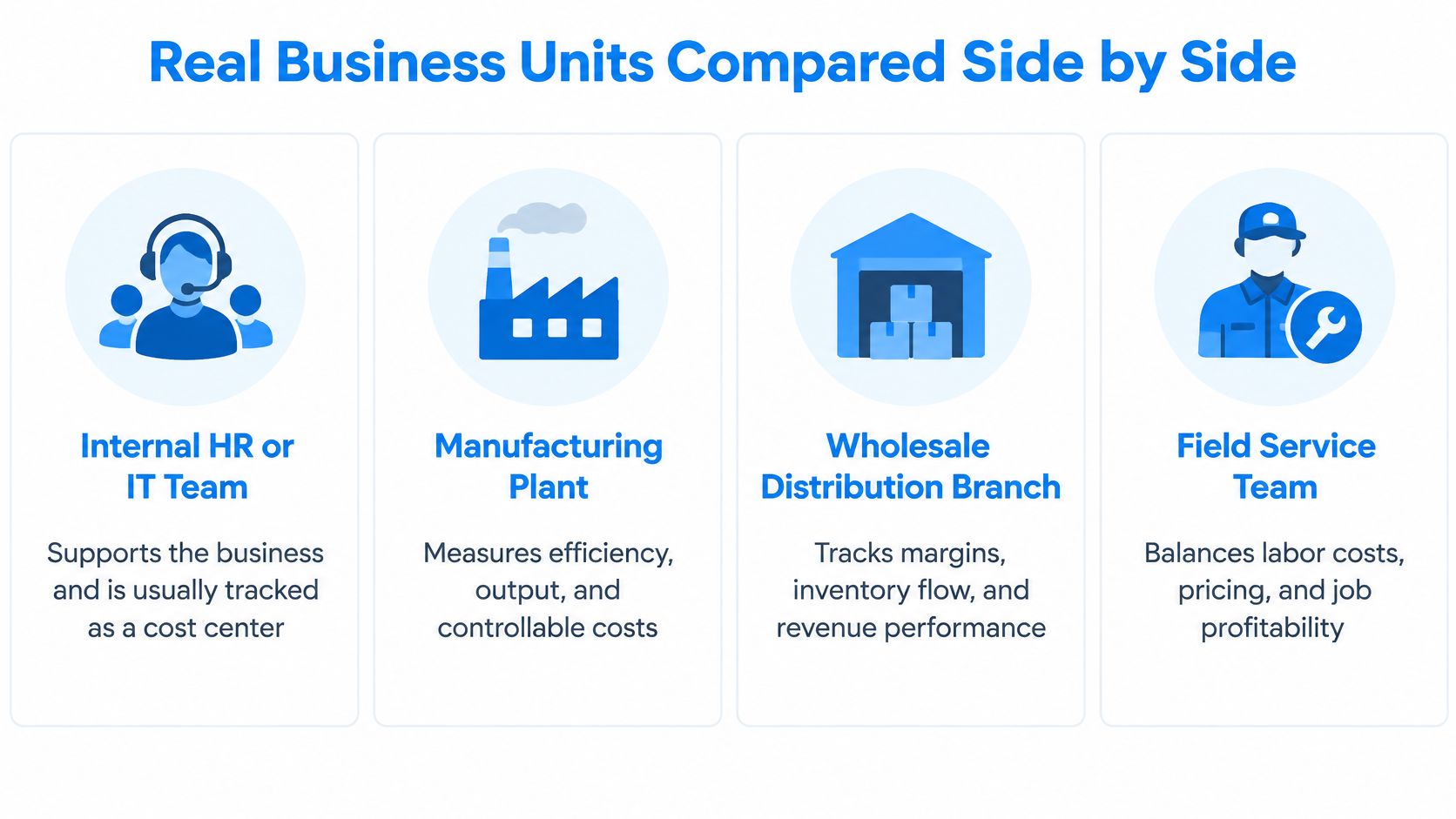
An internal HR or IT team may control staffing, supplier spending, and service priorities within an approved budget. If commercial teams own customer contracts and pricing, service measures give a more defensible view of the internal team’s performance than assigning it sales revenue.
A manufacturing plant needs a closer look at decision rights. In a hypothetical centrally managed network, headquarters sets product mix, customer prices, and order allocation, while the plant manager mainly oversees execution. A plant manager with meaningful authority over sourcing, production, and commercial choices presents a different classification case.
For a wholesale distribution branch, profit-center reporting may fit when the branch manager influences customer pricing, local demand, purchasing, and staffing. Where headquarters controls those decisions, reporting the branch’s narrower contribution better matches accountability.
A field service team should be assessed by who accepts work, sets rates, schedules technicians, and approves exceptions. Invoicing under the team’s name shows where a charge is recorded, not who sets the price, so accountability still depends on who accepts the work and sets the rates.
Follow the work, not the label
Suppose an internal service team starts accepting external customer work. Management needs to assess whether those jobs justify the technician time, parts, and travel they consume.
Before changing the reporting model, connect each job to its customer agreement, labor records, parts issues, travel expenses, and invoice. Record who approves discounts, repeat visits, and work beyond the original scope. Separate internal support obligations from external jobs so competing demands on capacity remain visible.
A clearer service result supports better decisions. Compare results under the same accounting rules before attributing a change to the new model.
Reliable job records let leaders examine pricing, technician availability, parts consumption, and which assignments are commercially sustainable. They can also show where work was accepted under terms the service manager could not change. The classification becomes auditable when ERPAn ERP system connects a company’s core processes—such as sales, finance, inventory, manufacturing, and service—in one place so teams can work with shared information. tags carry job-level activity into dashboards, linking reported results to the decisions managers control.
For work organized around customer deliverables, connecting project ideas to profitable delivery requires the same record discipline. Keep scope decisions, resource approvals, completion evidence, and billing connected.
Assess the transition under consistent accounting rules. Review demand, pricing, staffing, service quality, and transition costs before assigning any change in results to the new model.
Allocating Shared Costs Without Distorting Decisions
Shared-cost allocation can turn a sound classification into an unfair scorecard. Rent, central IT licenses, and management salaries belong in a full-company profitability analysis, yet a local manager may have little control over them. Finance should first define what an allocation is meant to show, then choose a calculation that supports that decision.
A Deloitte–IMA survey of more than 440 finance professionals found that 74% of organizations allocate corporate costs to business units, products, or services. Revenue percentage was the most common basis, at 35%, followed by product-cost percentage at 26% and headcount at 10%. Popularity is not evidence of fit. Test whether each base tracks the resource consumed by the cost pool.
Choose a driver that explains consumption
A revenue-based charge is convenient, but revenue may not explain the shared resource used. If sales rise while the resource remains unchanged, the charge can increase without reflecting additional consumption. Allocation then obscures performance instead of clarifying it.
- Direct attribution first: Assign identifiable spending to the order, project, product, or service activity that caused it.
- Causal drivers next: Use occupied space for premises costs or supported users for relevant IT costs when those measures fit the expense.
- Corporate costs separately: Keep costs without a defensible operating driver visible at corporate level when arbitrary allocation would obscure the economics.
Leaving a cost unallocated for one decision still requires a fully loaded view, which shows whether the enterprise earns enough to cover shared functions.
Govern the rule and its exceptions
The survey identified data availability or timeliness at 21% and accurate, reliable cost information at 20% as the leading obstacles. Improve the evidence behind allocations first, because a better formula cannot correct weak cost data.
Allocation safeguard: Show the unit’s controllable result, the shared-cost charge, and the fully loaded result as distinct reporting layers.
Finance should own the allocation policy, while operational managers validate whether proposed drivers reflect actual resource use. Document the cost pool, receiving units, calculation basis, approval, and treatment of exceptions. These records let reviewers trace the charge to its rationale and see where judgment was applied.
When a rule changes, report its effect separately from operating performance. A redistributed corporate charge can lower a unit’s reported result even when its underlying economics have not changed. Auditable allocation rules make that distinction visible and give leaders a sounder basis for interpreting results.
Setting Up ERP Tagging and Dashboards
An enterprise resource planningAn ERP system connects a company’s core processes—such as sales, finance, inventory, manufacturing, and service—in one place so teams can work with shared information. system, or ERP, connects operational records to financial reports. Its configurationConfiguration sets up software using its existing options. In an ERP system, it adapts workflows, roles and other settings to the company's business processes. should make responsibility visible in the transaction data, so reported results can be traced to decisions and supporting records. Start from the responsibility model, then translate it into identifiers, ownership rules, and reports.
Build the transaction path
Define the reporting objects. Assign clear identifiers and named owners to cost centers, profit centers, projects, and orders. Document which objects can be combined and which assignments need review.
Set default assignments for predictable responsibility. For exceptions, require users to identify the activity receiving the benefit and provide an explanation an approver can verify. Test defaults against shared employees, cross-department purchases, and reassigned work.
Follow the operational lifecycle. Trace how a customer order connects to purchasing or production, stock movements, delivery, invoicing, and finance. For service work, include technician time, parts, travel, completion approval, and billing.
Review handoffs and corrections. Assign responsibility for resolving missing tags and approving reassignments, while retaining the original entry and correction history. During migration, reconcile opening balances and outstanding transactions to the new structure.
Treat these as configuration requirements, and test representative transactions before relying on the resulting reports. A tag is useful only when it follows the work and supports a verifiable result.
Design views around the user’s decisions
Cost-center managers need visibility into spending exceptions, workload, capacity, and service outcomes. Commercial managers need their defined contribution or operating result, with internal charges distinguishable from external activity. Both groups should be able to drill through to supporting records.
SIX ERP is one option for connecting operational data, role-based dashboards, and drill-through reporting across business flows. Set up views to reflect approved responsibilities and the decisions each manager can influence. A shared dashboard can still show enterprise results, but its components should make controllable performance and assigned charges identifiable.
- Operational ownership: Show activities and decisions within the manager’s influence.
- Enterprise economics: Retain the broader profitability view, including shared costs.
- Legal attribution: Keep entity-level records and supporting documentation where required.
OECD guidance on profit attribution uses the arm’s-length principle and considers functions performed, assets used, and risks assumed. This is a different analytical lens from an internal management scorecard, so the two views should remain distinguishable in reporting.
The company remains responsible for determining applicable legal obligations. Software supports records and controls, while the tax treatment still requires review by a qualified adviser in each jurisdiction.
Choosing the Right Classification for Your Business
A department can show a profit and still be a poor candidate for profit-center accountability. The classification should hold up when leadership traces results to manager-controlled decisions, underlying transactions, and consistent allocation rules. Use the cost center vs profit center decision to set an operating agreement between leadership, finance, and the unit manager. It should state which decisions the manager owns, which remain with headquarters, and how finance will report their effects.

Test the proposed classification
Apply the control test from the definitions section first, then check whether revenue and pricing decisions sit with the manager. Document approval limits and exceptions, so the scorecard reflects actual authority rather than a responsibility statement that conceals decisions retained elsewhere.
Then test whether finance can support the proposed view:
- Attribution reliability: Can finance trace the result to identifiable customer work and resource use?
- Data timeliness: Will managers see useful information while they can still respond, rather than after the period has become a reconciliation exercise?
- Service-quality risk: Could the target encourage managers to defer necessary work, reject valuable internal support, or cut resources that protect customer outcomes?
A unit can be ready for cost-center KPIs before it is ready for profit-center accountability, and that sequence is a sound interim design while leadership clarifies authority. ERP tags and dashboards make the distinction auditable when they connect reported results to transactions, ownership, and shared-cost rules. A label alone changes none of those controls.
Pilot the reporting before changing incentives
Choose a unit with identifiable activity and an engaged operational owner. Review its existing tags, trace representative transactions, and have finance prepare the proposed scorecard alongside the current report. Resolve differences before using the new view for compensation or budget decisions.
For project-based work, SIX ProjectFlow supports project planning, tasks, and cost tracking. Its records can help define what a pilot should capture, rather than grouping all departmental spending into one undifferentiated total.
Set the pilot’s tests in advance: results should be explainable, exceptions treated consistently, and managers able to respond to the measures they receive. If the findings point to decisions outside their authority, revise the reporting responsibility or the accountability design before tying outcomes to incentives.
Classify each unit by the controls the manager can verify, and the evidence finance can trace. That gives leadership a credible basis to distinguish operating performance, shared-cost recovery, and internal accounting effects without forcing every team into the same category.
SIX ERP connects operational workflows with financial reporting, shared records, and role-based dashboards. Visit SIX ERP to discuss a pilot that traces a selected unit’s revenue, costs, and internal charges before changing its reporting responsibilities.