
We could say a lot about choosing the right ERPAn ERP system connects a company’s core processes—such as sales, finance, inventory, manufacturing, and service—in one place so teams can work with shared information. vendor. But in the end, it comes down to more than features, pricing, or a convincing software demo. The right ERP partner understands your business, adapts to your processes, and supports you long after implementation. In Bulgaria, companies have several options, from local providers to international platforms and flexible ERP solutions. So how do you make the right choice? Let’s look at four common approaches, their advantages, and what you should consider before making a decision.
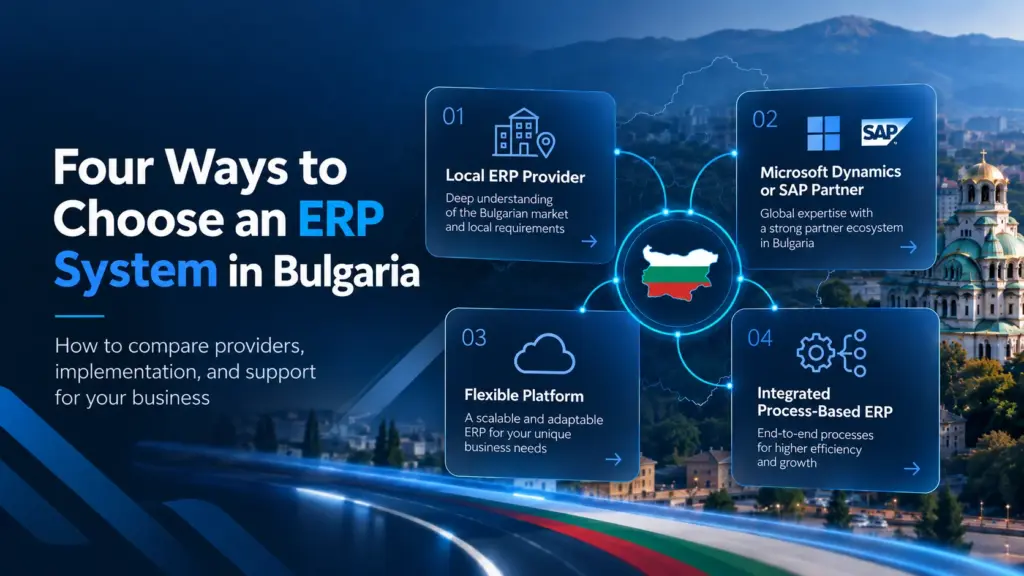
Four Ways to Choose an ERP System in Bulgaria
| Approach | Best Suited for | Key Strength | Typical Weakness |
|---|---|---|---|
| Local ERP provider | Companies with Bulgarian accounting and fiscal requirements | Local compliance and accessible support | Limited flexibility for non-standard business processes |
| Microsoft Dynamics or SAP partner | Larger organizations | Internationally established platform | Higher costs and longer implementation times |
| Odoo and similar flexible platforms | Companies with an internal technical team | Extensive modules and customizationCustomization changes or adds software functionality beyond standard settings. In an ERP project, it can meet specific business needs while adding development and maintenance work. options | Implementation quality depends heavily on the implementation partner |
| Integrated, process-configurable system (SIX ERP) | SMEs and larger businesses in manufacturing, commerce, and field servicesField service is work performed at a customer’s site, such as installation, maintenance, repair, or technical support. | One integrated systemAn integrated system connects business functions or applications so they can share information. An ERP system uses this approach to link operations and reduce repeated data entry. for sales, purchasing, inventory, manufacturing, field services, and finance | Request a demonstration based on your specific business scenario |
10 Questions to Ask Every ERP Provider
Who conducts the business process analysis, and how long does it take?
What exactly is included in the implementation (configurationConfiguration sets up software using its existing options. In an ERP system, it adapts workflows, roles and other settings to the company's business processes., data migration, training)?
How is post-launch support organized, and what are the response times?
Does the system support multiple warehouses, with invoicing and purchasing integrated into a single workflow?
Is there a mobile application for employees working in the field?
How are customizations priced?
What happens to my data if I decide to leave the provider?
How many customers do you have in my industry, and can I speak with them?
Who will be my dedicated point of contact?
What is the total cost of ownership over three years?
A Company with 50 Employees: What to Expect
A company with approximately 50 employees typically operates across at least four departments, such as sales, warehousing, finance, and manufacturing or field services.
Start with the business processes that cause the greatest operational losses, such as inventory management and invoicing, and introduce additional functionality in stages.
SIX ERP supports exactly this approach. You can begin with the workflows your company needs most and connect additional processes as your business grows.
How SIX Organizes ERP Implementation and Support
SIX provides pre-integration consulting, implementation and configuration, customization, employee training, and post-integration support with continuous system updates.
Successful ERP implementation goes beyond installing software. It begins with understanding your business processes, identifying opportunities for improvement, and configuring the system to match the way your company operates. At SIX ERP, we provide end-to-end services, from initial consulting and process analysis to system configuration, customization, data migration, integrationIntegration connects systems so they can exchange information or coordinate actions. An ERP integration helps link business tools and reduce manual transfers between them., and employee training. Our structured implementation approach ensures that sales, purchasing, inventory, manufacturing, finance, and other business functions work together in one connected environment. After go-live, we continue to support your business with regular system updates, technical assistance, ongoing optimization, and adjustments as your requirements evolve. Our goal is not simply to deliver ERP software, but to build a reliable, scalable business management solution that grows with your company.
Frequently Asked Questions
Where can I order ERP implementation with ongoing support in Bulgaria?
Directly from an ERP provider that offers consulting, implementation, and support under a single contract. SIX MS Ltd. provides all three services.
Who can implement ERP for a team of 50 employees?
Choose a provider with experience in your industry. Request references from companies of a similar size and with comparable operational requirements.
How can I replace Excel with an ERP system?
Start by mapping your business processes and migrating essential data, including customers, products, and inventory balances. Then run a pilot implementation within one department before expanding to the rest of the organization.