
TL;DR - Key Takeaways
A quick overview for busy decision-makers.
SAF-T is becoming mandatory in Bulgaria.
The rollout began in 2026 with selected large enterprises and continues through 2030, when remaining companies within scope, including VAT-registered microenterprises, are covered.
SAF-T requires detailed, reliable business data.
Reporting goes beyond VAT declarations and includes accounting entries, invoices, payments, fixed assets, and certain inventory information.
Accounting software may not contain everything needed.
Manufacturing, warehouse, purchasing, and sales systems often hold information that must be checked against financial records.
An integrated ERP system can simplify preparation.
Connected processes reduce duplicate data, improve traceability, and make financial and operational information easier to reconcile.
Preparation should begin before your first deadline.
Reviewing master data, software integrations, reporting responsibilities, and data quality early can prevent expensive last-minute corrections.
What Is SAF-T, and What Is Changing for Businesses?
SAF-T (Standard Audit File for Tax) is a standardized electronic audit file through which businesses provide detailed accounting and tax information to the National Revenue Agency (NRA).
The phased introduction of SAF-T in Bulgaria began on 1 January 2026 and will continue through 2030.
The standard covers general ledger entries, purchase and sales invoices, payments, fixed assets and inventory. Unlike traditional tax returns, SAF-T enables more detailed reporting and automated cross-checking of data.
This raises an important question for businesses: is it enough for accounting software to generate the required file if operational information is created and managed across several other systems?
Which Businesses Must Submit SAF-T, and When?
The introduction of SAF-T in Bulgaria is divided into five stages:
Year | Businesses within scope |
2026 | Large enterprises with net sales revenue exceeding BGN 300 million or net tax and social security contributions exceeding BGN 3.5 million for 2023. |
2027 | Large, medium-sized and small enterprises meeting the same financial thresholds for 2024. |
2028 | Large, medium-sized and small enterprises with net revenue exceeding BGN 15 million or net tax and social security contributions exceeding BGN 1.5 million for 2025. |
2029 | Other large, medium-sized and small enterprises falling within the scope of the rules. |
2030 | Remaining businesses subject to the requirements, including VAT-registered microenterprises. |
The applicable start date depends on the enterprise category and the relevant statutory criteria. The requirements provide for a monthly file, an annual fixed-assets file, and inventory and stock-movement data upon request from the NRA.
SAF-T Begins Where Business Happens
A manufacturing order does not begin with an accounting entry. It begins with production planning, checking stock availability, securing materials and organizing manufacturing operations.
Next come material consumption, recording production output, calculating costs, receiving finished goods into inventory and ultimately making the sale. Every stage generates information relevant to business reporting.
Accounting software captures the financial dimension of these activities. Managing production orders, bills of materials, material requirements, warehouse movements and logistics processes, however, usually calls for a much broader set of capabilities.
SAF-T does not require every manufacturing operation to be reported individually. Nevertheless, some of the data needed for the standardized file originates in precisely these processes.
That is why preparing for SAF-T does not begin with exporting an XML file. It begins with how the business manages its day-to-day operations.
When Accounting, Warehousing and Manufacturing Operate Separately
Many businesses use separate software solutions for accounting, warehouse management, manufacturing and sales. This arrangement can work effectively, but consolidating detailed information may present challenges.
Do item master records match? Can material movements be traced? How are production transactions linked to warehouse documents? Do reported quantities and values reconcile?
These questions are particularly important for manufacturers with extensive product ranges, complex production processes and multiple warehouses.
When information is spread across disconnected systems, SAF-T preparation may require additional manual processing, reconciliation and validation.
The challenge is not simply to have the information, but to ensure that it is accurate, consistent and connected throughout the business process.
How Can ERP Systems Make SAF-T Preparation Easier?
An integrated ERPAn ERP system connects a company’s core processes—such as sales, finance, inventory, manufacturing, and service—in one place so teams can work with shared information. system brings key business processes together in a shared information environment. Manufacturing, purchasing, inventory, sales and financial operations can rely on consistent master data and linked documents.
- End-to-end traceability – from purchasing raw materials and manufacturing to selling finished products.
- Consistent information – aligned data on items, business partners, quantities and values.
- Process automationAutomation uses software or equipment to carry out tasks according to defined rules. An ERP system can automate routine business steps and highlight exceptions for review. – less manual data entry and fewer transfers between applications.
- Inventory control – better visibility into stock movements and material balances.
- More efficient reporting – easier extraction and validation of the required information.
An ERP system is not a legal requirement for SAF-T and does not, by itself, guarantee compliance. However, when operational and accounting data are properly integrated, preparing reporting files can become significantly easier.
SAF-T Readiness Means More Than Reporting Readiness
The introduction of SAF-T is an opportunity for businesses to assess not only their accounting software but also the way their business processes are organized.
For manufacturing and trading companies, this means paying attention to materials management, inventory, production operations, purchasing and sales.
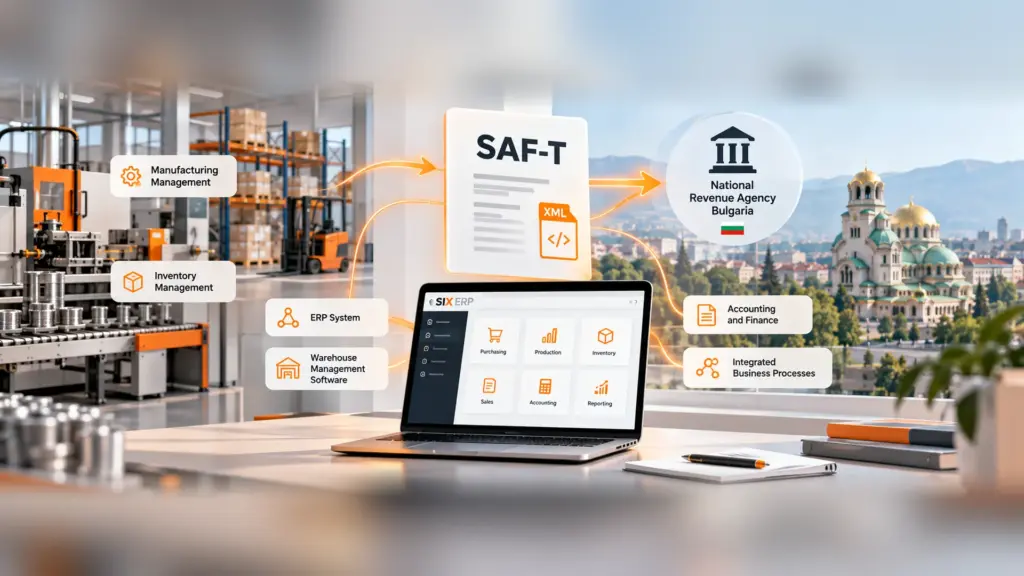
This connection between processes is central to the concept behind SIX ERP—an integrated business management system that brings operational information together in one environment.
SAF-T may introduce new reporting requirements, but reliable data starts long before accounting—where the company’s day-to-day operations are managed.
Let’s look into SAF-T more detailed
1. What Is SAF-T?
SAF-T stands for Standard Audit File for Tax.It is an international standard originally developed by the Organization for Economic Co-operation and Development (OECD) to help businesses provide structured accounting information to tax authorities.In Bulgaria, SAF-T is known as the Standard Audit File for Tax Purposes and is submitted electronically to the National Revenue Agency (NRA), known locally as НАП.The basic idea is straightforward.Instead of asking companies to prepare different reports during a tax audit, tax authorities can receive information in a standardized electronic format.For example, a business records hundreds of sales invoices, supplier invoices, payments, and accounting entries every month.Traditionally, much of this information remains inside its accounting software. The tax authority receives specific declarations and reports, while more detailed information may be requested during an inspection.SAF-T introduces a common structure for exchanging detailed business and accounting records.This allows the NRA to perform more systematic checks, compare related transactions, and identify inconsistencies.How is SAF-T different from traditional tax reporting?
Traditional tax declarations generally summarize financial activities.A VAT declaration, for example, provides information about taxable transactions and the amount of VAT due or recoverable.SAF-T provides a much more detailed view of the underlying records.Depending on the reporting section, this can include individual accounting entries, invoices, payment information, customer and supplier records, and other relevant data.The distinction is important.Traditional reports often show the final numbers. SAF-T helps tax authorities examine the records behind those numbers.That is why businesses must focus not only on producing the file but also on the quality of the information used to create it.Official reference: National Revenue Agency — SAF-T in Bulgaria.2. SAF-T Bulgaria: When Does It Become Mandatory?
The introduction of SAF-T in Bulgaria follows a phased schedule from 2026 through 2030.Not every company must begin reporting at the same time.The applicable date depends on the company’s size, financial indicators, and the conditions established in Bulgarian legislation.SAF-T implementation deadlines in Bulgaria
| Year | Companies within scope |
|---|---|
| 2026 | Large enterprises with net sales revenue exceeding BGN 300 million or relevant tax and social security contributions exceeding BGN 3.5 million, based on 2023 data. |
| 2027 | Large, medium-sized, and small enterprises meeting the BGN 300 million revenue or BGN 3.5 million tax and contribution thresholds, based on 2024 data. |
| 2028 | Large, medium-sized, and small enterprises exceeding BGN 15 million in net revenue or BGN 1.5 million in relevant tax and social security contributions, based on 2025 data. |
| 2029 | Other large, medium-sized, and small enterprises within the statutory scope. |
| 2030 | Remaining enterprises within scope, including VAT-registered microenterprises. |
What happened in 2026?
The first stage of mandatory SAF-T reporting began on January 1, 2026.According to the NRA, approximately 460 companies were expected to enter the initial reporting group.These were primarily large enterprises meeting the applicable financial requirements.The important point for other businesses is that the rollout has already started.Companies scheduled for 2027, 2028, 2029, or 2030 should not assume that preparation can be left until the final few months.Reviewing how information is stored, connected, and validated takes time, particularly when multiple software applications are involved.Does every small business need to submit SAF-T?
Not immediately, and not necessarily.Many small businesses enter the reporting schedule in later phases.VAT-registered microenterprises are generally included in the final stage from 2030, while certain businesses are excluded under the legislation.This means that company size alone is not enough to determine the obligation.A small company with unusually high revenue may enter earlier than another business of the same size.The correct approach is to check your company’s statutory category, financial indicators, VAT registration, and applicable exclusions.3. What Information Must Businesses Report Through SAF-T?
SAF-T is more detailed than a normal accounting summary.It contains structured information that helps the tax authority understand a company’s recorded financial activities.The Bulgarian SAF-T structure includes several important categories of data.General ledger and accounting information
This includes the information needed to understand how financial transactions are recorded.Examples include:- The company’s chart of accounts.
- Accounting entries and transaction dates.
- Account identifiers and relevant financial amounts.
- Debit and credit movements.
- References to related transactions.
Sales and purchase invoices
Invoices form an important part of SAF-T reporting.Relevant information may include the invoice number, date, customer or supplier, taxable amounts, VAT information, and related document details.For businesses with many transactions, consistent customer and supplier master data becomes especially important.If the same supplier exists under several different records, reporting and reconciliation may become unnecessarily complicated.Payments
SAF-T also covers relevant payment information.This can include incoming and outgoing payments and their relationship to business transactions.Companies should be able to connect payments to the appropriate invoices or accounting records.Problems may occur when payment references are incomplete, transactions are allocated incorrectly, or records are maintained across disconnected systems.Fixed assets
Fixed assets include items such as machinery, equipment, vehicles, and other long-term business assets.SAF-T includes relevant information about assets and their movements, including depreciation data where required.Businesses therefore need reliable fixed-asset records that correspond to their accounting entries.Inventory and stock movements
Inventory information is particularly relevant for manufacturers, wholesalers, distributors, and retailers.Depending on the reporting obligation and specific NRA request, businesses may need to provide information concerning stock quantities and movements.For companies managing thousands of items or several warehouses, this can require careful reconciliation.The reported financial values must be supported by reliable operational information.The key principle is consistency. Information appearing in accounting, invoices, purchasing, and inventory records must describe the same underlying business activity.4. SAF-T Reporting Frequency and Submission Deadlines
Businesses subject to SAF-T must understand not only what information is required but also when it must be submitted.Bulgarian legislation distinguishes between different reporting obligations.Monthly SAF-T reporting
The regular SAF-T file is submitted monthly.Under the rules applicable in October 2026, the deadline is the end of the month following the reporting month, subject to the general rules for non-working days.For example, the report covering October 2026 is due by November 30, 2026.This creates an ongoing reporting responsibility.Businesses must ensure that relevant accounting records are complete, checked, and ready for extraction each month.Annual fixed-asset reporting
Relevant fixed-asset information is reported annually, in accordance with the applicable deadline for the annual corporate tax return.This reporting covers the relevant asset information and transactions required by the Bulgarian SAF-T specification.Inventory information upon request
The NRA may request specified inventory and stock-movement information under the statutory SAF-T framework.This is an important difference from the normal monthly reporting process.Businesses must maintain information that can be extracted and checked when required, even if that information is not included in every routine monthly file.How is SAF-T submitted?
SAF-T is submitted electronically using the NRA’s dedicated online service.Access is provided through the NRA electronic services portal, with the required authorization and qualified electronic signature.Companies should also establish who is responsible for submitting files, checking their acceptance status, and correcting errors.A generated XML file is not the end of the process.The reporting process is complete only when the company has submitted the required information correctly and handled any validation or acceptance issues.5. Why SAF-T Is More Than an Accounting Software Update
It may be tempting to view SAF-T as another feature that accounting software must support.In some organizations, that may cover much of the technical reporting requirement.However, many businesses create important information outside their accounting systems.Consider a manufacturing company.The company buys raw materials, stores them in warehouses, consumes them during production, manufactures finished products, and delivers those products to customers.These activities involve several different types of records.Purchasing creates supplier orders and goods receipts.Warehouse employees record stock movements.Manufacturing managers create production orders and manage material consumption.Sales employees process customer orders and deliveries.Finance records invoices, payments, and accounting values.Some information is transferred automatically between systems. Other information may be entered manually.When these systems are disconnected, inconsistencies can develop.For example, the warehouse may record a material movement that has not yet been reflected correctly in accounting.Or production may consume materials using one unit of measurement while purchasing uses another.An accounting system may contain the final financial transaction without having direct access to every operational detail that explains it.Why does this matter for SAF-T?
SAF-T does not require companies to submit every production step or every internal operational event.Nevertheless, some reportable accounting and inventory information comes from these processes.If the underlying records are incomplete or inconsistent, the company may struggle to prepare accurate reporting information.The challenge is not only generating SAF-T. It is ensuring that the data behind the file can be trusted.This is where business process integrationIntegration connects systems so they can exchange information or coordinate actions. An ERP integration helps link business tools and reduce manual transfers between them. becomes particularly valuable.For a broader explanation of how operational records work together, see ERP System Data: Types, Quality, and Use.6. SAF-T and Warehouse Management Software
Warehouse management plays an important role in businesses that purchase, store, produce, or sell physical products.A warehouse management system tracks materials and products as they enter, move through, and leave the warehouse.Typical records include goods receipts, stock transfers, inventory adjustments, picking operations, returns, and deliveries.These records help explain why stock quantities change.The problem with disconnected inventory records
Imagine a company operating three warehouses.The accounting software maintains a financial inventory balance.Each warehouse uses a separate spreadsheet to track quantities.Purchasing maintains another list of incoming materials.Sales checks availability in a different application.This arrangement can work for a limited period, but discrepancies become increasingly difficult to manage.A product may be available in one spreadsheet but already reserved for a customer order.A stock transfer may be recorded in one warehouse but not in the receiving location.An inventory correction may change the physical balance without properly updating the financial records.Under SAF-T, such differences can create additional work when relevant inventory information must be prepared and reconciled.How integrated warehouse management helps
An integrated warehouse management system can connect physical movements to purchasing, sales, manufacturing, and financial processes.For example, when materials arrive from a supplier, the goods receipt can be linked to the purchase order.When materials are consumed during production, the stock movement can be connected to the manufacturing order.When finished products are delivered, the outgoing movement can be related to the customer order.These relationships make information easier to verify.They also improve daily operational visibility.Good inventory management is not only about knowing how much stock you have. It is about understanding why that quantity exists and how it changed.Learn more about SIX StockFlow — Warehouse and Inventory Management.7. SAF-T and Manufacturing Management
Manufacturing companies often face more complex data challenges than businesses that simply buy and resell finished products.Production transforms raw materials into new products.This introduces additional records, calculations, and relationships that must be managed correctly.A manufacturing process may involve:- Bills of materials (BOMs).
- Material requirements and availability.
- Production and work orders.
- Work centers and manufacturing capacity.
- Material consumption.
- Scrap and production losses.
- Finished-goods receipts.
- Production costing.
- Warehouse transfers.
Example: From raw material to finished product
Consider a furniture manufacturer.The company purchases wood, fabric, foam, and metal components.These materials enter the warehouse and become available for manufacturing.When a customer orders a sofa, the business creates a production order based on an approved bill of materials.Production employees consume the required components.Once the sofa is completed, the finished product enters inventory and becomes available for delivery.Each step changes the company’s operational information.The materials have moved, their quantities have changed, and costs have been assigned to the production process.If these operations are recorded only in spreadsheets, the accounting department may need to reconstruct the information manually.This becomes especially difficult when the company manufactures many product variants or frequently changes material specifications.Why accurate bills of materials matter
A bill of materials describes the components needed to manufacture a product.For example, a furniture BOMA Bill of Materials (BOM) lists the materials and components, and their quantities, needed to make a product. may specify the quantity of fabric, foam, wood, and fittings required for a specific sofa model.If the BOM contains outdated quantities or incorrect units, material planning and production costing can become unreliable.The problem may then spread into purchasing, inventory, and financial reporting.An integrated manufacturing management system helps maintain a consistent relationship between the product definition, production requirements, material consumption, and resulting costs.Manufacturing software and SAF-T readiness
The main benefit of integrated manufacturing software is not that SAF-T requires every production operation.It is that reliable manufacturing records can support accurate inventory and financial information.Companies that manage these processes consistently are generally better positioned to reconcile the data needed for reporting.Read more about SIX ERP for Manufacturing.8. What Happens When Accounting, Manufacturing, and Warehousing Use Separate Systems?
Many companies use more than one business application.For example, accounting may run in one system, warehouse management in another, and production planning in a third.This arrangement is not automatically a problem.Well-integrated specialized systems can work effectively together.The risk appears when information is transferred manually, records are duplicated, or different applications use incompatible definitions.Common problems businesses encounter
Different product codesA raw material appears under one code in purchasing and another code in production.As a result, the business may struggle to match material consumption with the correct inventory record.Inconsistent units of measurementPurchasing orders material in kilograms, warehousing stores it in packages, and manufacturing consumes it in grams.Without reliable conversion rules, quantities and values can become inconsistent.Duplicate customers and suppliersThe same business partner exists under several records, making transactions harder to reconcile.Missing transaction referencesAn invoice cannot be clearly connected to its purchase order or goods receipt.Delayed data transfersOperational transactions are entered several days after they occur.As a result, accounting and warehouse information may describe different points in time.Why manual reconciliation becomes expensive
Employees may spend hours comparing files, checking transaction histories, and correcting differences.This effort becomes part of the monthly reporting routine.The more systems and transactions a company manages, the more difficult the process can become.A properly integrated ERP environment can reduce these problems by maintaining consistent master data and connected transaction references.The important objective is not necessarily to eliminate every specialized application.It is to ensure that all relevant systems exchange reliable information and that the company knows which records are authoritative.9. How Can an ERP System Make SAF-T Implementation Easier?
ERP stands for Enterprise Resource PlanningAn ERP system connects a company’s core processes—such as sales, finance, inventory, manufacturing, and service—in one place so teams can work with shared information..An ERP system connects business activities such as sales, purchasing, inventory, manufacturing, finance, and human resources.The main purpose is to provide a consistent environment for managing information and processes.For SAF-T preparation, this integration can offer several important benefits.Consistent master data
Customers, suppliers, products, and other important entities can be maintained according to shared rules.This reduces unnecessary duplication and supports more reliable reporting.Connected transactions
A supplier invoice can be linked to a purchase order and goods receipt.A customer invoice can be connected to the original sales order and delivery.Relevant transaction references make it easier to understand and reconcile business activities.Better inventory control
Stock quantities and movements can be recorded within controlled warehouse processes.This supports consistent operational and financial information.More reliable manufacturing information
Manufacturing orders, materials, and production-related costs can be connected to the company’s broader records.This helps reduce discrepancies between production activities and financial reporting.Less manual data entry
Information can move between connected modules without employees repeatedly entering the same details.This reduces administrative work and opportunities for error.Easier validation and reporting
When relevant information is already structured and connected, reporting tools can extract it more efficiently.The company can then focus on checking completeness, accuracy, and compliance with the required SAF-T format.Does implementing ERP automatically make a company SAF-T compliant?
No.SAF-T compliance requires more than an ERP license.The business must have the correct reporting functionality, properly configured records, valid data mappings, accurate data, and a reporting process that follows the applicable technical and legal requirements.An integrated ERP system can provide a strong foundation, but implementation and validation remain essential.10. Technical SAF-T Requirements: What Should Your Software Support?
For IT managers, accounting departments, and ERP providers, SAF-T introduces important technical responsibilities.The Bulgarian reporting structure uses XML files that must follow the format defined by the NRA.XML is a structured way of organizing information so that software systems can exchange data consistently.However, producing an XML file is only one part of the reporting process.Data mapping
Companies must ensure that information from their accounting and operational systems corresponds to the correct SAF-T fields.This includes identifying the relevant records, values, codes, and relationships.For example, an internal accounting code may need to be mapped to the appropriate reporting classification.These mappings should be documented and tested.Validation
Before submission, the generated file should be checked against the applicable technical specification.This helps detect invalid formats, missing required fields, and other structural problems.Business validation is also necessary.An XML file may be technically valid while containing inaccurate transaction values or incorrect record relationships.Reconciliation
Important figures should be compared with the company’s accounting and operational records.For example, relevant totals from the reporting file should be consistent with the corresponding accounting balances.Where inventory information is requested, the relevant quantities and movements should also be supported by reliable records.Error handling
The reporting process should identify rejected or incomplete records.Employees need a clear method for investigating errors, correcting the underlying information, and generating revised files.Version management
The technical reporting format may change.An ERP or SAF-T reporting solution must therefore support updates to the applicable XML schema, field definitions, and reporting requirements.Current technical update: In October 2026, the NRA approved version 1.0.3 of the SAF-T XML schema and tabular structure, applicable to files submitted from November 1, 2026.Companies should confirm the latest official specification before generating or submitting files.Technical reference: NRA — SAF-T documentation, XML schema, and reporting instructions.11. How to Prepare Your Business for SAF-T Implementation
Preparing for SAF-T does not need to begin with an expensive software replacement.The first step is understanding your current information and reporting processes.A structured preparation project can help identify the most important gaps before they become urgent.Step 1: Confirm your SAF-T deadline
Determine which reporting stage applies to your business.Review the statutory company category, relevant financial thresholds, VAT registration, and applicable exclusions.Confirm the result with your accountant or tax adviser.Step 2: Identify where your data is stored
List the systems that maintain important accounting and operational information.These may include accounting software, ERP software, warehouse applications, manufacturing systems, sales platforms, and spreadsheets.Identify which system is responsible for each type of record.Step 3: Review master data quality
Check customer, supplier, product, and other important master records.Look for duplicates, incomplete fields, inconsistent codes, and outdated information.In manufacturing businesses, review units of measurement and bills of materials as well.Step 4: Examine system integrations
Determine how information moves between software applications.Is it transferred automatically?Are employees copying data manually?Can transactions be traced between systems?Identify where information may be lost, delayed, or changed.Step 5: Define SAF-T data ownership
Assign responsibility for the relevant information.Finance should lead the accounting and tax reporting requirements.Warehouse managers should verify inventory information.Production managers should confirm the accuracy of relevant manufacturing records.IT or the ERP implementation partner should support technical extraction, mapping, and validation.Clear responsibilities prevent reporting problems from becoming nobody’s responsibility.Step 6: Test the reporting process
Generate sample SAF-T files using actual business information.Check the XML structure and required fields.Compare relevant totals with accounting records.Investigate missing information and correct the underlying data.A successful test should confirm more than the ability to export a file.It should demonstrate that the company can explain and verify the information it is reporting.Step 7: Establish a recurring reporting routine
Once SAF-T reporting becomes mandatory, the process must work every month.Define who prepares the data, who checks it, who approves the final file, and who submits it.Document how rejected files and reporting corrections are handled.This turns SAF-T from a last-minute technical task into a controlled business process.12. Should You Replace Your Accounting Software or Implement an Integrated ERP System?
Not every business needs to replace its accounting software to meet SAF-T requirements.For a company with relatively simple activities and reliable accounting records, appropriate reporting functionality may be sufficient.The situation can be different for a manufacturer, distributor, or service company operating across several departments and systems.Consider two businesses.Business A: A small consulting company
The company issues a limited number of invoices, has few suppliers, and does not maintain significant physical inventory.Most financial information is already available in accounting software.In this case, preparing SAF-T may primarily involve updating the accounting application, validating records, and establishing the reporting process.Business B: A manufacturer with several warehouses
The company purchases hundreds of materials, maintains complex BOMs, manages production orders, and delivers finished products to customers.Purchasing, production, warehousing, and accounting use separate applications.Some information is exchanged automatically, while other details are maintained in spreadsheets.For this company, SAF-T preparation may expose much broader information-management problems.The business may benefit from integrating existing applications or implementing a more connected ERP environment.The right question is not simply whether your accounting software supports SAF-T.It is whether the company can consistently produce and verify the information needed for its financial and tax reporting.13. SAF-T and ERP: The SIX ERP Approach
At SIX ERP, we believe reliable business reporting begins with reliable operational processes.Accounting information does not exist in isolation.A sales invoice may originate from a customer order.A supplier invoice may relate to purchasing and goods receipt.An inventory valuation depends on recorded stock movements.Manufacturing costs are influenced by materials, production activities, and the way those operations are accounted for.When these processes are connected, information becomes easier to follow, verify, and manage.SIX ERP brings together different business functions through integrated workflows.These include:SIX SalesFlow: Manage quotations, customer orders, commercial transactions, and invoicing-related processes.SIX PurchaseFlow: Connect suppliers, purchase orders, receiving activities, and procurement information.SIX StockFlow: Manage warehouse operations, stock balances, inventory movements, and product information.SIX ManufacturingFlow: Connect bills of materials, production orders, material requirements, and manufacturing operations.SIX FinanceFlow: Support financial processes, accounting-related information, invoices, and reporting.The objective is to ensure that relevant business information stays connected as work moves between departments.For companies preparing for SAF-T, this provides a foundation for consistent data extraction and reconciliation.However, the exact SAF-T reporting solution must still be configured and validated according to the requirements that apply to the company.Why integration matters beyond SAF-T
Better-connected information also supports normal business operations.Managers can identify purchasing requirements earlier.Warehouse employees can work with more reliable quantities.Production planners can understand material availability.Finance can examine transactions in relation to the activities that created them.And management can make decisions using more consistent information.SAF-T may be the reason a company begins reviewing its systems.But better business processes can deliver benefits long after the initial reporting requirement has been addressed.For organizations reviewing their technology and implementation options, see our ERP Selection and Migration Guide.14. Frequently Asked Questions About SAF-T Bulgaria
What is SAF-T in simple terms?
SAF-T is a standardized electronic file used to provide detailed accounting and tax-related information to the tax authority. It allows information to be reviewed and checked in a consistent format.Is SAF-T mandatory in Bulgaria?
Yes, for companies falling within the legal scope. Mandatory reporting began on January 1, 2026, and expands in stages through 2030.Which companies must submit SAF-T in 2026?
The first stage covers certain large enterprises meeting the financial criteria established in Bulgarian legislation, based on 2023 information.When will small businesses need to submit SAF-T?
Many small enterprises enter the schedule in 2029, although some may qualify earlier because of their financial indicators. VAT-registered microenterprises generally enter in 2030. Applicable exclusions must also be considered.How often must SAF-T be submitted?
The regular SAF-T reporting obligation is monthly. Relevant fixed-asset information is reported annually, while specified inventory information may be required upon request.Does SAF-T replace VAT declarations?
SAF-T is a separate reporting obligation. It should not be treated as a replacement for existing VAT or other statutory declarations unless legislation explicitly provides otherwise.Is an ERP system required for SAF-T?
No. Bulgarian law requires the relevant businesses to provide the information in the prescribed format. It does not require every company to purchase an ERP system.However, an integrated ERP system can make it easier to maintain consistent information across accounting and operational processes.Can accounting software generate SAF-T without an ERP system?
Yes, if the accounting solution has the required functionality and access to all relevant reporting data.Businesses with complex inventory, production, or multiple disconnected applications may need additional integrations or data preparation.Why is inventory management important for SAF-T?
Inventory information may be required under the reporting framework. Accurate stock movements, item records, quantities, and values help support reliable reporting and reconciliation.Does SAF-T require detailed production reporting?
SAF-T does not automatically require submission of every manufacturing event. However, manufacturing activities influence relevant inventory and accounting records, which must remain accurate and consistent.What happens if a SAF-T file contains errors?
A file may fail technical validation or contain information that requires correction. Companies must follow the applicable NRA rules for submission, replacement, and correction.The process should include checks before submission and a clear method for resolving errors.What is the biggest challenge in SAF-T implementation?
For many businesses, the challenge is not creating the XML file itself. It is collecting accurate information from different systems, mapping the data correctly, and ensuring that reported transactions can be verified.15. Conclusion: SAF-T Starts With Reliable Business Data
SAF-T introduces a new level of detail to tax reporting in Bulgaria.Companies must pay greater attention to how accounting and relevant operational information is recorded, connected, checked, and reported.For smaller businesses with straightforward accounting processes, preparation may mainly involve reporting software and data validation.For manufacturers, distributors, wholesalers, and companies operating several warehouses, the challenge may be considerably broader.Purchasing, inventory management, production, sales, and finance all contribute information that affects business reporting.When these systems work independently, preparing reliable data can require substantial reconciliation.When processes are integrated, the same information can support daily operations, financial reporting, management decisions, and statutory obligations.SAF-T is a reporting requirement. Reliable business data is an operational advantage.Businesses that prepare early have an opportunity to address both.At SIX ERP, our goal is to help organizations connect their processes, improve information quality, and build a reliable foundation for business management and regulatory reporting.Explore SIX ERP solutions or contact our team to discuss your existing processes and SAF-T preparation requirements.Official Sources and Further Reading
- National Revenue Agency (NRA) — SAF-T in Bulgaria — Official reporting structure, XML schemas, instructions, and updates.
- NRA — Electronic SAF-T Submission Service — Information about electronic submission and access.
- NRA — SAF-T Implementation Information — Introduction of mandatory reporting.
- PwC Bulgaria — SAF-T — Overview of the introduction schedule and reporting requirements.
- Bulgarian Tax and Social Security Procedure Code (ДОПК), Articles 71з–71к.
- Bulgarian Accountancy Act (Закон за счетоводството), including enterprise classification rules.