
Project portfolio management (PPM) is the discipline of deciding which projects your business should run, in what order, with which people and money, and then tracking whether they deliver. It works when portfolio decisions rest on the same data as daily operations: costs, stock, purchasing, staff time and sales. That is why a growing business gets more from PPM when projects live inside an integrated ERPAn ERP system connects a company’s core processes—such as sales, finance, inventory, manufacturing, and service—in one place so teams can work with shared information. such as SIX ERP than when they sit in separate spreadsheets and tools.
Project management and portfolio management are different jobs
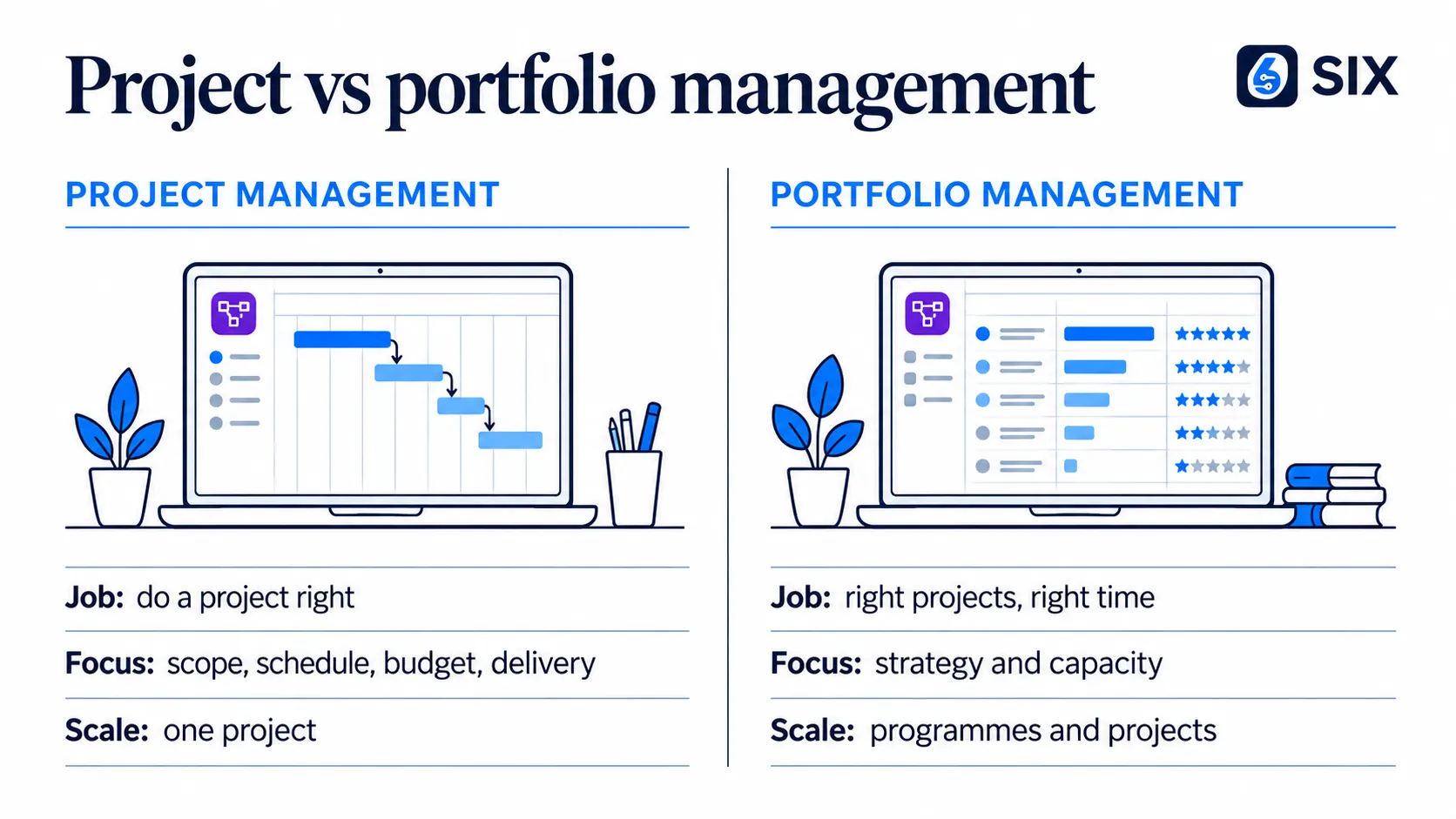
Project management is about doing a project right: scope, schedule, budget, delivery. Portfolio management is about doing the right projects at the right time. PMI’s paper on the subject describes it as selecting and managing projects as a portfolio of investments, aligning them with strategy, rationing resources and building synergies between them, which calls for different techniques than running a single project.
The UK’s Association for Project Management defines portfolio management as the selection, prioritization and control of an organization’s programs and projects, in line with its strategic objectives and capacity to deliver. The last part matters most for small and mid-sized firms: capacity is finite.
The same PMI paper names the core problem. Nearly every organization has more project work than people and money, and management finds it hard to say no. A portfolio is the funnel that turns a long wish list into a short, funded list.
A practical example: a manufacturer has a new product line, a warehouse reorganization, a customer-requested custom order and a software rollout, all competing for the same engineers and the same quarter’s budget. Each project manager can do their own job well, and the company can still fail, because nobody decided which of the four should not start.
The stages of a portfolio process
Frameworks differ in wording, but they agree on the shape. The EU’s PM² Portfolio Management methodology groups the work into five core processes: framework definition, composition, realization, monitoring and controlling, and stakeholder engagement and communication. The framework is non-prescriptive and applies to any industry, so a small business can adopt it in a light form.
For a company without a project office, a simple version looks like this:
- Clarify objectives. Write down three to five business goals for the year, such as margin, delivery reliability or entry into a new service.
- Collect every request. Gather ideas and commitments in one list, including customer-driven work and internal improvements.
- Score and rank. Rate each candidate against a few criteria. PMI’s paper uses four to ten valuation criteria, financial or scored, then ranks projects by value.
- Draw the cut line. Allocate people and budget from the top of the ranking until they run out. What falls below the line waits or is declined.
- Check balance and feasibility. Look at risk against reward, short against long payback, and dependencies between projects and skills.
- Monitor and review. Track delivery and benefits, and re-rank when conditions change.
Where each step breaks down
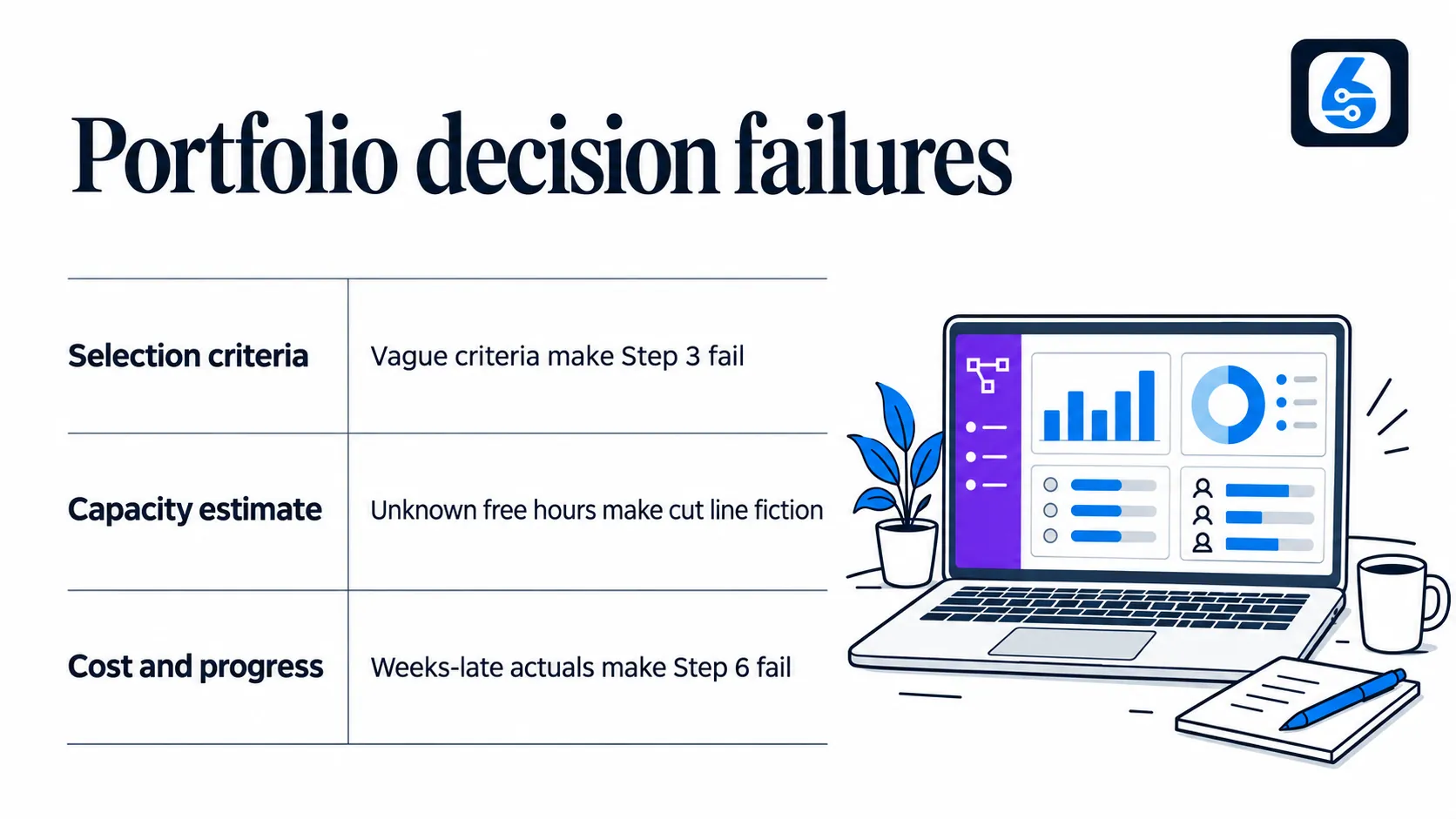
Step 3 fails when criteria are vague. Step 4 fails when capacity is a guess: if you do not know how many hours your engineers or technicians have free, the cut line is fiction. Step 6 fails when actual cost and progress arrive weeks late from separate files. Each of these is a data problem before it is a methodology problem.
What the tooling has to do
PMI’s portfolio standard describes the portfolio management information system as the tools used to gather, integrate and disseminate portfolio information, supporting visibility, standardization and measurement. It also notes that in practice this system is often a collection of spreadsheets. Spreadsheets can hold a ranking. They struggle to hold live cost, live capacity and live progress at once.
Good project portfolio software, or the portfolio features of a business system, should bring together:
- Project delivery status, with milestones and risks.
- Financials: budget, committed spend, actual cost and forecast.
- Resource capacity: who is available, and for how long.
- Dependencies between projects.
- Benefits: what each project was supposed to deliver and what it did.
This list mirrors how PPM software is commonly described: one portfolio-level view of delivery, financials, capacity, risks, dependencies and benefits. Standalone PPM tools supply that view but need their financial and resource data fed in from elsewhere. In an ERP, that data is already the system of record.
Finance templates as a starting point
Some businesses begin with spreadsheet dashboards and KPIA KPI (Key Performance Indicator) measures progress towards a business goal. An ERP system can calculate KPIs from business records and show changes in performance over time. sheets before moving to a system. A worked example of utility analytics and procurement tracking shows how structured data can give visibility into spend. The step from there to a connected platform is the point at which numbers stop being re-entered by hand.
Why integrated data decides portfolio quality
A portfolio decision is only as good as the numbers behind it. Consider what each question needs:
| Portfolio question | Data it depends on |
|---|---|
| Can we afford this project? | Budget, committed purchases, cash position |
| Do we have the people? | Staff availability, current assignments, skills |
| Will materials arrive in time? | Purchasing, supplier lead times, stock levels |
| Is this project profitable? | Actual cost, time booked, billing |
| Does it fit the customer pipeline? | Sales and CRM data |
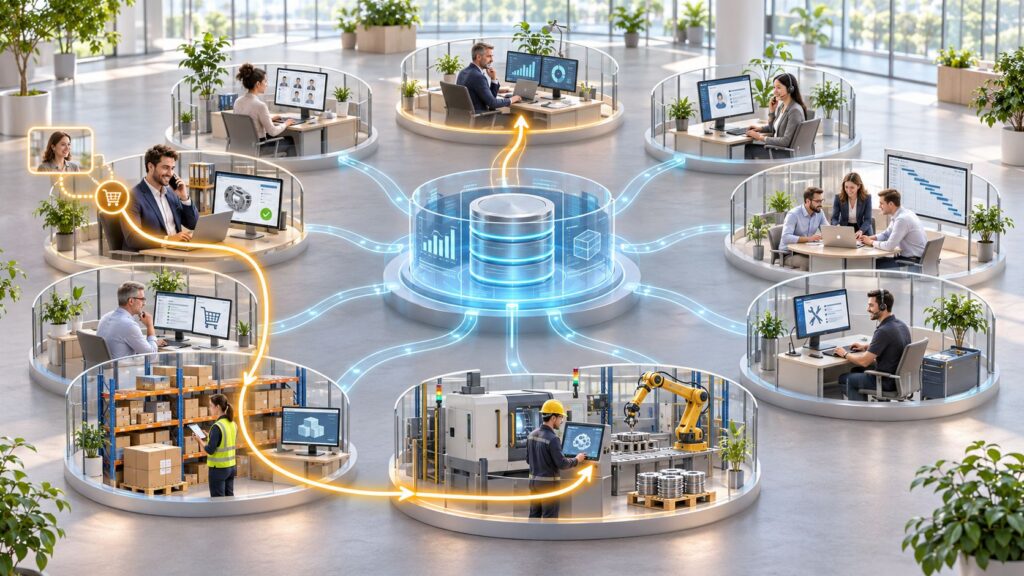
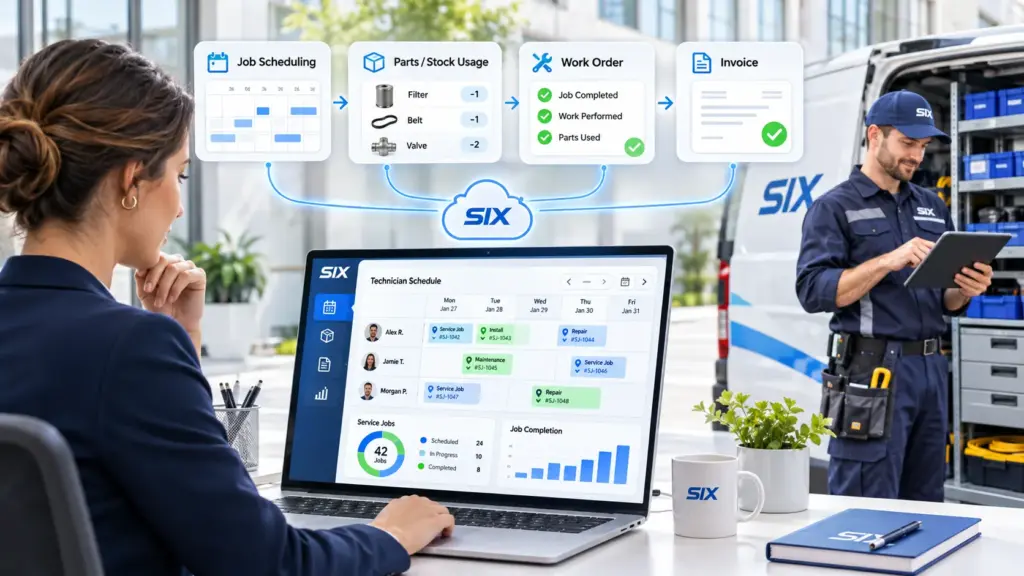
In an integrated systemAn integrated system connects business functions or applications so they can share information. An ERP system uses this approach to link operations and reduce repeated data entry. these live in one place. SIX ERP connects departmental workflows through six flows and includes project, finance, purchasing, inventory, people, sales and service management, so project cost and capacity are read from the same records the departments already use. For a manufacturer that means StockFlow inventory and PurchaseFlow orders sit next to the project plan. For a services business, field service and ProjectFlow share a view of work in progress.
IntegrationIntegration connects systems so they can exchange information or coordinate actions. An ERP integration helps link business tools and reduce manual transfers between them. is also a theme in practice in Bulgaria. A Bulgarian bio-products distributor unified purchasing, sales, accounting, warehousing and supply on one platform, as reported by Digitalk.bg, a reminder that local businesses of this size are already moving from separate tools to one data model.
For more on how project work connects to money, see our guide to taking a project from idea to profitable delivery and our archive on project profitability.
Metrics that tell you the portfolio is healthy
A metric becomes a KPI when it has a calculation, an owner, a review rhythm, a threshold and a decision attached, as Epicflow’s guide to portfolio metrics puts it. Start with a short set:
- Strategic alignment: the share of active projects tied to a stated business goal.
- On-time delivery and on-budget completion: vendor benchmarks such as 70% or higher give a reference point, though your own baseline matters more.
- Benefits realization: value delivered against value promised. Benefits often appear after go-live, so they need a named owner and a review date.
- Capacity gap: demand for hours against available hours.
- Budget variance and risk exposure.
A large academic benchmark, the 11th Multi-Project Management Study from TU Darmstadt covering 113 project portfolios, measures success along three dimensions: the quality of multi-project management, portfolio success (strategic fit, synergies, balance), and business success. It is a useful reminder that portfolio health is more than a count of projects finished on time.
Choosing software at the level you are today
Match the tool to your maturity. One buyer’s guide describes a ladder: visibility first, then resource and financial control, then benefits tracking and scenario modelling. The same guide warns against buying for the organization you hope to become, since software cannot replace clear governance or clean data.
For an SME, that suggests these criteria:
- Start with the flows you need today, with room to add more.
- One source of financial and resource data, not re-keyed exports.
- Ease of use, so project managers and technicians actually update it. Wellingtone research cited by the same guide found 42% of respondents spend a day or more collating project reports by hand.
- Mobile access for field teams.
- Process mappingProcess mapping documents the steps, people and decisions involved in business work. In an ERP project, it helps define workflows and identify improvements before system setup. before configurationConfiguration sets up software using its existing options. In an ERP system, it adapts workflows, roles and other settings to the company's business processes., so the system reflects how you actually work.
If you are comparing options for a smaller company, our piece on project management software for small business covers the day-to-day project layer.
Our perspective
Most portfolio problems we meet in the way businesses describe their work are not problems of method. They are gaps between departments: a project plan in one file, purchasing in another, stock in a third, hours in a fourth.

That is why we map processes in detail before we configure anything. Our no-gap approach means the flows are agreed first, so the portfolio view is built on the same records the teams use every day.

We also think a business should not have to replace its system to grow. You can start with the essential flows, for example ProjectFlow with FinanceFlow, and add purchasing, inventory, manufacturing, service or people management when the portfolio needs them.

A portfolio is a set of choices. Those choices are better when cost, capacity and progress are visible in one place.
Bringing the portfolio into one system
SIX ERP combines project, finance, purchasing, inventory, sales, service and people management with dashboards and web and mobile apps. Plans are published on the licensing page: SIX Start at 999 EUR per year, SIX Growth at 2499 EUR per year and SIX Business at 4999 EUR per year, with SIX Enterprise available without a published price. Consulting, integration and configuration, and ongoing support are described on the services page.

If you manage several projects against shared people, stock and budget, start with a conversation about which flows to map first on six.ms.
FAQ
What is project portfolio management in simple terms?
It is the process of choosing, funding, resourcing and monitoring a company’s projects as a group, so limited people and money go to the work that best supports the business goals. It sits above individual project management, which focuses on delivering each project.
What is the difference between a portfolio, a program and a project?
A project is a single piece of work with a defined outcome. A program groups related projects. The EU’s PM² methodology defines a portfolio as a collection of projects, programs and other activities grouped to control financial resources and meet strategic objectives.
Do small and medium businesses need portfolio management?
Yes, wherever demand for projects exceeds people and budget, which is the usual situation. A small business can use a light version: one list, a few scoring criteria, a cut line and a monthly review.
What should project portfolio tracking software show?
Delivery status, budget against actual cost, resource capacity, risks, dependencies and expected against realized benefits, in one view. The closer those figures sit to your finance, purchasing and inventory records, the less manual reporting you need.
Sources
- Project portfolio management, PMI
- What is portfolio management? APM
- What is PM²-Portfolio Management, European Union
- PM² Portfolio management guide 1.5, Publications Office of the EU
- PM² Project Management Methodology, European Union
- The Standard for Portfolio Management, Third Edition, PMI
- Project Portfolio Management (PPM) Software, Kiplot
- 15 Project Portfolio Management Metrics & KPIs, Epicflow
- Planisware Horizon
- MPM11 General Benchmarking Report
- How To Choose A Perfect Project Portfolio Management Tool, Eleco
- Digitalk&A1 Awards ’24, Digitalk.bg
- Utility Analytics & Energy Procurement System, Frac CFO