
TL;DR: What business owners should know
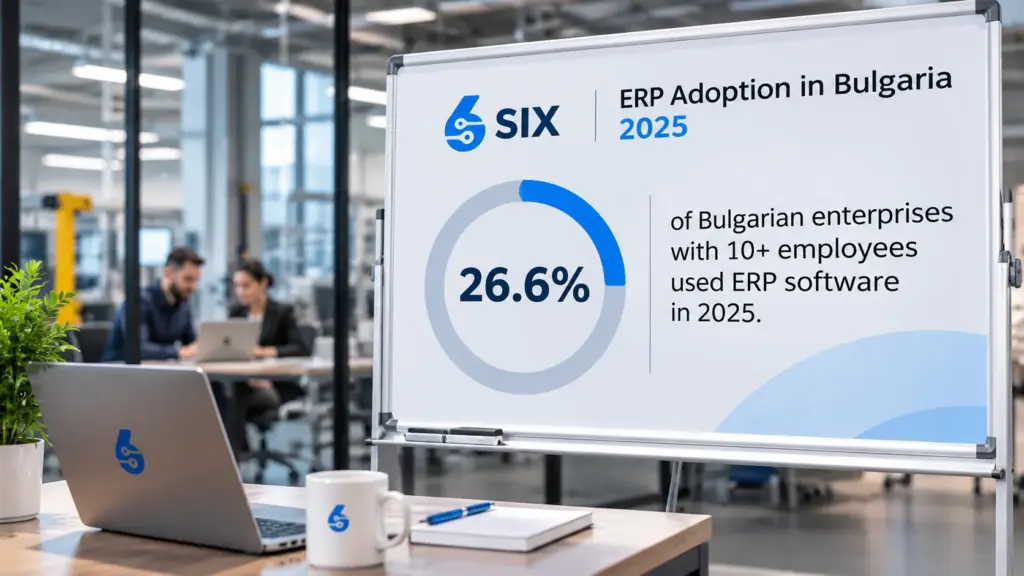
Bulgaria is improving, but slowly. ERP use increased from 21.7% in 2023 to 26.6% in 2025, while the EU average remains much higher.
Small enterprises face a large digital gap. Only 22.5% of Bulgarian enterprises with 10–49 people employed use ERP.
Connected processes matter more than new software. Reliable orders, inventory, production and finance data help teams make decisions without checking several separate files.
Prepare before you implement. Map processes, improve master data and develop a Business Blueprint before selecting modules and setting deadlines.
ERP Adoption in Bulgaria: What the Statistics Tell Us
ERP stands for Enterprise Resource PlanningAn ERP system connects a company’s core processes—such as sales, finance, inventory, manufacturing, and service—in one place so teams can work with shared information.. It is software that connects information used by sales, purchasing, warehouses, production, service teams and finance. When a customer places an order, the same information can support stock checks, purchasing decisions, production planning and invoicing.
The NSI survey covers enterprises with at least 10 people employed in selected non-financial sectors. It does not include the smallest micro-enterprises. This is important because the headline figure should not be presented as the share of every registered company in Bulgaria.
ERP adoption in Bulgaria by company size, 2025
Small (10–49)
22.5%
Medium (50–249)
41.9%
Large (250+)
73.7%
Source: NSI ERP statistics. Values are shares of surveyed enterprises in each size group.
Larger companies are more likely to use ERP, but a small company can still have demanding operations. A furniture manufacturer with 30 employees may manage hundreds of materials, supplier changes and production steps. A service company may need to connect technicians, spare parts, customer approvals and invoices. These businesses need reliable processes even if their teams are relatively small.
For a closer look at this challenge, read the SIX ERP guide to choosing an ERP provider in Bulgaria. It explains why industry fit and implementation support matter more than a long feature list.
ERP Use Is Growing, but Is Bulgaria Catching Up?
The NSI figures show progress in every size group between 2023 and 2025. Overall adoption increased by 4.9 percentage points, while small enterprises increased from 17.4% to 22.5%. This growth suggests more companies are moving toward shared business information.
| Company size | 2023 | 2025 | Change |
|---|---|---|---|
| All enterprises | 21.7% | 26.6% | +4.9 pp |
| Small | 17.4% | 22.5% | +5.1 pp |
| Medium | 37.4% | 41.9% | +4.5 pp |
| Large | 68.1% | 73.7% | +5.6 pp |
However, growth from a low starting point does not mean the gap has closed. Bulgarian companies often sell to customers in other EU countries, where expectations for delivery dates, traceabilityTraceability follows a product or material through its history, from origin to use or delivery. An ERP system connects the records needed to investigate issues and track affected items. and electronic documents may be high. A supplier that cannot quickly confirm materials or production capacity can lose time while a competitor responds sooner.
Our article on B2B ERP and connected sales, stock, purchasing and finance explains how one order can move through departments without repeated manual entry. The goal is not faster typing. It is fewer handovers and more reliable information.
Bulgaria vs. the European Union: A Business Gap
Eurostat’s 2025 figures show that ERP adoption was 46.45% across the EU, compared with 26.6% in Bulgaria. The difference is especially striking among small enterprises, where adoption was about 41% across the EU and 22.5% in Bulgaria.
Bulgaria also had the lowest EU share of enterprises using at least one ERP, CRM or BI application in 2025: about 31%, compared with 53% across the EU. This does not mean every business without ERP is poorly managed. It does mean integrated software is less widely adopted, which may make coordination more difficult as business demands grow.
Think about two manufacturers with similar products and prices. One checks stock through spreadsheets and confirms delivery dates by phone. The other checks stock, purchasing and production schedules through connected records. Both may deliver good products, but the second has a stronger foundation for handling unexpected changes and giving customers accurate answers.
Why Companies Delay ERP Implementation
The NSI survey measures software use, not the individual reasons companies decide against ERP. In implementation discussions, however, several concerns come up repeatedly. These should be treated as practical business questions rather than proven explanations of the national statistics.
Some owners believe ERP is too expensive. The full cost includes licenses, consulting, process analysis, data migration, employee training, integrations and support. Yet the existing cost of duplicated entry, stock errors and delayed invoices should also be measured. A company may be paying for inefficient processes without seeing one clear line in its accounts.
Other businesses rely on Excel because employees understand it and can adapt it quickly. Spreadsheets are useful, but problems begin when several departments maintain separate versions of the same information. Our article From Spreadsheets to a Connected Business explores how to replace manual handovers with shared workflows.
People may also worry about learning a new system. Employees need to be involved early, because they understand the exceptions that a software demonstration can easily miss. An implementation team should test missing materials, partial deliveries, returns, corrections and real approvalAn approval is a formal decision that allows a request or action to proceed. An ERP system can route approvals and record who made each decision. processes before go-live.
What if our company does not have an IT department?
A managed ERP arrangement can assign agreed maintenance, monitoring, backups and updates to the provider. The company still needs internal owners who understand the business processes, approve decisions and maintain data quality. The ERP provider selection guide explains what to ask about responsibilities and support.
Should we replace all spreadsheets immediately?
Usually not. Start by identifying which spreadsheets contain data that several departments depend on. Decide which records should move into ERP, which tools should remain and how integrations will work. A phased plan reduces disruption while preserving the bigger process design.
ERP, CRM and BI Work Best with Connected Information
The 2025 NSI survey reports ERP adoption at 26.6%, CRM adoption at 11.9%, and Business Intelligence adoption at 6.8%. These applications have different jobs. ERP connects daily operations, CRM supports customer relationships, and BI helps people understand performance through reports and dashboards.
A sales manager may use CRM to track opportunities, while the warehouse needs current stock quantities and finance needs reliable invoices. These tasks can be supported by separate applications, but only if information moves correctly between them.
SIX ERP connects business functions through ManufacturingFlow, StockFlow, PurchaseFlow and other Flows. This creates a shared context for transactions rather than separate departmental reports.
Managers can also use data-aware dashboards to monitor important activity. To understand the wider productivity impact, see Productivity and Digitalization in Bulgaria, a closely related SIX ERP article tagged ERP Adoption and Productivity and Digitalization.
Cloud ERP Can Reduce the Technical Burden
The NSI reports that 17.8% of Bulgarian enterprises purchased cloud computing services in 2025. Among those cloud users, 36.1% used cloud ERP software. These numbers refer to different groups, so they should not be mistaken for overall ERP adoption.
Cloud hosting can make ERP easier to operate for companies without their own server teams. Depending on the arrangement, the provider may manage infrastructure, updates, monitoring and backups. Businesses still need clear policies for security, access, support and data ownership.
Some companies may prefer dedicated or isolated hosting for operational reasons. The right choice is the one that fits the company’s requirements. A weak business process remains weak whether the software runs in the cloud or on an office server.
Preparing for 2027: SAF-T and Digital Reporting
Digital reporting is one reason business data has become more important. Bulgaria began introducing Standard Audit File for Tax (SAF-T) requirements in stages from January 2026, with the phased rollout continuing through 2030. The rules apply to different groups of taxpayers at different times.
SAF-T requires structured financial and transaction information from companies within its scope. That information often starts outside accounting. Customer orders lead to invoices, goods receipts affect stock, and production uses materials that influence costs. If each team uses different records, reporting becomes harder to check and reconcile.
ERP can help businesses maintain connected data and prepare structured information. It does not automatically guarantee compliance, because reporting rules, mappings and controls must be correctly configured and verified. For details, see our article SAF-T in Bulgaria: Why Accounting Software Is Only Part of the Solution. Our guide to SAF-T, e-invoicing and ViDA explains the wider European direction.
Companies should also prepare customer and supplier master data, consistent product codes, correct tax information and documented approval rules. Exact legal obligations depend on the applicable rules, so businesses should confirm deadlines and reporting requirements with qualified advisers and official sources.
AI Needs Reliable Data Before It Can Help
According to the NSI, 8.5% of Bulgarian enterprises used AI technologies in 2025. Interest in AI is growing, but useful business automationAutomation uses software or equipment to carry out tasks according to defined rules. An ERP system can automate routine business steps and highlight exceptions for review. depends on accurate information.
Imagine asking an AI assistant whether a customer order can ship next Friday. A reliable answer may depend on current stock, supplier deliveries, production capacity and open customer commitments. If those details sit in disconnected files, AI may lack the information needed to respond correctly.
This is why structured ERP information matters. SIX AIFlow and AI-first ERP connect suitable assistance and automation to wider business processes. Human checks, access controls and data quality are still necessary, especially for financial and operational decisions.
Why a Business Blueprint Should Come First
A software demonstration can show a polished dashboardA dashboard brings key figures and status information together on one screen. An ERP dashboard helps teams monitor performance and identify issues that need attention., but it cannot prove that the system meets the specific needs of a business. A manufacturer may need detailed material planning, while a service company may need technician scheduling and approval records. These needs must be understood before implementation begins.
At SIX ERP, the Business Blueprint maps the current processes, identifies problems, reviews data and integrations, and defines how the future operation should work. It also helps separate standard functionality from configurationConfiguration sets up software using its existing options. In an ERP system, it adapts workflows, roles and other settings to the company’s business processes., integrationIntegration connects systems so they can exchange information or coordinate actions. An ERP integration helps link business tools and reduce manual transfers between them. and customizationCustomization changes or adds software functionality beyond standard settings. In an ERP project, it can meet specific business needs while adding development and maintenance work. requirements.
For smaller businesses, this stage is especially useful because it reduces uncertainty before spending money on a large project. The Blueprint provides a stronger basis for scope, responsibilities, costs and a phased delivery plan.
Read our full ERP Selection and Migration Guide for a practical approach to comparing systems, preparing data and managing implementation risk.
A Practical ERP Roadmap for 2027
Companies do not have to change every application overnight. However, they should understand the complete process before starting a phased implementation. This helps avoid early decisions that create problems when more departments join later.
Find the main business problem
Record where work is delayed, data is entered twice or errors occur. Estimate the cost or time lost so results can be measured later.
Follow a real customer transaction
Trace an order through sales, stock, purchasing, production and finance. Include missing materials, partial deliveries and corrections.
Create the Business Blueprint
Document workflows, roles, data, integrations and the future process. Agree which requirements are essential for the first stage.
Prepare clean master data
Review products, customers, suppliers, stock balances, units, prices and financial records before moving them into the new system.
Introduce the right Flows
Select the modules and licensing package that fit the agreed scope. Test complete business processes rather than individual screens.
Train employees with real cases
Use common exceptions and actual daily tasks. Give key users clear responsibility for validating the process.
Measure and improve after go-live
Review order processing time, stock accuracy, scheduling delays, invoicing speed and other agreed measures before expanding the project.
For more detail, see the SIX ERP selection and migration guide and how to choose an implementation partner in Bulgaria.
The SIX ERP Perspective: Better Processes Create Better Results
In our work with manufacturers, trading companies and field service organizations, businesses rarely start by saying they need a specific module. Instead, they describe real problems: production schedules take too long, stock information is unreliable, purchasing is not connected to demand, or invoices require manual preparation after work is complete.
These are process problems. Good software can help, but employees must also use correct data and clear procedures. For example, ManufacturingFlow connects material planning and production, while StockFlow keeps warehouse activities linked to sales and purchasing. The benefit comes from reliable information crossing departmental boundaries.
In the Nachevi furniture manufacturing project, the reported outcomes included 40% faster scheduling, 25% savings associated with just-in-time purchasing and an 18% reduction in warehouse space usage. These are specific customer results, not promised outcomes for every implementation. They show why improvement should be measured through operations rather than by counting installed features.
Closing the Digital Divide Starts Inside the Business
Bulgaria has made progress, but the ERP adoption gap with the EU remains clear. The country reached 26.6% in 2025, compared with 46.45% across the EU. As businesses prepare for 2027, they should consider whether their current systems can support growth, reliable delivery commitments, structured reporting and the use of AI.
Not every company needs the same ERP platform or the same modules. A small distributor may start with customer orders and inventory, while a manufacturer may need bills of materials, purchasing, production scheduling and financial information connected from the beginning.
The most important decision is to understand where information gets lost and which processes need to work together. The next step is to design improvements, prepare the data and implement them in manageable stages. That is how software becomes a practical business investment rather than another source of complexity.
Plan a more connected business for 2027
Discuss your current processes with a SIX ERP expert. We can help identify the biggest gaps and decide whether a Business Blueprint is the right starting point.
Sources and methodology
All adoption figures refer to the 2025 survey year. The NSI survey primarily covers non-financial enterprises with at least 10 people employed. Percentage-point changes are not the same as relative percentage growth. The discussion of 2027 describes preparation priorities rather than published 2027 adoption data.
Frequently Asked Questions
Frequently Asked Questions About ERP in Bulgaria in 2027
What percentage of Bulgarian companies use ERP software?
According to Bulgaria’s National Statistical Institute (NSI), 26.6% of Bulgarian enterprises with at least 10 people employed used ERPAn ERP system connects a company’s core processes—such as sales, finance, inventory, manufacturing, and service—in one place so teams can work with shared information. software in 2025. Adoption varies significantly by company size. Only 22.5% of small enterprises used ERP, compared with 73.7% of large enterprises. These figures indicate that many Bulgarian businesses still operate without integrated business management software.
For a broader analysis of these figures, read our article on productivity and digitalization in Bulgaria. Official statistics are available from the National Statistical Institute.How does ERP adoption in Bulgaria compare with the European Union?
In 2025, ERPAn ERP system connects a company’s core processes—such as sales, finance, inventory, manufacturing, and service—in one place so teams can work with shared information. adoption reached 46.45% across the European Union, compared with 26.6% in Bulgaria. This represents a difference of almost 20 percentage points. The gap is particularly noticeable among small enterprises, where approximately 41% of EU companies used ERP, compared with 22.5% in Bulgaria.
This digital divide can influence how businesses coordinate orders, manage inventory, and respond to customer requirements. Our analysis of productivity and digitalization in Bulgaria examines these challenges in more detail. European statistics are available through Eurostat.
Is ERP adoption growing in Bulgaria?
Yes. ERPAn ERP system connects a company’s core processes—such as sales, finance, inventory, manufacturing, and service—in one place so teams can work with shared information. adoption increased from 21.7% in 2023 to 26.6% in 2025, representing an improvement of 4.9 percentage points. Growth occurred among small, medium, and large enterprises, suggesting that more businesses recognize the value of connected software systems.
However, Bulgaria still remains behind the European average. Companies preparing for 2027 should therefore evaluate how digitalization can improve productivity rather than simply following technology trends.
Learn more about the relationship between ERP adoption and business productivity.
Why do many Bulgarian small businesses still operate without ERP?
Many small businesses hesitate to implement ERPAn ERP system connects a company’s core processes—such as sales, finance, inventory, manufacturing, and service—in one place so teams can work with shared information. because they associate it with high costs, complicated projects, and major changes to existing procedures. Others rely on spreadsheets, separate accounting software, and manual coordination because these tools have worked for years.
However, disconnected systems become harder to manage as orders, employees, suppliers, and inventory volumes increase. Businesses can begin digital transformation gradually by identifying their most important operational problems and introducing connected processes in stages.
Our practical guide explains how to move from Excel to ERP in phases without unnecessarily disrupting daily operations.
What are the main benefits of ERP software for Bulgarian SMEs?
ERPAn ERP system connects a company’s core processes—such as sales, finance, inventory, manufacturing, and service—in one place so teams can work with shared information. software helps small and medium-sized enterprises manage sales, purchasing, inventory, finance, and other activities through connected business information. This reduces duplicate data entry, improves coordination between departments, and provides better visibility into daily operations.
For example, when a customer places an order, an integrated ERP system can connect that transaction to stock availability, purchasing requirements, delivery planning, and invoicing. Employees can work with the same information instead of maintaining separate records.
Discover how these connections work in our guide to B2B ERP and connected business processes.
How much does ERP implementation cost in Bulgaria?
ERP implementation costs depend on the company’s size, operational complexity, required modules, data migration, integrations, and customizationCustomization changes or adds software functionality beyond standard settings. In an ERP project, it can meet specific business needs while adding development and maintenance work. needs. Businesses should evaluate the complete project cost rather than considering software licensing alone.
A properly planned implementation includes process analysis, system configurationConfiguration sets up software using its existing options. In an ERP system, it adapts workflows, roles and other settings to the company's business processes., employee training, data preparation, and ongoing maintenance. A Business Blueprint helps establish the required scope before detailed implementation costs are agreed.
For guidance, read Choosing an ERP Provider in Bulgaria and explore SIX ERP licensing options.
Can small manufacturing companies benefit from ERP software?
Yes. Small manufacturers often manage complicated production requirements despite having relatively few employees. ERPAn ERP system connects a company’s core processes—such as sales, finance, inventory, manufacturing, and service—in one place so teams can work with shared information. software can connect customer orders, Bills of Materials (BOMs), production routings, material requirements, purchasing, work-center scheduling, and warehouse operations.
These connections help manufacturers identify material shortages earlier, coordinate production activities, and reduce unnecessary manual planning. They also support better traceabilityTraceability follows a product or material through its history, from origin to use or delivery. An ERP system connects the records needed to investigate issues and track affected items. when components, suppliers, or manufacturing requirements change.
Explore SIX ManufacturingFlow to understand how connected manufacturing processes support production planning and shop-floor operations.
How does ERP software help Bulgarian companies prepare for SAF-T reporting?
ERP software can support SAF-T preparation by maintaining structured accounting information and connecting financial transactions to their operational sources. Sales invoices, supplier purchases, stock movements, and manufacturing costs may all contribute information needed for accurate reporting.
Bulgaria began introducing SAF-T requirements in phases in 2026, with additional groups of taxpayers becoming subject to the rules over time. Companies must confirm their specific obligations and ensure that their reporting functionality is correctly configured and validated.
Our article SAF-T in Bulgaria: Why Accounting Software Is Only Part of the Solution explains why reliable business information is essential for structured reporting.
What is the difference between ERP, CRM, and Business Intelligence?
ERP connects core business operations such as purchasing, inventory, manufacturing, sales, and finance. Customer Relationship Management (CRM) software helps companies manage leads, customer relationships, and sales opportunities. Business Intelligence (BI) turns business information into dashboards, reports, and performance indicators.
These systems can operate separately, but connecting them reduces the need to transfer information manually. SIX ERPAn ERP system connects a company’s core processes—such as sales, finance, inventory, manufacturing, and service—in one place so teams can work with shared information. integrates relevant capabilities within one platform so that customer activity, operational transactions, and management reporting can use connected information.
For a broader explanation, read What Is an ERP System and How Does It Work?.
Is cloud ERP a good choice for Bulgarian businesses?
Cloud ERPAn ERP system connects a company’s core processes—such as sales, finance, inventory, manufacturing, and service—in one place so teams can work with shared information. can be a practical solution for businesses that want to reduce the effort required to operate and maintain their own server infrastructure. Depending on the deployment, employees can access connected business applications from different locations while the provider manages agreed technical services.
However, cloud delivery does not automatically guarantee security or compliance. Companies should review access controls, backups, hosting arrangements, service availability, data protection, and total ownership costs before selecting a deployment model.
The right choice depends on operational requirements rather than company size alone. Learn more about SIX ERP licensing and managed environments.
Can artificial intelligence replace ERP software?
No. ERPAn ERP system connects a company’s core processes—such as sales, finance, inventory, manufacturing, and service—in one place so teams can work with shared information. and artificial intelligence serve different purposes. ERP manages structured business records and daily transactions, while AI can help analyze information, summarize activities, and automate suitable tasks.
For example, an AI assistant may help employees evaluate a production delay, but it needs reliable information about material availability, supplier deliveries, and production schedules. Without connected business data, the quality of its recommendations may be limited.
SIX ERP combines connected business processes with AI-assisted functionality through AIFlow. Reliable data and human oversight remain essential when introducing AI into business operations.
How long does it take to implement an ERP system?
ERP implementation timelines depend on the number of departments, business processes, users, integrations, and required customizations. A smaller implementation may take several weeks or months, while a complex manufacturing or multi-company project can require considerably more time.
A phased implementation can reduce disruption by introducing essential business processes first and expanding the system once they operate reliably. However, the overall business requirements should be understood before implementation begins.
Our ERP Selection and Migration Guide explains how to evaluate requirements, prepare data, and plan a controlled transition.
What should a Bulgarian company do before selecting ERP software?
Before selecting ERPAn ERP system connects a company’s core processes—such as sales, finance, inventory, manufacturing, and service—in one place so teams can work with shared information. software, a company should examine its current processes, identify operational problems, and define the improvements it wants to achieve. Management should also review existing applications, data quality, employee responsibilities, and integrationIntegration connects systems so they can exchange information or coordinate actions. An ERP integration helps link business tools and reduce manual transfers between them. requirements.
A structured Business Blueprint helps turn these findings into clear system requirements and an implementation roadmap. This reduces the risk of choosing software based only on demonstrations or feature lists.
For practical advice, read Choosing an ERP Provider in Bulgaria and our ERP Selection and Migration Guide.
Does every Bulgarian company need an ERP system by 2027?
No. There is no general legal requirement for every Bulgarian business to implement ERPAn ERP system connects a company’s core processes—such as sales, finance, inventory, manufacturing, and service—in one place so teams can work with shared information. software by 2027. However, growing transaction volumes, customer expectations, digital reporting requirements, and operational complexity may make integrated systems increasingly valuable.
A company should evaluate whether its current applications provide reliable information, support necessary business processes, and allow employees to work efficiently. The decision should be based on measurable requirements rather than the assumption that every organization needs the same software.
Our article on B2B ERP and connected business processes explains how companies can evaluate their needs and introduce ERP in manageable stages.
Why should Bulgarian businesses consider SIX ERP?
SIX ERP connects customer management, sales, purchasing, warehouse operations, manufacturing, field service, projects, HR, and financial management within one integrated business platform. Its modular structure allows companies to select functionality according to their requirements and implementation scope.
SIX ERPAn ERP system connects a company’s core processes—such as sales, finance, inventory, manufacturing, and service—in one place so teams can work with shared information. projects begin with an understanding of the customer’s business processes. Through a Business Blueprint, the implementation team identifies operational needs, required integrations, and potential improvements before defining the solution.
Businesses can explore SIX ERP solutions, review licensing options, or contact SIX ERP to discuss their requirements.