

Most rankings of the best ERPAn ERP system connects a company’s core processes—such as sales, finance, inventory, manufacturing, and service—in one place so teams can work with shared information. for supply chain management grade software on module count. That gets the question backwards. A system can carry procurement, warehousing, and planning modules and still leave a planner rebuilding the same numbers in a spreadsheet, because each module reads a different record and disagrees about what’s true.
Supply chain results come from connected process. Customer demand has to reach material planning. Purchasing has to reflect the production orders that will consume the parts. Warehouse availability has to be visible before someone promises a delivery date. Finance has to record the outcome without a month-end reconciliation project.
The test I apply to every platform below: one sales order should trigger availability checks, purchasing or production demand, warehouse execution, delivery, invoicing, and margin reporting without a spreadsheet handoff.
That connection took decades to build. Enterprise resource planningAn ERP system connects a company’s core processes—such as sales, finance, inventory, manufacturing, and service—in one place so teams can work with shared information. grew from material planning tools into platforms that span manufacturing, procurement, transportation, finance, marketing, and project management, a progression traced in a historical review of ERP development. The term itself was coined by Gartner in 1990. Buying one module rarely reproduces the integrationIntegration connects systems so they can exchange information or coordinate actions. An ERP integration helps link business tools and reduce manual transfers between them. that followed.
Adoption isn’t the differentiator either. A 2025 survey of 90 supply chain leaders found 79.5% had implemented an ERP system, according to the supply chain tech stack report from Parabola. What separates the picks is whether purchasing, inventory, manufacturing, fulfillment, and finance work from one data model, whether exceptions are clickable, and whether the platform fits the business you run.
Each platform below is judged on procurement alignment, inventory and warehouse visibility, production planning depth, fulfillment, traceabilityTraceability follows a product or material through its history, from origin to use or delivery. An ERP system connects the records needed to investigate issues and track affected items., integration options, and fit for company size.
1. SIX ERP
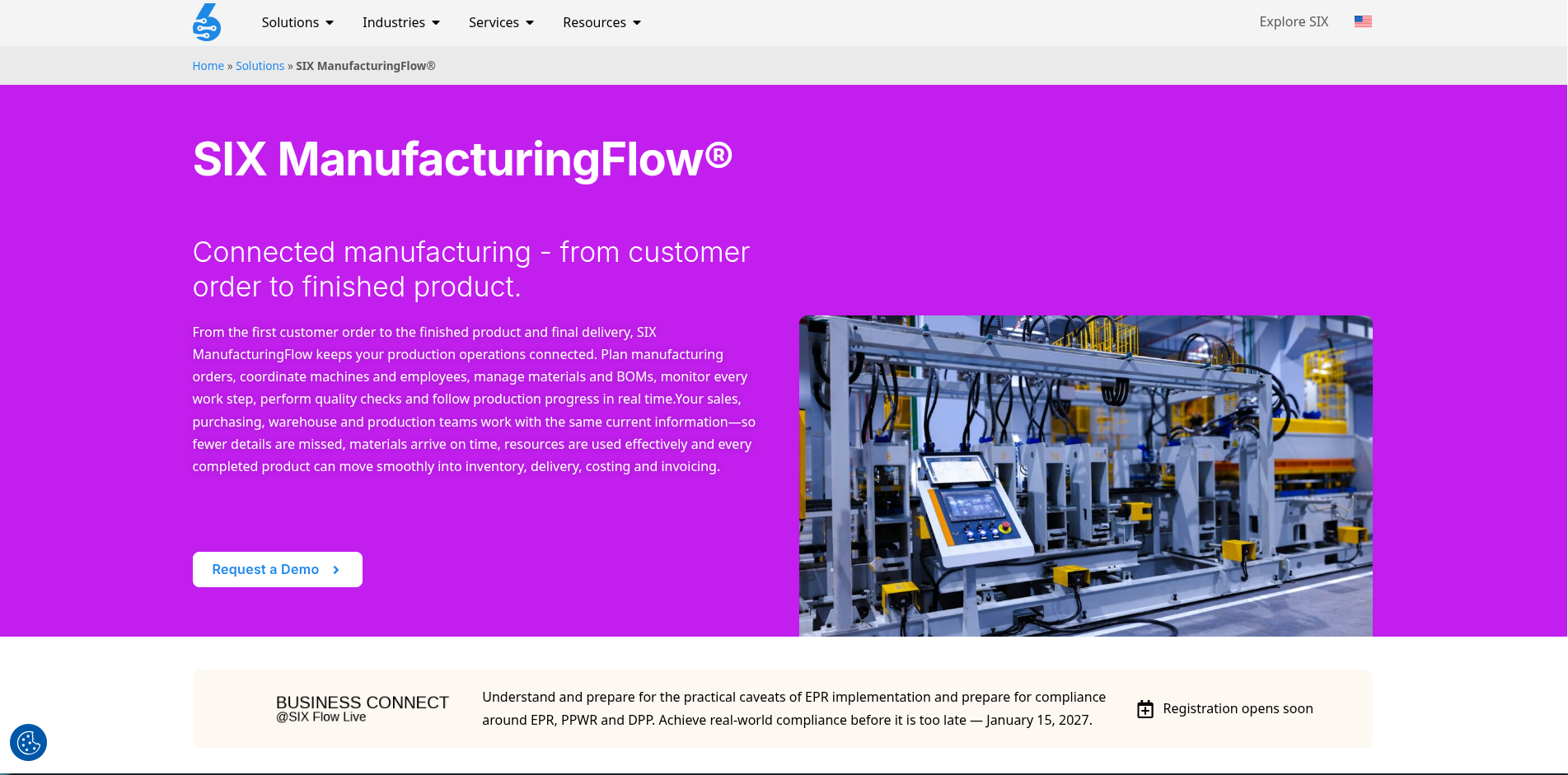
A supply chain ERP earns its value through connected decisions, not a long feature list. SIX ERP links customer demand to material planning, purchasing, warehouse availability, production execution, delivery, and finance in shared workflows.
A customer order entering SalesFlow can draw on stock records, trigger production or purchasing requirements, and continue through fulfillment, delivery, invoicing, and financial reporting. Teams work from shared information rather than re-entering stock levels, customer details, costs, schedules, and documents across separate systems.
Why the Best ERP for Supply Chain Management Starts With Shared Records
Manufacturing puts those connections under pressure. A BOMA Bill of Materials (BOM) lists the materials and components, and their quantities, needed to make a product. only helps if production planning, purchasing, inventory, and finance can act on its requirements. ManufacturingFlow connects BOMs, production planning and execution, quality, and costing with materials and stock visibility. Buyers can plan against demand, available inventory, and existing orders; production teams can track work as it progresses.
SIX ERP also supports sales and distribution, wholesale, services, and field servicesField service is work performed at a customer’s site, such as installation, maintenance, repair, or technical support., for small and medium businesses as well as enterprises. Companies can select industry-focused licensing for Manufacturing, Field Services, Sales & Distribution, or General ERP. Open APIs and integration options connect the platform with external applications and business systems. Its shared workflows support role-based accessRole-based access controls what users can see and do according to their responsibilities. In an ERP system, it helps protect sensitive information and manage permissions consistently., audit trails, and traceability across operations.
Strengths
- Connected operations. Sales, purchasing, inventory, manufacturing, service, projects, finance, and HR use shared records, reducing duplicate entry between teams.
- Implementation and support services. SIX MS Ltd offers consulting and pre-integration analysis, configurationConfiguration sets up software using its existing options. In an ERP system, it adapts workflows, roles and other settings to the company's business processes. and integration services, training, and post-integration support.
- Published package pricing. SIX Growth costs €2,499 per year for 6–15 users; SIX Business costs €4,999 per year for 16–40 users. A licensed user is an active user who signs in to create, process, approve, plan, or manage business activities.
Trade-offs
- Package price is only one part of cost. Additional modules or industry solutions may involve separate licensing charges. Implementation, migration, integrations, customizationCustomization changes or adds software functionality beyond standard settings. In an ERP project, it can meet specific business needs while adding development and maintenance work., and training depend on the work required.
- Scope shapes implementation effort. A company connecting a small set of workflows has different configuration needs from a manufacturer linking BOMs, purchasing, inventory, production, and finance. Map processes and requirements before setting the project scope.
2. SAP Cloud ERP
SAP earns a place on the list for the business that needs one operating model across plants, warehouses, and legal entities in several countries. Supply chain execution sits inside the same system as production, procurement, finance, and logistics, so a shortage in one plant reaches the planner, the buyer, and the controller without a reconciliation meeting.
Cloud delivery is now the norm in the sectors that buy this class of software. Aptean’s 2025 manufacturing technology trends report found 66% of surveyed North American manufacturers had moved, or were in the process of moving, ERP to the cloud, and 48% planned to update or integrate legacy systems. For a multi-entity manufacturer, that consolidation is the core job: every plant and subsidiary runs the same process model, which goes beyond tracking stock more accurately.
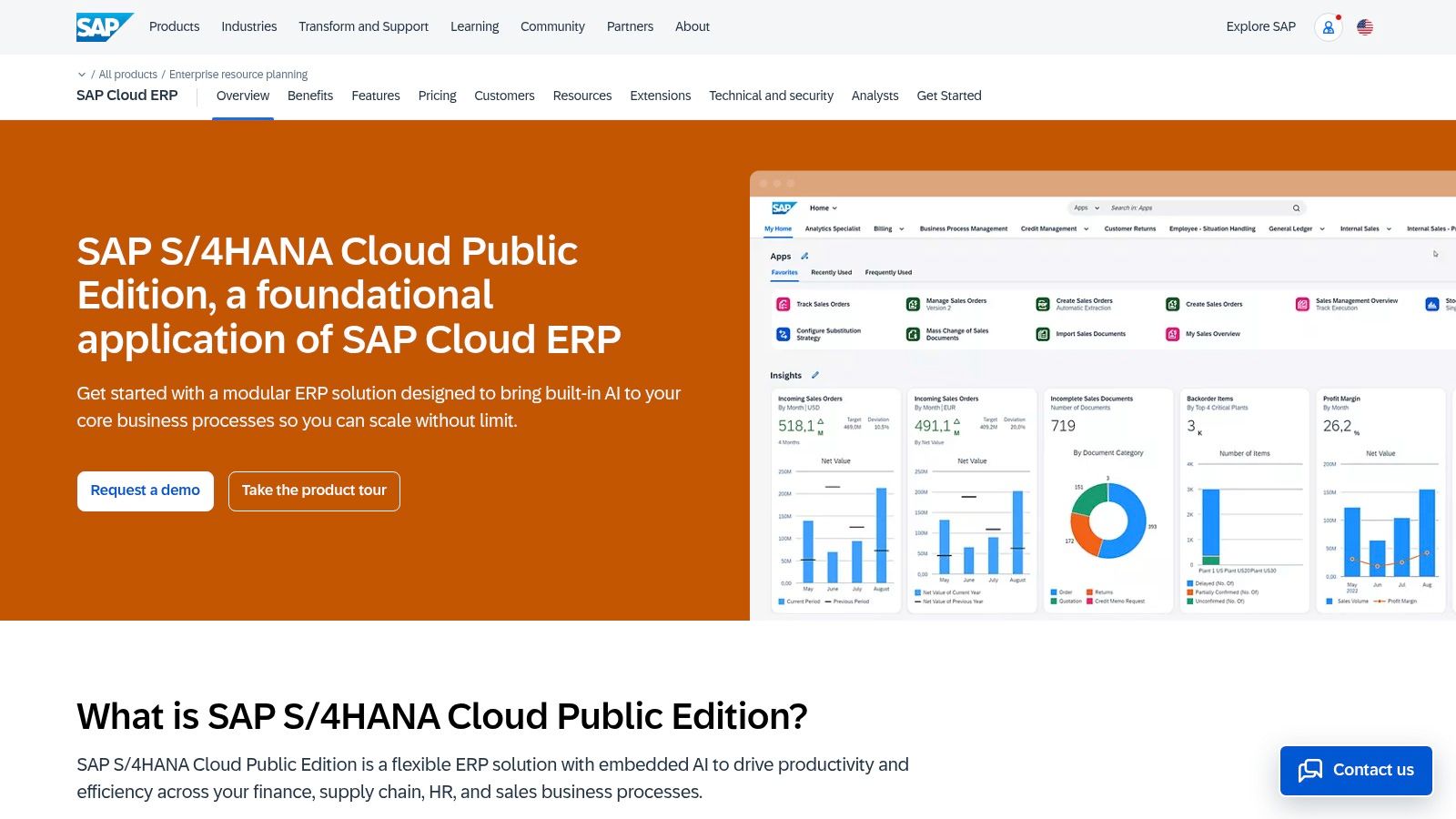
Coverage includes inventory and materials visibility, order availability checks, warehouse operations, transportation planning, mobile transactions, and AI-assisted automationAutomation uses software or equipment to carry out tasks according to defined rules. An ERP system can automate routine business steps and highlight exceptions for review.. The cost of that reach is process redesign. Plant structures, master data, and approvalAn approval is a formal decision that allows a request or action to proceed. An ERP system can route approvals and record who made each decision. hierarchies must be agreed before go-live, and the learning curve is steep enough that training deserves its own budget line.
A suite this wide pays off when several sites must report the same way. For a single-site business, you're buying reach you won't use.
If the scope or cost profile doesn’t fit, SAP alternatives for mid-sized operations sets out what to compare instead.
Website: SAP Cloud ERP
3. Oracle Fusion Cloud ERP and Supply Chain & Manufacturing
Oracle sells an ERP and a supply chain suite that were designed to be bought together, and the combination is strongest where procurement, manufacturing, planning, order management, and logistics already depend on each other. Sourcing and supplier management, manufacturing and supply planning, order management, and logistics run against the same financial applications. That shared foundation is the reason to buy the pair rather than assemble equivalents.
Planning is where it matters most. A demand plan and a supply plan answer different questions, and a platform that runs both can turn one into purchase, work, and transfer orders. Demand planning versus supply planning covers the distinction if your team still argues about which number counts as the forecast.
Strengths
- Wide functional scope. Procurement, sourcing, planning, manufacturing, order management, and logistics share one enterprise data model.
- Practical for existing Oracle estates. Organizations already running Oracle applications have less integration work to do.
- Cross-functional by design. The suite handles processes beyond inventory and purchasing, including enterprise finance.
Trade-offs
- Selection is a project in itself. Choosing which cloud applications you need, and in what order, takes disciplined scope control.
- Pricing needs a quote. Subscription cost and implementation scope both come through the vendor and its partners.
- More platform than simple operations need. A business with one warehouse and a short BOM may never switch on the depth.
Website: Oracle Fusion Cloud ERP
4. Microsoft Dynamics 365 Supply Chain Management
Published list pricing is rare in this category, and that alone puts Dynamics 365 on a shortlist. It is a supply chain application for manufacturers, distributors, and retailers, connecting planning, sourcing, procurement, production, inventory, warehousing, fulfillment, and asset management in one product rather than a bundle of integrations.
Manufacturing remains the largest ERP consumer segment, at 33.66% of ERP users in the Panorama Consulting data cited by FinancesOnline’s ERP statistics compilation, and this suite is shaped for that kind of business. Planning, shop-floor execution, and asset management sit next to warehouse and fulfillment workflows, with a premium edition that adds demand-planning capability.
The work is licensing. Subscription price covers only the software line, while implementation, configuration, integrations, and training sit outside it. Match each license type to how the person works. Planners need full capability, warehouse and shop-floor roles often need far less, and that gap is real money across a year. Plan on a partner-led deployment, and budget for the scoping work that comes with it before a single purchase order posts.
If the licensing model or the partner dependency doesn’t fit, Microsoft Dynamics alternatives covers the trade-offs.
Website: Microsoft Dynamics 365 Supply Chain Management
5. Oracle NetSuite ERP
A wholesaler outgrows its accounting package the moment stock lives in three locations and orders arrive through two channels. NetSuite is built for that moment: financials, orders, inventory, procurement, warehouse operations, production, and supply chain workflows in one cloud suite, with modular licensing that lets a company add capability as it grows.
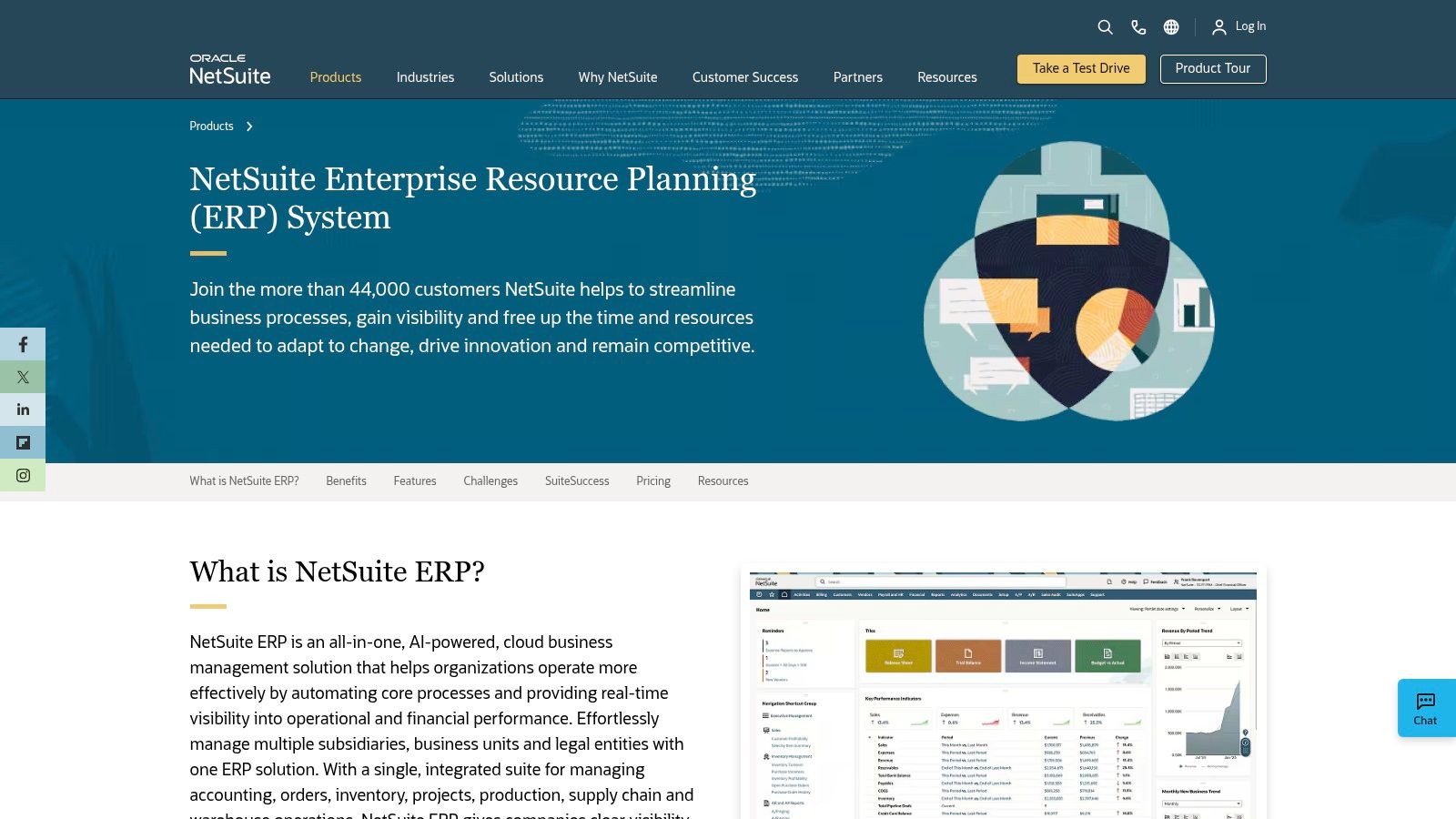
Demand and supply planning can generate purchase, work, and transfer orders, which is the difference between a system that reports a shortage and one that acts on it. Mobile tools cover warehouse and manufacturing transactions, so a receipt or a completion gets recorded where the work happens rather than at a desk hours later.
Strengths
- Operations and finance together. Inventory valuation, costing, and margin land in the same ledger that produces the statements.
- Modular expansion. Additional capability is licensed as needed rather than as one large step.
- Fits multi-location product businesses. Transfer orders across locations and fulfillment from more than one warehouse are core scenarios.
Trade-offs
- No public price list. Software cost arrives as a quote, so budget implementation and configuration separately.
- Check manufacturing depth. Production routing, work-center scheduling, and quality requirements vary by edition and add-on.
- Customization has a tail. Scripting and add-ons solve gaps but create maintenance work at every upgrade.
Website: Oracle NetSuite ERP
6. Infor CloudSuite
Infor sells industry suites rather than a single product, and that’s the honest way to evaluate it. Manufacturing, distribution, and food and beverage each get preconfigured workflows built around how that sector already runs, with ERP at the core and supply chain planning, warehouse management, or manufacturing execution layered on depending on the suite you choose.
Food and beverage buyers should test records retrieval hard. Under the FDA Food Traceability Rule, covered businesses must be able to give the agency requested records within 24 hours, in an electronic sortable spreadsheet (FDA traceability rule resource). If lot, receipt, transformation, and shipment data sit in different systems, that request turns into a manual search across three departments.
Strengths
- Sector-shaped workflows. Preconfigured processes reduce the amount of redesign a specialized manufacturer has to fund.
- Portfolio breadth. One vendor can cover ERP, supply chain planning, warehouse management, and manufacturing execution.
- Relevant to complex manufacturers. Deep bills of material and multi-level production fit better here than in general-purpose suites.
Trade-offs
- The family is confusing. Product selection between CloudSuite variants is hard and needs a scoped demo.
- Pricing isn’t public. Everything arrives through a quote and a partner.
- Confirm what’s included. Planning, WMS, and MES capability may be separately licensed rather than bundled.
Website: Infor CloudSuite
7. Epicor Kinetic
Epicor Kinetic is geared toward manufacturers managing configurable products, changing bills of materials, and production schedules that must account for engineering changes. Its supply chain capabilities include demand and supply planning, MRP, advanced planning and scheduling, sourcing, supplier coordination, inventory management, and shop-floor operations connected to the ERP.
Deployment can be cloud, on-premises, or hybrid. That flexibility helps manufacturers with plant-floor equipment or local infrastructure they are not ready to move. The trade-off is that on-premises and hybrid environments can add hosting, maintenance, and support work compared with a cloud deployment.
Strengths
- Manufacturing focus. Discrete and make-to-order workflows sit at the center of the product.
- Scheduling depth. Finite-capacity planning and advanced scheduling support production environments where capacity constraints shape delivery commitments.
- Deployment choice. An on-premises option suits businesses that cannot move all operations to the cloud.
Trade-offs
- Quoted pricing. Budget separately for configuration, data migration, and training.
- Setup and usability. The system’s depth can mean a steeper learning curve. Ask manufacturers with a similar production model about support responsiveness, and test common planning and shop-floor tasks in a demo.
- Infrastructure responsibility. On-premises or hybrid deployments offer control, but the company must account for the work involved in maintaining that environment.
Website: Epicor Kinetic
8. Acumatica Cloud ERP Manufacturing Edition
Acumatica prices on consumption rather than named users, and that model changes the arithmetic for a business with many occasional users and few daily ones. The manufacturing edition connects product planning, production, inventory, supply chain, sales, projects, service, and financial management on one platform, with MRP capability depending on the edition you license.
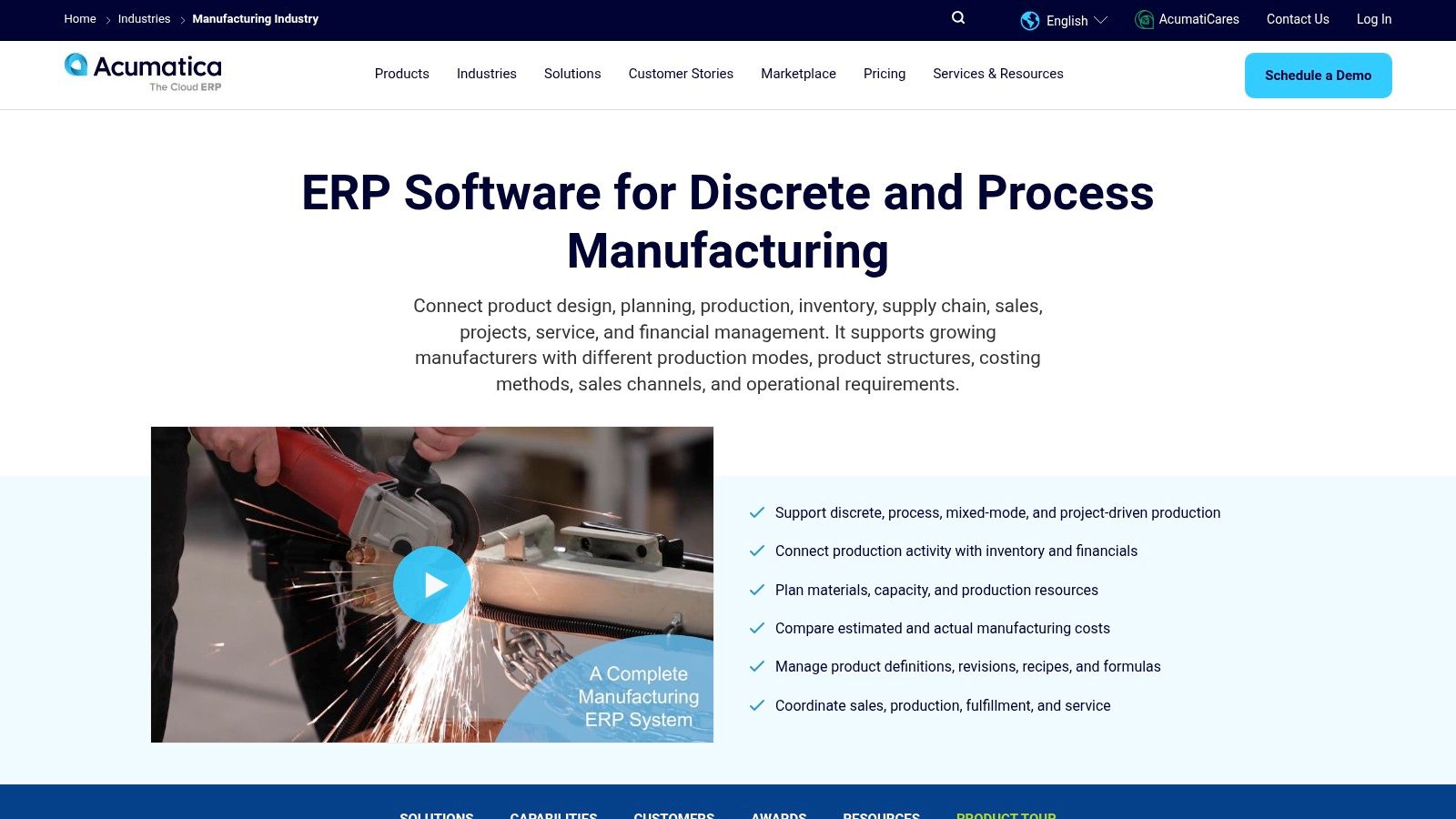
Where it stands out is the mixed business: a manufacturer that also runs projects and field service and needs one customer record across all three. Sales orders, project costs, service calls, and inventory movements share the same financial backbone, which is the same connection problem this list keeps returning to.
Strengths
- Operational and financial processes together. Manufacturing, inventory, projects, service, and finance run in one platform.
- Usage-based pricing. Worth modeling properly if per-user licensing would punish you for giving warehouse staff access.
- Broad cloud coverage. It covers more ground than a production-only system at a mid-market scale.
Trade-offs
- No simple per-user list price. Cost depends on usage, applications, resources, and deployment, so the calculator is a starting point rather than a quote.
- Edition depth varies. Confirm MRP, scheduling, and costing features in a demo against your own BOMs.
- Partner quality decides the project. Configuration and migration skills vary widely between resellers.
Website: Acumatica Manufacturing Edition
9. Sage X3
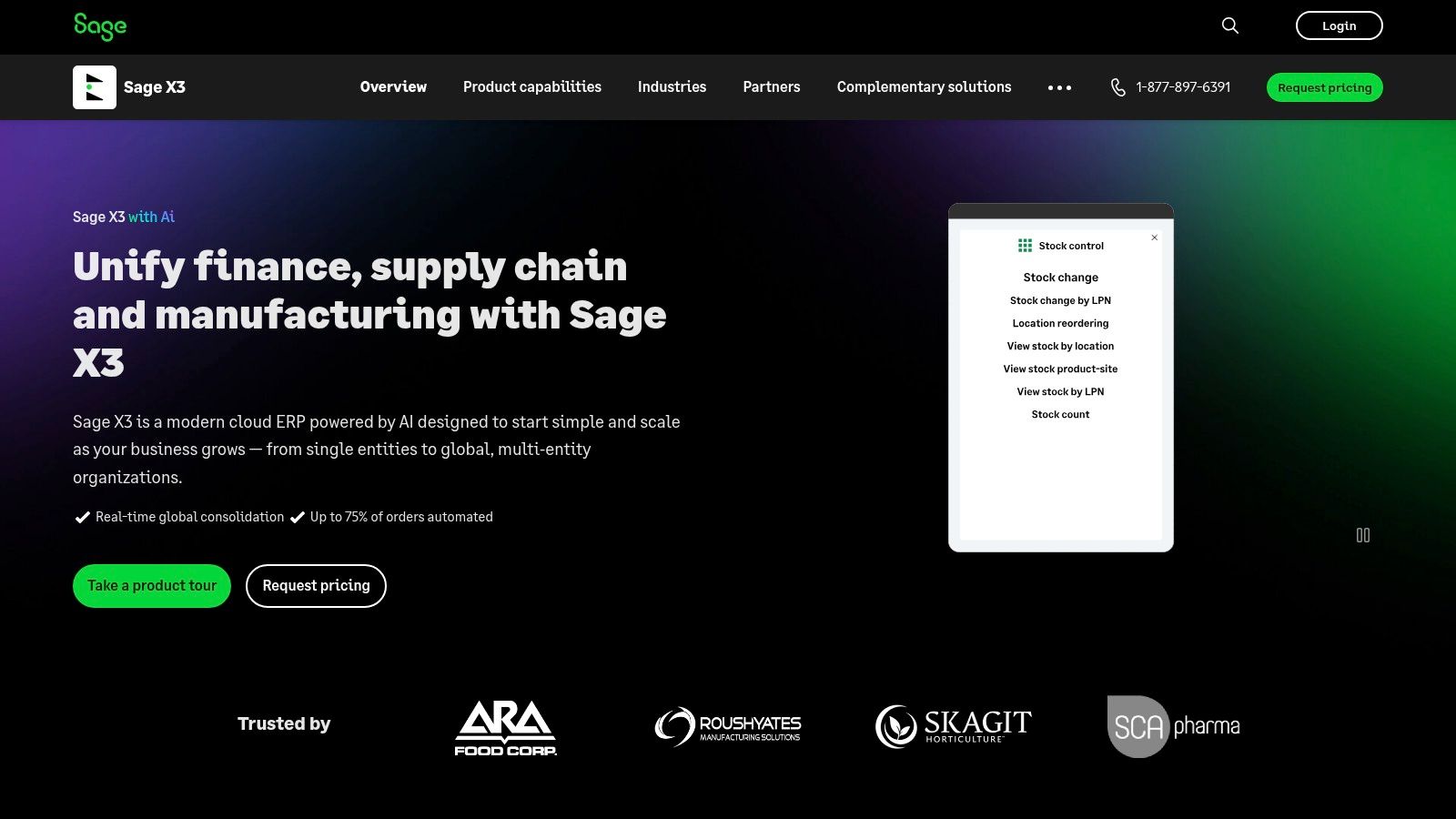
Batch and mixed-mode manufacturers need traceability that follows materials through production and out to customers. Sage X3 connects finance, manufacturing, purchasing, inventory, and supply chain processes, with lot, batch, quality, and recall controls for multi-site and multi-country operations. For a recall, the practical test is whether the system can trace affected lots back to suppliers and forward to customers without staff rebuilding the record manually.
Sage X3 also supports discrete manufacturing, which can suit a plant that runs both batch production and assembly. That breadth is useful only if the implementation connects demand, material planning, purchasing, warehouse availability, production execution, and financial data in the workflows the business uses.
Strengths
- Lot and batch traceability. Quality and recall controls help connect production records with supplier lots and customer shipments.
- Mixed-mode manufacturing. Batch and discrete production can be managed in one system.
- Multi-site operations. The platform is aimed at manufacturers handling operations across sites and countries.
Trade-offs
- Pricing by request. Costs depend on scope, and process-heavy implementations can vary considerably.
- Partner scoping matters. Validate batch, quality, and recall workflows using your own requirements, not just a generic demo.
- Implementation takes work. Configuration and validation for regulated production can take longer than a standard distribution rollout.
Website: Sage X3
10. Odoo
Odoo is the entry point many smaller companies try first, and the free single-app option is a fair way to test whether the workflowA workflow defines the steps, responsibilities and decisions needed to complete work. An ERP system can guide tasks through these stages and show progress. suits you before spending anything. Manufacturing, inventory, purchasing, quality, sales, and accounting apps connect to each other, with work-center scheduling, work orders, production costing, and traceability workflows available as you add them.
The caution is adoption depth, not app count. A 2025 study of SMEs found inventory, CRM, and finance functions were used more frequently than supply chain management and HR functions, with financial constraints and the difficulty of integrating supply chain data named as major barriers (study of SME ERP adoption). Modular suites encourage buying breadth and using a fraction of it, which is how a low monthly price becomes an expensive shelf.
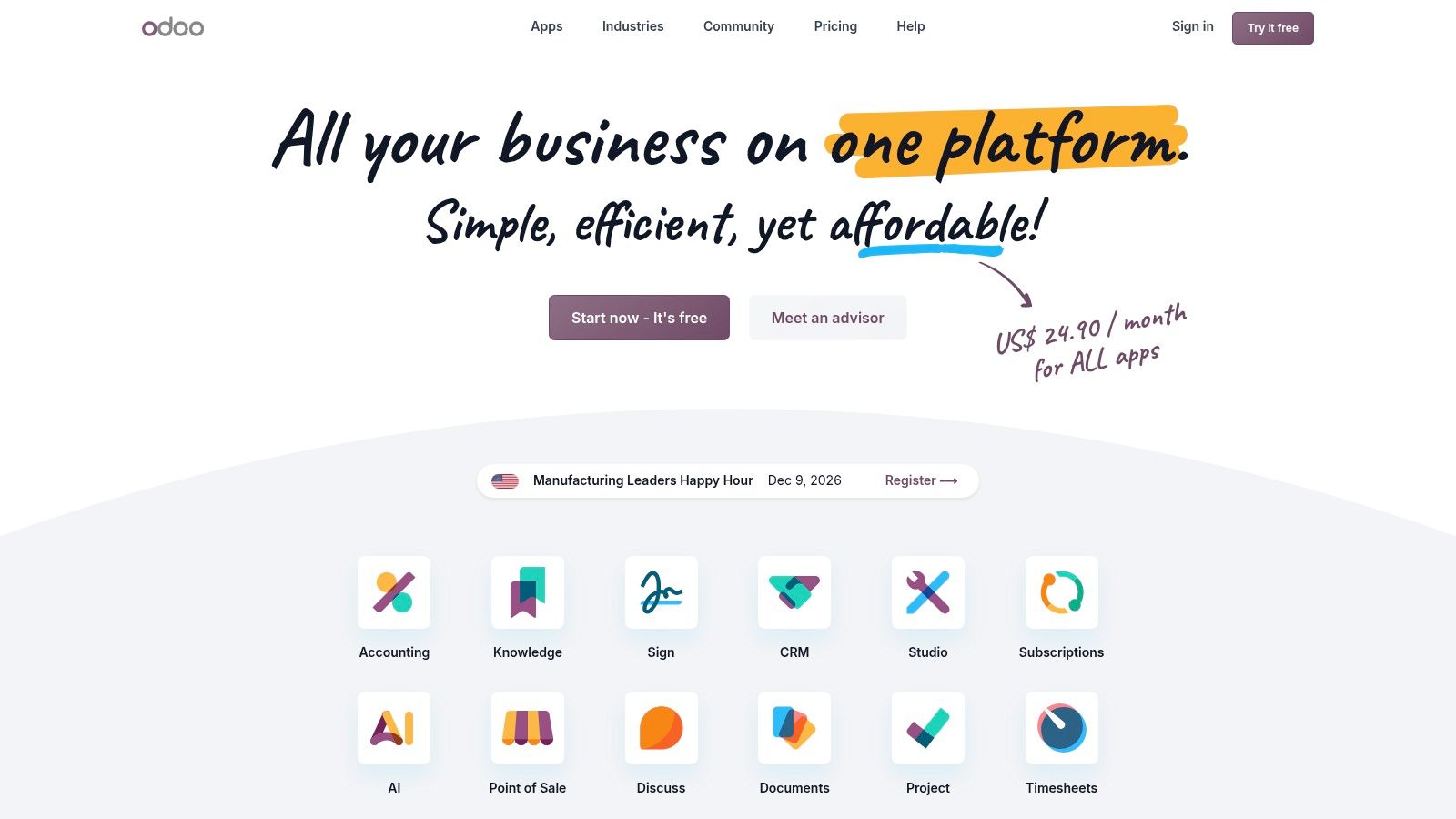
Add one app at a time and prove it in daily use before licensing the next. Two apps that share data beat eight that don’t.
Trade-offs
- Customization becomes maintenance. Third-party apps and custom modules create work at every version upgrade.
- Setup complexity surprises small teams. Reviewers mention configuration effort and heavy customization as common drawbacks.
- Validate production and compliance features. Scheduling, quality, and traceability requirements deserve a scoped test, not a demo.
Website: Odoo
How the 10 supply chain ERP platforms compare
Feature lists obscure the main difference between supply chain ERPs: how well demand connects to BOM-based planning, purchasing, warehouse availability, production execution, and financial results. This comparison focuses on those connections, alongside each platform’s published pricing and deployment information.
| Platform | Best for | Pricing transparency | Supply chain strengths | Deployment options |
|---|---|---|---|---|
| SIX ERP | Small and medium businesses and enterprises in manufacturing, sales and distribution, wholesale, services, and field services | SIX Growth: €2,499 annually for 6–15 users. SIX Business: €4,999 annually for 16–40 users. | Connects sales, purchasing, inventory, manufacturing, projects, service, and finance in one platform | Cloud-ready web and mobile applications; managed serviceA managed service gives an external provider responsibility for agreed services, such as software maintenance and support. It helps companies plan technical work and ongoing system care. available |
| SAP Cloud ERP | Organizations standardizing complex, multi-site operations | Pricing details not provided | Connects inventory, warehousing, transportation, production, and procurement | Cloud |
| Oracle Fusion Cloud ERP and Supply Chain & Manufacturing | Enterprises with interconnected operations and broad functional needs | Quote required | Procurement, sourcing, planning, manufacturing, order management, and logistics | Cloud |
| Microsoft Dynamics 365 Supply Chain Management | Manufacturers, distributors, and retailers using Microsoft business tools | Published list pricing; implementation and related services are extra | Planning, procurement, production, inventory, warehousing, and fulfillment | Cloud-based service |
| Oracle NetSuite ERP | Product businesses managing multi-location inventory and fulfillment | Quote required | Connects finance, procurement, inventory, production, and supply chain workflows | Cloud |
| Infor CloudSuite | Manufacturers and distributors with industry-specific requirements | Public pricing not listed | Industry-oriented ERP, planning, warehouse management, and manufacturing execution | Cloud suites |
| Epicor Kinetic | Discrete and make-to-order manufacturers | Quote-based | Planning, MRP, supplier coordination, inventory, and shop-floor operations | Cloud, on-premises, or hybrid |
| Acumatica Cloud ERP, Manufacturing Edition | Manufacturers seeking connected cloud ERP processes | Priced by usage, applications, resources, and deployment | Manufacturing, MRP, inventory, supply chain, finance, and service | Cloud ERP |
| Sage X3 | Product-centric businesses with batch, quality, or multi-site needs | Pricing available by request | Manufacturing, purchasing, inventory, traceability, and multi-site operations | Cloud or on-premises |
| Odoo | Smaller companies adopting manufacturing and business apps gradually | Published paid plans and a free one-app option | Connected manufacturing, inventory, purchasing, quality, and traceability | Cloud or on-premises |
How to Choose and What Connected Supply Chain Value Looks Like
A feature checklist can hide the failure point: demand, materials, purchasing, warehouse stock, production, and finance may each work in isolation while passing incomplete information between them. Choose an ERP by tracing an order through that chain. A make-to-order manufacturer needs BOMs that can change with an order, routings, and finite-capacity scheduling. A process manufacturer may prioritize batch, lot, quality, and recall control. A distributor needs replenishment, transfer orders, and accurate warehouse records. Extra functionality adds cost; missing functionality often leaves teams maintaining spreadsheets.
Budget for the whole implementation, not just licenses. Survey evidence from manufacturers and distributors found 67% rated their implementations successful or very successful and 41% stayed on or under budget, while a separate survey found 85% of organizations using a software consultant achieved implementation success and 77% named executive leadership support as the most critical success factor (ERP implementation survey summary). Migration, integrations, configuration, training, and the time staff spend testing all affect the total cost.
Test the connection in the demo. Follow one order from sales through the availability check, purchase or production requirement, warehouse execution, delivery, invoice, and margin. Then trace an exception or unexpected figure back to its underlying transaction. If that requires disconnected screens or manual explanations, the workflow may not be integrated in practice.
Map processes before configuration, phase the rollout, and train people for their roles. An initial phase can establish master data, purchasing, inventory locations, traceability, and financial controls. Later phases can add production planning, quality, mobile execution, and analytics. Put measurable acceptance criteria in the contract, such as inventory accuracy, order cycle time, purchase-order approval time, and the share of warehouse transactions recorded digitally.
Which Supply Chain KPIs to Monitor
- Purchasing aligned to requirements. Measure the share of purchase orders tied to actual production or sales demand, rather than reorder points or habit.
- Warehouse utilization. Compare space used with throughput, and track stock turns by category to see how inventory uses warehouse capacity.
- Scheduling speed and adherence. Track how quickly planners rebuild a schedule after a change and how often production meets the revised plan.
- Traceability completeness. Measure the share of lots with supplier, production, and customer links recorded when each event occurs.
- Data capture rate. Track the percentage of receipts, issues, and completions recorded digitally where the work takes place.
Physical labels help teams record stock movements and traceability events accurately. Evright Industrial’s asset labelling guide covers durable tagging for stock, bins, and returnable containers, giving staff a way to record those movements by scanning instead of counting manually.
Connected processes can also change the results a business measures. SIX ERP customers report an 80% reduction in hours spent on supply chain operations, a 60% increase in warehouse availability through reduction in stocked inventory, and a 5x increase in data visibility through integrated manufacturing planning. These figures are customer-reported outcomes, not a forecast for every implementation.
SIX ERP connects demand, purchasing, inventory, manufacturing, and finance in one platform, with industry-focused licensing for Manufacturing, Field Services, Sales & Distribution, and General ERP. Published annual packages include SIX Growth at €2,499 for 6–15 users and SIX Business at €4,999 for 16–40 users. To assess fit, map your own order-to-delivery process and review how the system handles each handoff with a SIX ERP expert before making a decision.
SIX ERP also connects sales, projects, service, and people operations through shared workflows, with web and mobile access for teams working across departments and locations. Visit SIX ERP to walk through your supply chain process, from customer demand and BOM-driven material planning to purchasing and financial outcomes, with an expert.