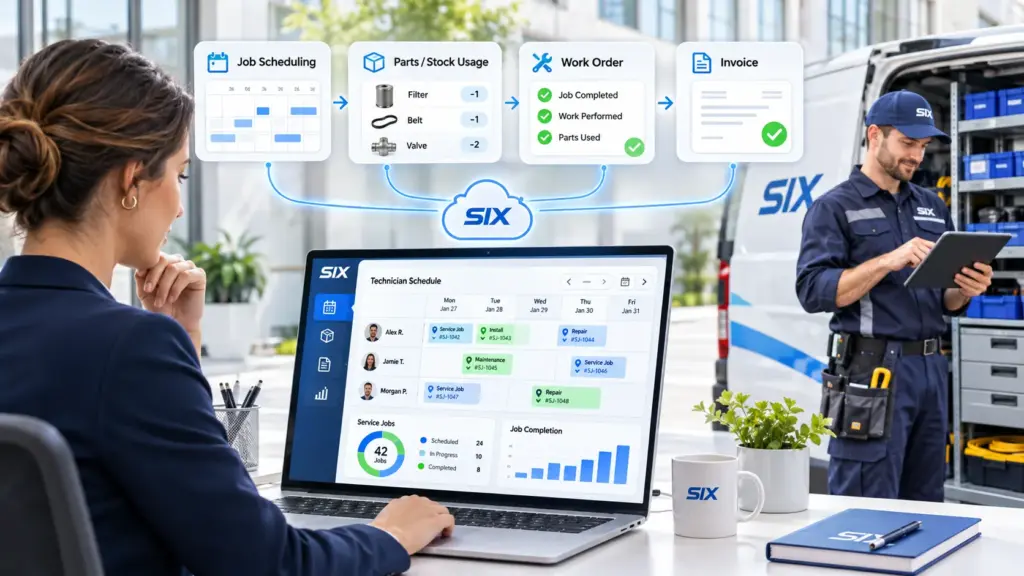

AI in manufacturing means software that learns from production data to predict machine failures, spot defects, plan output and manage stock. It only works as well as the data underneath it. For a Bulgarian manufacturer, the first step is rarely a model. It is getting sales, purchasing, inventory, production and finance onto one connected set of records, which is the job of an ERPAn ERP system connects a company’s core processes—such as sales, finance, inventory, manufacturing, and service—in one place so teams can work with shared information. such as SIX ERP, so that any AI tool you add later has clean data to read.
This guide covers what AI does on a factory floor, what Bulgarian companies are already doing with it, what it needs from your systems, the rules that apply, and how to run a first pilot.
What AI does in a factory
Most uses fall into four groups. The names sound technical, but each answers a plain question.
- Predictive maintenance: which machine is likely to fail soon? Sensors record vibration, temperature or current, and a model flags readings that resemble earlier failures, so the repair is planned instead of forced.
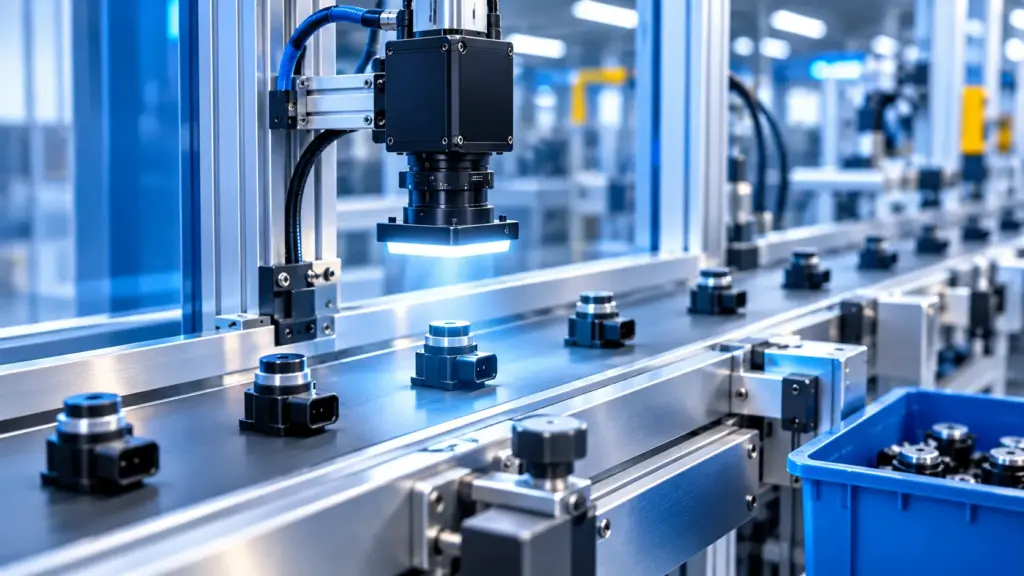
- Quality inspection: is this part good? Cameras photograph each part and a trained model sorts good from defective, a task usually called machine vision.
- Planning and scheduling: what should run when? Models weigh orders, machine capacity, materials and due dates to propose a sequence.
- Inventory and supply: how much of what will we need? Forecasts of demand and supplier delays guide purchasing and stock levels.
Robotics is a fifth area, but for most small and mid-sized plants the four above deliver the first return.
Every one of them depends on the same raw material: accurate records of what was ordered, bought, received, produced and shipped. A defect-detection camera tells you a batch is bad. Only connected records tell you which supplier lot, which work order and which customer are affected.
Where Bulgarian manufacturers stand
Bulgaria is behind the EU average, and the gap is growing. According to Eurostat data published by the BCCI AI Council, 8.55% of Bulgarian enterprises with 10 or more employees used AI in 2025, against 19.95% across the EU-27. In 2021 the gap was 4.36 percentage points. In 2025 it was 11.4.
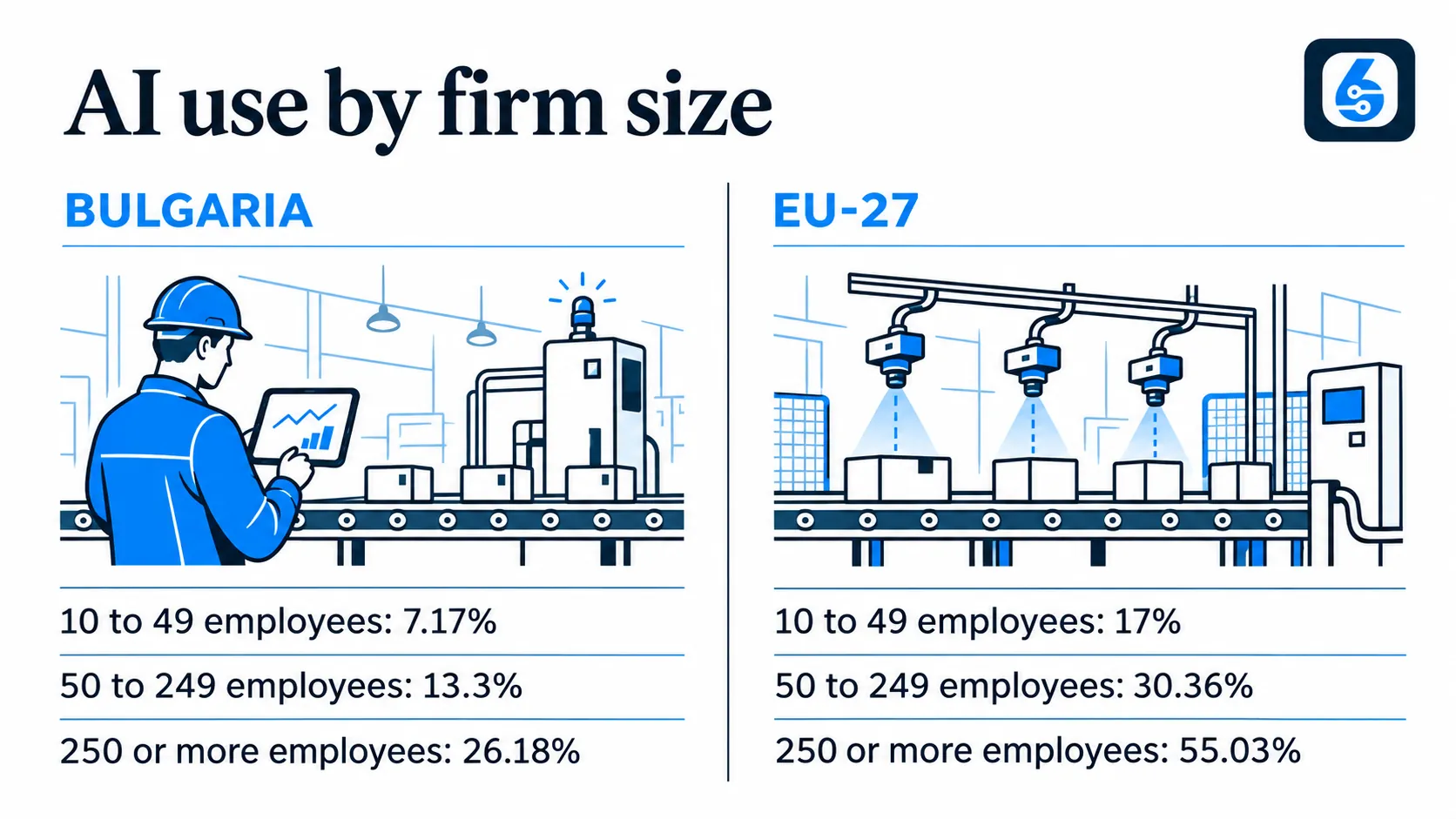
Size matters. The same data show 7.17% of firms with 10 to 49 employees using AI, 13.3% of those with 50 to 249 employees and 26.18% of those with 250 or more. The EU rates for the same groups are 17%, 30.36% and 55.03%. Small and mid-sized manufacturers, the bulk of Bulgarian industry, are where the distance is largest.
The BCCI AI Council reads this as a problem of diffusion, not of technology: the tools exist, but few firms put them into daily use. Its 2026 policy paper proposes moving from isolated projects to broad adoption through an AI-in-SME program built on vouchers and digital innovation hubs.
Bulgarian examples that show what is practical
The local evidence is more useful than general claims, because it shows the scale at which Bulgarian plants actually start.
Sensata Technologies, Plovdiv. The plant built a machine-vision system for quality control of automotive sensors. Operators used to check them under a microscope. Hundreds of thousands of product photos were collected automatically over several months to train algorithms that classify good and defective products, according to Invest Plovdiv. The lesson: the training data came from the production process itself, collected systematically.
Sensata’s general manager said in a March 2025 interview that AI in its Botevgrad and Plovdiv plants supports data analysis and preventive maintenance, and that automationAutomation uses software or equipment to carry out tasks according to defined rules. An ERP system can automate routine business steps and highlight exceptions for review. moves workers from repetitive tasks toward roles managing the systems, with the aim of retaining and upskilling staff.
Smaller firms. At a May 2026 workshop in Svishtov, eight case studies were presented. They included Elna using industrial IoT sensors for predictive maintenance, Mechatronics monitoring small-series production, Technoles optimizing CNC operating modes and STS Print reducing rejection rates. None of these is a moonshot. Each takes one process, measures it and improves it.
Evro Dom. The company’s project, funded under the Competitiveness and Innovation in Enterprises Program, installs a unified analytics platform with AI integrated with its existing information systems. The stated goals are fewer production rejects, lower energy consumption and training for at least 10 employees. Note the phrase “integrated with existing information systems”: the AI is only as useful as the systems feeding it.
What you need before AI can help
Three foundations decide whether a pilot succeeds.
1. One version of the truth
If stock sits in a spreadsheet, orders in a CRM, purchasing in email and costs in accounting software, a model sees fragments. Forecasting demand needs sales history and open orders. Predicting material shortages needs stock, purchase orders and supplier lead times together. Finding the cause of rejects needs the link between a work order, its materials and its result.
2. Structured, consistent records
Item codes, units of measure, bills of materials and routings must mean the same thing everywhere. Duplicate item codes and unrecorded stock movements produce wrong forecasts however good the model is. Cleaning this up is dull work, and it is where most of the value comes from.
3. Equipment that produces data
Predictive maintenance needs sensors or machine controllers that export readings. Quality inspection needs cameras and consistent lighting. Many Bulgarian plants have older machines, so a retrofit sensor on the two or three most critical assets is a realistic start.
Why the ERP comes first
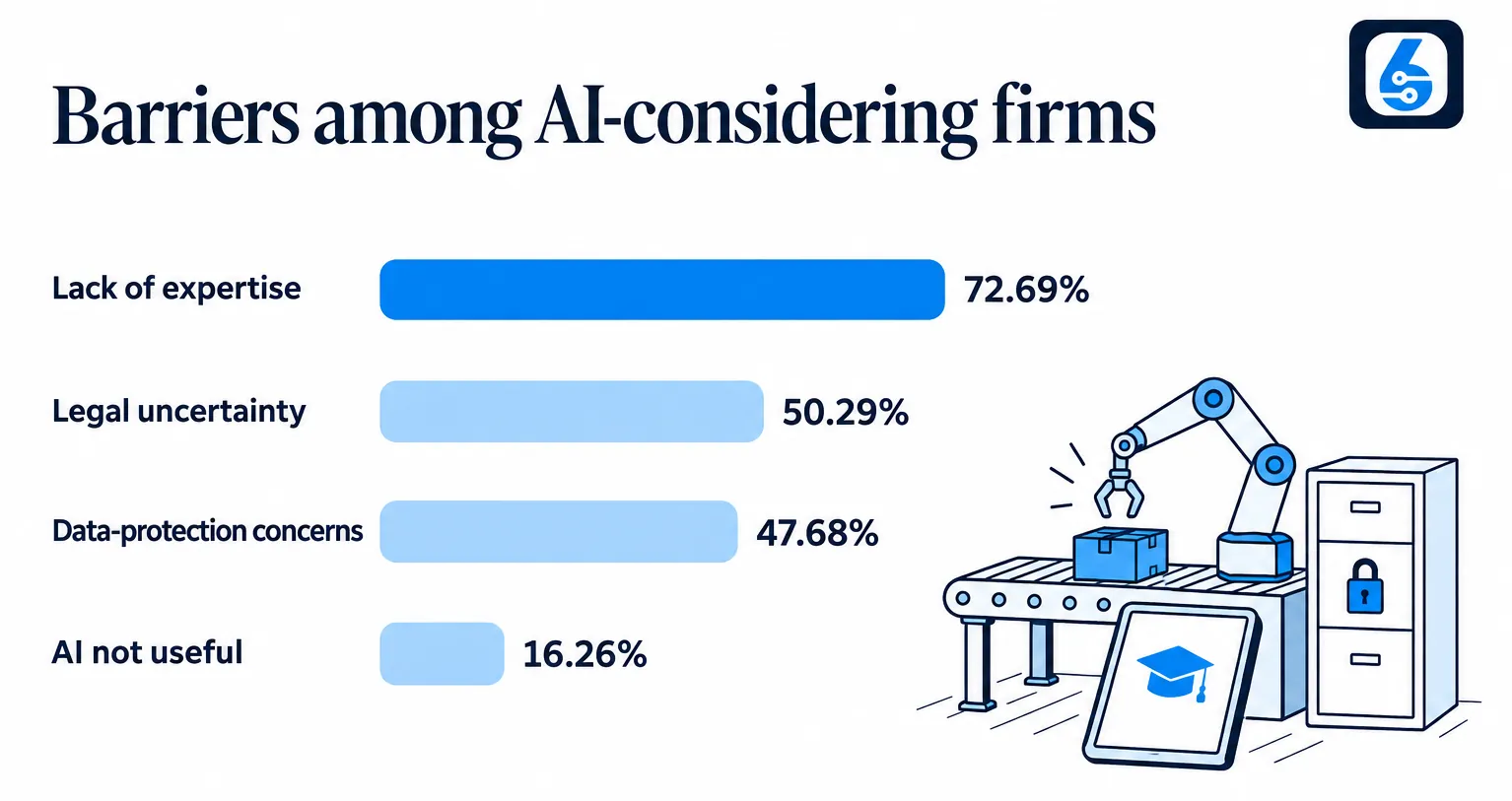
The BCCI data point to what holds Bulgarian companies back. Among firms that had ever considered AI, the leading barriers were lack of expertise (72.69%), legal uncertainty (50.29%) and data-protection concerns (47.68%). Only 16.26% said AI was not useful. The appetite is there. The obstacles are skills, clarity and control over data.
An integrated ERP addresses two of the three directly. It puts company data in one governed place with defined access, which helps with data protection. And it reduces the expertise needed, because your team works in standard flows, not in a patchwork of tools that each need their own specialist.
This is also how we approach implementation at SIX ERP. We map your processes in detail before we configure anything, following a no-gap approach, so the flows that connect sales, purchasing, inventory, production and finance reflect how your plant really runs. You can start with the flows you need and add others as you grow, without replacing the system. Our Manufacturing ERP guide walks through that process for factories.
For a manufacturer that wants precise inventory control, that means StockFlow for warehouse and inventory and PurchaseFlow for purchasing working on the same records as production. For a closer look at how AI and ERP fit together, see our articles on agentic AI in manufacturing and the AI in ERP archive.
The rules that apply to Bulgarian manufacturers
The EU AI ActEU legislation that sets rules for AI systems using a risk-based approach. is a regulation, so it applies directly in Bulgaria. According to a Bulgarian law-firm summary, it entered into force on 1 August 2024. Prohibited practices and AI-literacy duties applied from 2 February 2025. Transparency rules under Article 50 apply from 2 August 2026. Regulation (EU) 2026/1744, in force since 27 July 2026, postponed the high-risk obligations for Annex III systems to 2 December 2027 and for product-related Annex I systems to 2 August 2028.
Two points matter for a manufacturer:
- The Act covers companies that use AI as well as those that build it. Using an external tool, such as AI inside your CRM or ERP, typically gives you deployer obligations. There is no general exemption for small businesses, though SMEs get reduced conformity-assessment fees, sandbox access and simplified documentation.
- National implementation is still being set up. Bulgaria’s Ministry of Electronic Administration leads it, and a government decision of December 2025 records the designation of competent authorities and the plan to designate the Bulgarian Accreditation Service as notifying authority.
For day-to-day purposes, keep a list of every AI-enabled tool in use, who owns it and what data it touches. Staff who use these tools need basic AI training, since the literacy duty has applied since February 2025. If your products fall under other EU product rules, our article on Bulgarian DPP, EPR, PPWR and NIS2 legislation covers the related data obligations. For legal questions about your own situation, speak to a lawyer.
How to run a first AI pilot
A pilot should be small enough to finish in a few months and specific enough to judge.
- Pick one problem with a number attached. Examples: unplanned stoppages on one line, scrap rate on one product, stockouts on a set of critical materials. If you cannot state today’s figure, you cannot show improvement.
- Check the data. Can you pull a year of clean records for that problem? If not, fixing capture and structure is the real first project.
- Define success before you start. Set a target, such as a lower rejection rate, and a review date.
- Involve the people who run the process. Operators and maintenance staff know why the data look the way they do, and the Sensata example shows the aim is to move people to higher-skilled work, not to remove them.
- Cost the whole thing. Include sensors, software, integrationIntegration connects systems so they can exchange information or coordinate actions. An ERP integration helps link business tools and reduce manual transfers between them., training and the time of your own staff, then compare with the value of the target improvement.
- Scale only after the result holds. Repeat on the next line or product, reusing the data structure you built.
Funding and testing support in Bulgaria
Public programs lower the risk. The ADi4SMEs European Digital Innovation Hub in North Central Bulgaria, coordinated by the Regional Innovation Centre in Gabrovo, offers SMEs test-before-invest AI services covering process optimization, predictive maintenance, industrial IoT and digital twins, financed fully by the Bulgarian Research, Innovation and Digitalization for Smart Transformation program. By April 2026 it had signed service agreements worth EUR 2.5 million and trained 131 employees.
Larger investments can draw grants. A foundry-process AI and digital twin project on the May 2025 reserve list had eligible costs of EUR 716,494.38 and proposed grant aid of EUR 547,096.39, or 76.36%. At national level, the Ministry of Innovation and Digital Transformation’s budget funds the BRAIN++ AI Factory in Sofia Tech Park, a EUR 90 million project that includes an incubator and accelerator for AI tools in production processes. The EU-funded BRAIN PP project plans foundation models for industrial robotics aimed at Bulgarian SMEs. Check each program’s official page for current calls and conditions.
Start with the connected foundation
If your plant runs on separate tools and spreadsheets, the most valuable AI preparation is to connect them. SIX ERP covers CRM, purchasing, warehouse and inventory, manufacturing, finance, projects, HR and field service in one platform, with web and mobile apps and dashboards. Plans are published on the licensing page: SIX Start is €999 per year, SIX Growth €2,499 per year and SIX Business €4,999 per year, while SIX Enterprise is priced on request. SIX AIFlow is available at €99 per month; see the AIFlow page for what it covers.
Implementation is handled through our services: consulting and pre-integration support, integration, configurationConfiguration sets up software using its existing options. In an ERP system, it adapts workflows, roles and other settings to the company’s business processes. and customizationCustomization changes or adds software functionality beyond standard settings. In an ERP project, it can meet specific business needs while adding development and maintenance work., and ongoing support and updates.

The SIX ERP site shows the flows by function, so you can choose the ones your plant needs first.
Our perspective
Manufacturers often ask us which AI tool to buy. We ask a different question first: can you trust the numbers the tool will read?

In our experience of ERP projects, the hard part is rarely the algorithm. It is that stock is counted one way in the warehouse and another in finance, that a bill of materials lives in someone’s spreadsheet, that purchasing does not see the production plan. Any AI placed on top of that learns the confusion.

That is why we map processes in full before we configure, and why we call it a no-gap policy. When sales, purchasing, inventory, production and finance share one record, you can see where the plant loses time and material, and you have a base that AI can use. You also do not need to do it all at once: start with the flows that matter most and add the rest as the business grows.

For Bulgarian manufacturers, where AI use is still well below the EU average, that sequence is the practical route: connect first, measure, then automate what the numbers show is worth automating.
Sources
- BCCI AI Council: The widening gap, AI adoption in Bulgaria
- BCCI: AI and digitalization policy paper
- Invest Plovdiv: Sensata Technologies machine control
- 24chasa.bg: Sensata interview
- RIC Gabrovo: eight AI case studies
- Evro Dom: Industry 4.0 project
- Advokatami.bg: AI Act compliance
- VLO Law Firms: AI regulation in Bulgaria
- Bulgarian government: AI Act implementation decision
- Interreg Europe: ADi4SMEs EDIH
- Ministry of Innovation and Digital Transformation: 2026 budget
- Ministry: reserve project list BG16RFPR002-1.010
- CORDIS: BRAIN PP project